

366
Í. Uriarte and A. Farías
sustain processing plants. Patagonian red octopus ( E� megalocyathus) inhabits the
southern tip of South America, in the Pacific and Atlantic Oceans. In Chile, Patagonian
red octopus has been fished for decades under the wrong denomination of ‘common
octopus’, and for that reason it is indistinguishable from O� mimus in fishery statistics.
Rocha and Vega (2003) reported that the octopus fished down south of the VIII
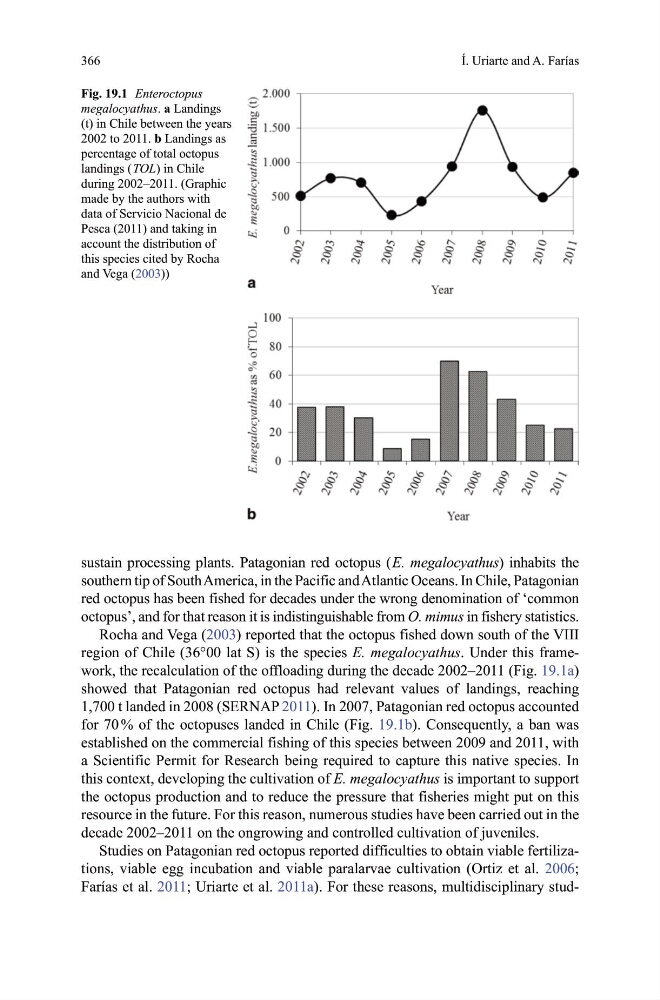
region of Chile (36°00 lat S) is the species E� megalocyathus. Under this framework, the recalculation of the offloading during the decade 2002–2011 (Fig. 19.1a)
showed that Patagonian red octopus had relevant values of landings, reaching
1,700 t landed in 2008 (SERNAP 2011). In 2007, Patagonian red octopus accounted
for 70 % of the octopuses landed in Chile (Fig. 19.1b). Consequently, a ban was
established on the commercial fishing of this species between 2009 and 2011, with
a Scientific Permit for Research being required to capture this native species. In
this context, developing the cultivation of E� megalocyathus is important to support
the octopus production and to reduce the pressure that fisheries might put on this
resource in the future. For this reason, numerous studies have been carried out in the
decade 2002–2011 on the ongrowing and controlled cultivation of juveniles.
Studies on Patagonian red octopus reported difficulties to obtain viable fertilizations, viable egg incubation and viable paralarvae cultivation (Ortiz et al. 2006;
Farías et al. 2011; Uriarte et al. 2011a). For these reasons, multidisciplinary studFig. 19.1 Enteroctopus
megalocyathus. a Landings
(t) in Chile between the years
2002 to 2011. b Landings as
percentage of total octopus
landings ( TOL) in Chile
during 2002–2011. (Graphic
made by the authors with
data of Servicio Nacional de
Pesca (2011) and taking in
account the distribution of
this species cited by Rocha
and Vega (2003))
Í. Uriarte and A. Farías
sustain processing plants. Patagonian red octopus ( E� megalocyathus) inhabits the
southern tip of South America, in the Pacific and Atlantic Oceans. In Chile, Patagonian
red octopus has been fished for decades under the wrong denomination of ‘common
octopus’, and for that reason it is indistinguishable from O� mimus in fishery statistics.
Rocha and Vega (2003) reported that the octopus fished down south of the VIII
region of Chile (36°00 lat S) is the species E� megalocyathus. Under this framework, the recalculation of the offloading during the decade 2002–2011 (Fig. 19.1a)
showed that Patagonian red octopus had relevant values of landings, reaching
1,700 t landed in 2008 (SERNAP 2011). In 2007, Patagonian red octopus accounted
for 70 % of the octopuses landed in Chile (Fig. 19.1b). Consequently, a ban was
established on the commercial fishing of this species between 2009 and 2011, with
a Scientific Permit for Research being required to capture this native species. In
this context, developing the cultivation of E� megalocyathus is important to support
the octopus production and to reduce the pressure that fisheries might put on this
resource in the future. For this reason, numerous studies have been carried out in the
decade 2002–2011 on the ongrowing and controlled cultivation of juveniles.
Studies on Patagonian red octopus reported difficulties to obtain viable fertilizations, viable egg incubation and viable paralarvae cultivation (Ortiz et al. 2006;
Farías et al. 2011; Uriarte et al. 2011a). For these reasons, multidisciplinary studFig. 19.1 Enteroctopus
megalocyathus. a Landings
(t) in Chile between the years
2002 to 2011. b Landings as
percentage of total octopus
landings ( TOL) in Chile
during 2002–2011. (Graphic
made by the authors with
data of Servicio Nacional de
Pesca (2011) and taking in
account the distribution of
this species cited by Rocha
and Vega (2003))