

351
18 Amphioctopus aegina
18.3 Broodstock Maintenance and Spawning
The broodstock for the marbled octopus, Amphioctopus aegina, are collected from
otter board and beam trawlers or by using octopus traps, operating along the eastern part of the Gulf of Thailand, South China Sea and the Pacific Ocean. Onboard,
the octopuses are maintained in 50-L-capacity cylindrical fibreglass tanks containing 30 L of fresh sea water with aeration and then, upon landing, are transported
to the cephalopod hatchery. The octopuses are separated by sex and maintained
for a 7-day acclimatization period in an open system of circular concrete tanks of
1,800-mm diameter, with a capacity of 2 m
3
and a 30-cm water depth. In order to
minimize any change in water quality, particularly temperature, tanks are equipped
with aeration devices and supplied with running filtered sea water that flows
through a central drainage (the sea-water supply system in this chapter is also described in Chap. 7: ‘Aquaculture to Restocking’). Cylindrical polyvinyl chloride
(PVC) pieces (50 mm diameter, 150 mm length) are previously placed on the tank
bottom as dens or shelters. Octopuses are fed twice daily at 0800 and 1700 h with
chopped fish meat, Selaroides leptolepis. Tanks are cleaned daily by siphoning out
the water containing debris and replacing about 50 % of their volume.
After 7 days, the octopuses are transferred to make a 1 : 1 pair in one tank (two
individuals per tank) under similar conditions. Under these conditions, octopuses
mate and spawn spontaneously in the tanks. The mating behavioural sequence can
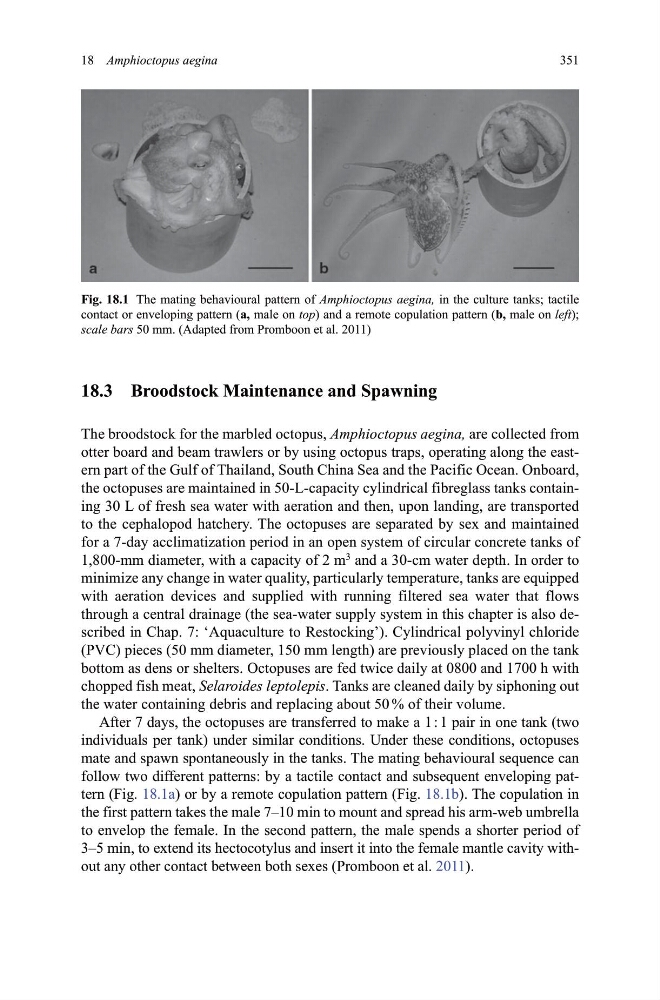
follow two different patterns: by a tactile contact and subsequent enveloping pattern (Fig. 18.1a) or by a remote copulation pattern (Fig. 18.1b). The copulation in
the first pattern takes the male 7–10 min to mount and spread his arm-web umbrella
to envelop the female. In the second pattern, the male spends a shorter period of
3–5 min, to extend its hectocotylus and insert it into the female mantle cavity without any other contact between both sexes (Promboon et al. 2011).
Fig. 18.1 The mating behavioural pattern of Amphioctopus aegina, in the culture tanks; tactile
contact or enveloping pattern (a, male on top) and a remote copulation pattern (b, male on left);
scale bars 50 mm. (Adapted from Promboon et al. 2011)
18 Amphioctopus aegina
18.3 Broodstock Maintenance and Spawning
The broodstock for the marbled octopus, Amphioctopus aegina, are collected from
otter board and beam trawlers or by using octopus traps, operating along the eastern part of the Gulf of Thailand, South China Sea and the Pacific Ocean. Onboard,
the octopuses are maintained in 50-L-capacity cylindrical fibreglass tanks containing 30 L of fresh sea water with aeration and then, upon landing, are transported
to the cephalopod hatchery. The octopuses are separated by sex and maintained
for a 7-day acclimatization period in an open system of circular concrete tanks of
1,800-mm diameter, with a capacity of 2 m
3
and a 30-cm water depth. In order to
minimize any change in water quality, particularly temperature, tanks are equipped
with aeration devices and supplied with running filtered sea water that flows
through a central drainage (the sea-water supply system in this chapter is also described in Chap. 7: ‘Aquaculture to Restocking’). Cylindrical polyvinyl chloride
(PVC) pieces (50 mm diameter, 150 mm length) are previously placed on the tank
bottom as dens or shelters. Octopuses are fed twice daily at 0800 and 1700 h with
chopped fish meat, Selaroides leptolepis. Tanks are cleaned daily by siphoning out
the water containing debris and replacing about 50 % of their volume.
After 7 days, the octopuses are transferred to make a 1 : 1 pair in one tank (two
individuals per tank) under similar conditions. Under these conditions, octopuses
mate and spawn spontaneously in the tanks. The mating behavioural sequence can
follow two different patterns: by a tactile contact and subsequent enveloping pattern (Fig. 18.1a) or by a remote copulation pattern (Fig. 18.1b). The copulation in
the first pattern takes the male 7–10 min to mount and spread his arm-web umbrella
to envelop the female. In the second pattern, the male spends a shorter period of
3–5 min, to extend its hectocotylus and insert it into the female mantle cavity without any other contact between both sexes (Promboon et al. 2011).
Fig. 18.1 The mating behavioural pattern of Amphioctopus aegina, in the culture tanks; tactile
contact or enveloping pattern (a, male on top) and a remote copulation pattern (b, male on left);
scale bars 50 mm. (Adapted from Promboon et al. 2011)