

338
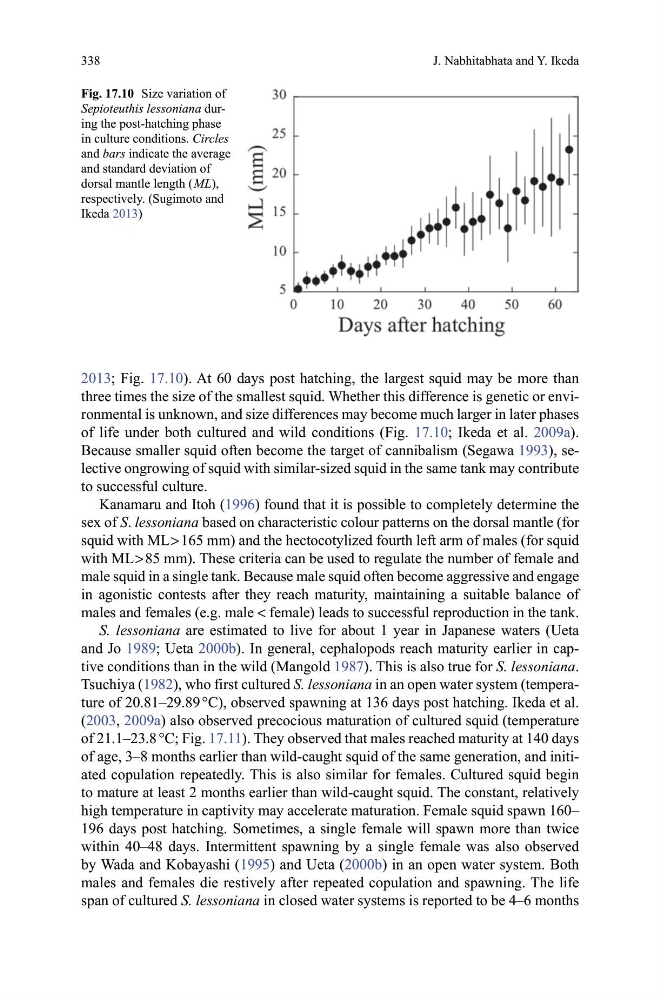
2013; Fig. 17.10). At 60 days post hatching, the largest squid may be more than
three times the size of the smallest squid. Whether this difference is genetic or environmental is unknown, and size differences may become much larger in later phases
of life under both cultured and wild conditions (Fig. 17.10; Ikeda et al. 2009a).
Because smaller squid often become the target of cannibalism (Segawa 1993), selective ongrowing of squid with similar-sized squid in the same tank may contribute
to successful culture.
Kanamaru and Itoh (1996) found that it is possible to completely determine the
sex of S. lessoniana based on characteristic colour patterns on the dorsal mantle (for
squid with ML > 165 mm) and the hectocotylized fourth left arm of males (for squid
with ML > 85 mm). These criteria can be used to regulate the number of female and
male squid in a single tank. Because male squid often become aggressive and engage
in agonistic contests after they reach maturity, maintaining a suitable balance of
males and females (e.g. male < female) leads to successful reproduction in the tank.
S� lessoniana are estimated to live for about 1 year in Japanese waters (Ueta
and Jo 1989; Ueta 2000b). In general, cephalopods reach maturity earlier in captive conditions than in the wild (Mangold 1987). This is also true for S� lessoniana.
Tsuchiya (1982), who first cultured S� lessoniana in an open water system (temperature of 20.81–29.89 °C), observed spawning at 136 days post hatching. Ikeda et al.
(2003, 2009a) also observed precocious maturation of cultured squid (temperature
of 21.1–23.8 °C; Fig. 17.11). They observed that males reached maturity at 140 days
of age, 3–8 months earlier than wild-caught squid of the same generation, and initiated copulation repeatedly. This is also similar for females. Cultured squid begin
to mature at least 2 months earlier than wild-caught squid. The constant, relatively
high temperature in captivity may accelerate maturation. Female squid spawn 160–
196 days post hatching. Sometimes, a single female will spawn more than twice
within 40–48 days. Intermittent spawning by a single female was also observed
by Wada and Kobayashi (1995) and Ueta (2000b) in an open water system. Both
males and females die restively after repeated copulation and spawning. The life
span of cultured S� lessoniana in closed water systems is reported to be 4–6 months
Fig. 17.10 Size variation of
Sepioteuthis lessoniana during the post-hatching phase
in culture conditions. Circles
and bars indicate the average
and standard deviation of
dorsal mantle length ( ML),
respectively. (Sugimoto and
Ikeda 2013)
J. Nabhitabhata and Y. Ikeda
2013; Fig. 17.10). At 60 days post hatching, the largest squid may be more than
three times the size of the smallest squid. Whether this difference is genetic or environmental is unknown, and size differences may become much larger in later phases
of life under both cultured and wild conditions (Fig. 17.10; Ikeda et al. 2009a).
Because smaller squid often become the target of cannibalism (Segawa 1993), selective ongrowing of squid with similar-sized squid in the same tank may contribute
to successful culture.
Kanamaru and Itoh (1996) found that it is possible to completely determine the
sex of S. lessoniana based on characteristic colour patterns on the dorsal mantle (for
squid with ML > 165 mm) and the hectocotylized fourth left arm of males (for squid
with ML > 85 mm). These criteria can be used to regulate the number of female and
male squid in a single tank. Because male squid often become aggressive and engage
in agonistic contests after they reach maturity, maintaining a suitable balance of
males and females (e.g. male < female) leads to successful reproduction in the tank.
S� lessoniana are estimated to live for about 1 year in Japanese waters (Ueta
and Jo 1989; Ueta 2000b). In general, cephalopods reach maturity earlier in captive conditions than in the wild (Mangold 1987). This is also true for S� lessoniana.
Tsuchiya (1982), who first cultured S� lessoniana in an open water system (temperature of 20.81–29.89 °C), observed spawning at 136 days post hatching. Ikeda et al.
(2003, 2009a) also observed precocious maturation of cultured squid (temperature
of 21.1–23.8 °C; Fig. 17.11). They observed that males reached maturity at 140 days
of age, 3–8 months earlier than wild-caught squid of the same generation, and initiated copulation repeatedly. This is also similar for females. Cultured squid begin
to mature at least 2 months earlier than wild-caught squid. The constant, relatively
high temperature in captivity may accelerate maturation. Female squid spawn 160–
196 days post hatching. Sometimes, a single female will spawn more than twice
within 40–48 days. Intermittent spawning by a single female was also observed
by Wada and Kobayashi (1995) and Ueta (2000b) in an open water system. Both
males and females die restively after repeated copulation and spawning. The life
span of cultured S� lessoniana in closed water systems is reported to be 4–6 months
Fig. 17.10 Size variation of
Sepioteuthis lessoniana during the post-hatching phase
in culture conditions. Circles
and bars indicate the average
and standard deviation of
dorsal mantle length ( ML),
respectively. (Sugimoto and
Ikeda 2013)
J. Nabhitabhata and Y. Ikeda