

336
diet when caretakers throw it into the tank, but after repeated exposure, they begin
to pay attention to it and catch it immediately. Juvenile squid will also seize dead
diet that is provided by caretakers with forceps. This method ensures that all squid
are fed, even when individuals do not hunt food that is thrown in the water column.
Providing the diet ad libitum can avoid starvation and cannibalism and is important
for culturing squid successfully.
Growth
A large decrease in survivorship occurs in cultures within 30 days after hatching
(Lee et al. 1994; Ikeda et al. 2003, 2009a). The most likely reason for the high death
rate of S� lessoniana, as for other squids, during the early phase of life is starvation
as a result of insufficient feeding. Hatchlings of S� lessoniana consume both inner
yolk and live dietary specimens for up to 1 week (Shimazoe 2010). Hatchlings may
learn by trial and error how to catch food during this phase, as do other loliginid
squid (Chen et al. 1996).
17.3.2.4 Ongrowing
Feeding
Because a live diet of marine organisms (e.g. zooplankton and fish larvae) is only
obtainable by laboratories situated near oceans, dead diets provide a suitable and
economical alternative for inland squid cultures. Young S� lessoniana are fed on a
mixture of live and dead frozen prey items, including Japanese sardine Sardinops
sp. and Japanese anchovy Engraulis sp. (Ikeda et al. 2003, 2009a). Subadult and
adult squid can be fed on a variety of prey items, either alive or dead. Lee et al.
(1994) estimated the feeding rate of captive S� lessoniana (60–300 days of age) in a
closed water system to be 20–35 % BW·day
−1
.
Growth and Survival
Fins of S� lessoniana hatchlings are subterminal, small, and round. However, they
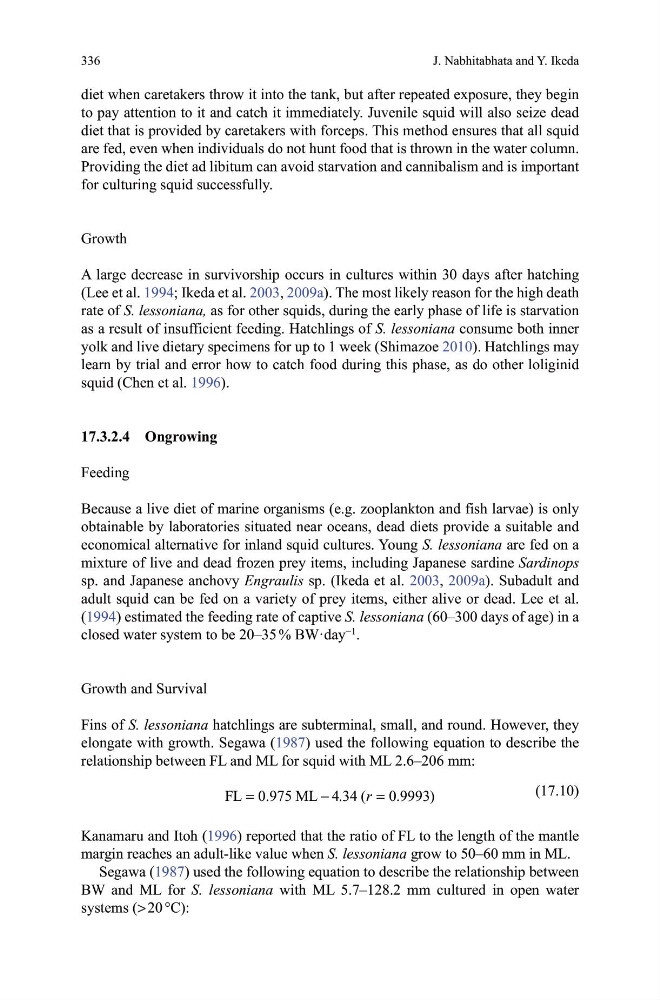
elongate with growth. Segawa (1987) used the following equation to describe the
relationship between FL and ML for squid with ML 2.6–206 mm:
(17.10)
Kanamaru and Itoh (1996) reported that the ratio of FL to the length of the mantle
margin reaches an adult-like value when S� lessoniana grow to 50–60 mm in ML.
Segawa (1987) used the following equation to describe the relationship between
BW and ML for S� lessoniana with ML 5.7–128.2 mm cultured in open water
systems (> 20 °C):
FL 0.975 ML 4.34 (
0.9993)
r
=
−
=
J. Nabhitabhata and Y. Ikeda
diet when caretakers throw it into the tank, but after repeated exposure, they begin
to pay attention to it and catch it immediately. Juvenile squid will also seize dead
diet that is provided by caretakers with forceps. This method ensures that all squid
are fed, even when individuals do not hunt food that is thrown in the water column.
Providing the diet ad libitum can avoid starvation and cannibalism and is important
for culturing squid successfully.
Growth
A large decrease in survivorship occurs in cultures within 30 days after hatching
(Lee et al. 1994; Ikeda et al. 2003, 2009a). The most likely reason for the high death
rate of S� lessoniana, as for other squids, during the early phase of life is starvation
as a result of insufficient feeding. Hatchlings of S� lessoniana consume both inner
yolk and live dietary specimens for up to 1 week (Shimazoe 2010). Hatchlings may
learn by trial and error how to catch food during this phase, as do other loliginid
squid (Chen et al. 1996).
17.3.2.4 Ongrowing
Feeding
Because a live diet of marine organisms (e.g. zooplankton and fish larvae) is only
obtainable by laboratories situated near oceans, dead diets provide a suitable and
economical alternative for inland squid cultures. Young S� lessoniana are fed on a
mixture of live and dead frozen prey items, including Japanese sardine Sardinops
sp. and Japanese anchovy Engraulis sp. (Ikeda et al. 2003, 2009a). Subadult and
adult squid can be fed on a variety of prey items, either alive or dead. Lee et al.
(1994) estimated the feeding rate of captive S� lessoniana (60–300 days of age) in a
closed water system to be 20–35 % BW·day
−1
.
Growth and Survival
Fins of S� lessoniana hatchlings are subterminal, small, and round. However, they
elongate with growth. Segawa (1987) used the following equation to describe the
relationship between FL and ML for squid with ML 2.6–206 mm:
(17.10)
Kanamaru and Itoh (1996) reported that the ratio of FL to the length of the mantle
margin reaches an adult-like value when S� lessoniana grow to 50–60 mm in ML.
Segawa (1987) used the following equation to describe the relationship between
BW and ML for S� lessoniana with ML 5.7–128.2 mm cultured in open water
systems (> 20 °C):
FL 0.975 ML 4.34 (
0.9993)
r
=
−
=
J. Nabhitabhata and Y. Ikeda