

330
at the corners. The cages are made from a monofilament nylon net with a 13-mm
mesh size, corresponding to the initial size of squid. Underwater hard frames for
cages are avoided in order to prevent collisions or rubbing of squid that cause skin
damage and consequent infectious disease. In order to fit into the existing net-cage
facilities, the cage dimensions are 2 × 2.5 × 2 m and are submerged to a depth of
1.5 m. Cages therefore contain 7.5 m
3
seawater and have a 5-m
2
surface area. The
optimum squid density is reported to be about 5–10 individuals·m
−2
(3–7 ind·m
−3
)
through a 60-day period for squid with an initial ML of about 50 mm length and
weight of 16 g (40 days; Nabhitabhata 1978, 1996; Nabhitabhata and Kbinrum
1981; Nabhitabhata et al. 1996). Because the nets are made from monofilament,
cages should be left at the ongrowing sites until fouling organisms are observed
growing on the net. The fouled net has enhanced visibility to the squid and reduces
their collisions with the net.
17.3.2 Open and Closed Seawater System
in Temperate Countries
Methods of aquaculture for S� lessoniana in tropical countries and temperate countries can share many things. In this section, the methodology specifically applied
to closed water systems and open water systems in temperate countries will be
described for comparison.
17.3.2.1 Broodstock Maintenance
In Japan, jigging and set net are the main fishery tools for collecting subadult and
adult S� lessoniana. Munekiyo and Kawagishi (1993) and Ueta (2000a) found that
S� lessoniana caught by set net follow a lunar cycle; the catch amount increases at
the full moon and decreases at the new moon. The sex ratio of S� lessoniana caught
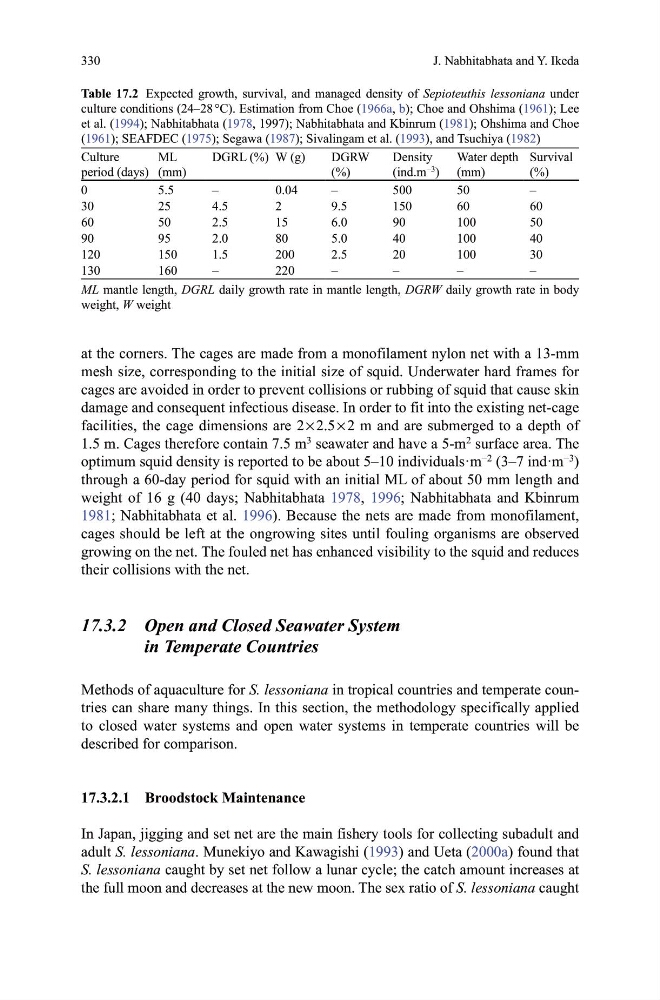
Table 17.2 Expected growth, survival, and managed density of Sepioteuthis lessoniana under
culture conditions (24–28 °C). Estimation from Choe (1966a, b); Choe and Ohshima (1961); Lee
et al. (1994); Nabhitabhata (1978, 1997); Nabhitabhata and Kbinrum (1981); Ohshima and Choe
(1961); SEAFDEC (1975); Segawa (1987); Sivalingam et al. (1993), and Tsuchiya (1982)
Culture
period (days)
ML
(mm)
DGRL (%) W (g)
DGRW
(%)
Density
(ind.m
−3
)
Water depth
(mm)
Survival
(%)
0
5.5
–
0.04
–
500
50
–
30
25
4.5
2
9.5
150
60
60
60
50
2.5
15
6.0
90
100
50
90
95
2.0
80
5.0
40
100
40
120
150
1.5
200
2.5
20
100
30
130
160
–
220
–
–
–
–
ML mantle length, DGRL daily growth rate in mantle length, DGRW daily growth rate in body
weight, W weight
J. Nabhitabhata and Y. Ikeda
at the corners. The cages are made from a monofilament nylon net with a 13-mm
mesh size, corresponding to the initial size of squid. Underwater hard frames for
cages are avoided in order to prevent collisions or rubbing of squid that cause skin
damage and consequent infectious disease. In order to fit into the existing net-cage
facilities, the cage dimensions are 2 × 2.5 × 2 m and are submerged to a depth of
1.5 m. Cages therefore contain 7.5 m
3
seawater and have a 5-m
2
surface area. The
optimum squid density is reported to be about 5–10 individuals·m
−2
(3–7 ind·m
−3
)
through a 60-day period for squid with an initial ML of about 50 mm length and
weight of 16 g (40 days; Nabhitabhata 1978, 1996; Nabhitabhata and Kbinrum
1981; Nabhitabhata et al. 1996). Because the nets are made from monofilament,
cages should be left at the ongrowing sites until fouling organisms are observed
growing on the net. The fouled net has enhanced visibility to the squid and reduces
their collisions with the net.
17.3.2 Open and Closed Seawater System
in Temperate Countries
Methods of aquaculture for S� lessoniana in tropical countries and temperate countries can share many things. In this section, the methodology specifically applied
to closed water systems and open water systems in temperate countries will be
described for comparison.
17.3.2.1 Broodstock Maintenance
In Japan, jigging and set net are the main fishery tools for collecting subadult and
adult S� lessoniana. Munekiyo and Kawagishi (1993) and Ueta (2000a) found that
S� lessoniana caught by set net follow a lunar cycle; the catch amount increases at
the full moon and decreases at the new moon. The sex ratio of S� lessoniana caught
Table 17.2 Expected growth, survival, and managed density of Sepioteuthis lessoniana under
culture conditions (24–28 °C). Estimation from Choe (1966a, b); Choe and Ohshima (1961); Lee
et al. (1994); Nabhitabhata (1978, 1997); Nabhitabhata and Kbinrum (1981); Ohshima and Choe
(1961); SEAFDEC (1975); Segawa (1987); Sivalingam et al. (1993), and Tsuchiya (1982)
Culture
period (days)
ML
(mm)
DGRL (%) W (g)
DGRW
(%)
Density
(ind.m
−3
)
Water depth
(mm)
Survival
(%)
0
5.5
–
0.04
–
500
50
–
30
25
4.5
2
9.5
150
60
60
60
50
2.5
15
6.0
90
100
50
90
95
2.0
80
5.0
40
100
40
120
150
1.5
200
2.5
20
100
30
130
160
–
220
–
–
–
–
ML mantle length, DGRL daily growth rate in mantle length, DGRW daily growth rate in body
weight, W weight
J. Nabhitabhata and Y. Ikeda