

287
16 Loligo vulgaris and Doryteuthis opalescens
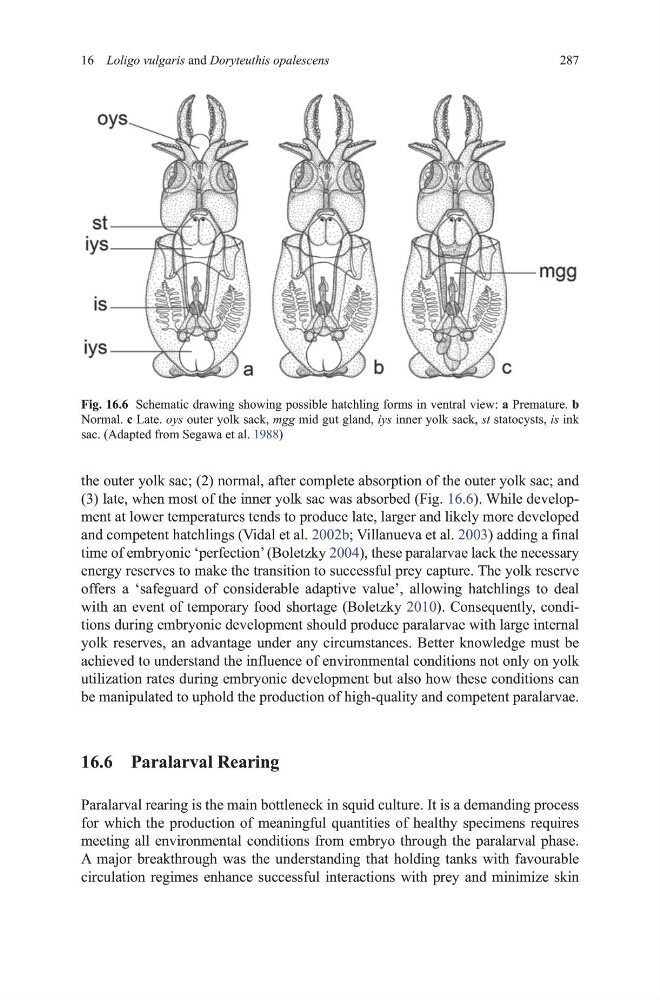
the outer yolk sac; (2) normal, after complete absorption of the outer yolk sac; and
(3) late, when most of the inner yolk sac was absorbed (Fig. 16.6). While development at lower temperatures tends to produce late, larger and likely more developed
and competent hatchlings (Vidal et al. 2002b; Villanueva et al. 2003) adding a final
time of embryonic ‘perfection’ (Boletzky 2004), these paralarvae lack the necessary
energy reserves to make the transition to successful prey capture. The yolk reserve
offers a ‘safeguard of considerable adaptive value’, allowing hatchlings to deal
with an event of temporary food shortage (Boletzky 2010). Consequently, conditions during embryonic development should produce paralarvae with large internal
yolk reserves, an advantage under any circumstances. Better knowledge must be
achieved to understand the influence of environmental conditions not only on yolk
utilization rates during embryonic development but also how these conditions can
be manipulated to uphold the production of high-quality and competent paralarvae.
16.6 Paralarval Rearing
Paralarval rearing is the main bottleneck in squid culture. It is a demanding process
for which the production of meaningful quantities of healthy specimens requires
meeting all environmental conditions from embryo through the paralarval phase.
A major breakthrough was the understanding that holding tanks with favourable
circulation regimes enhance successful interactions with prey and minimize skin
Fig. 16.6 Schematic drawing showing possible hatchling forms in ventral view: a Premature. b
Normal. c Late. oys outer yolk sack, mgg mid gut gland, iys inner yolk sack, st statocysts, is ink
sac. (Adapted from Segawa et al. 1988)
16 Loligo vulgaris and Doryteuthis opalescens
the outer yolk sac; (2) normal, after complete absorption of the outer yolk sac; and
(3) late, when most of the inner yolk sac was absorbed (Fig. 16.6). While development at lower temperatures tends to produce late, larger and likely more developed
and competent hatchlings (Vidal et al. 2002b; Villanueva et al. 2003) adding a final
time of embryonic ‘perfection’ (Boletzky 2004), these paralarvae lack the necessary
energy reserves to make the transition to successful prey capture. The yolk reserve
offers a ‘safeguard of considerable adaptive value’, allowing hatchlings to deal
with an event of temporary food shortage (Boletzky 2010). Consequently, conditions during embryonic development should produce paralarvae with large internal
yolk reserves, an advantage under any circumstances. Better knowledge must be
achieved to understand the influence of environmental conditions not only on yolk
utilization rates during embryonic development but also how these conditions can
be manipulated to uphold the production of high-quality and competent paralarvae.
16.6 Paralarval Rearing
Paralarval rearing is the main bottleneck in squid culture. It is a demanding process
for which the production of meaningful quantities of healthy specimens requires
meeting all environmental conditions from embryo through the paralarval phase.
A major breakthrough was the understanding that holding tanks with favourable
circulation regimes enhance successful interactions with prey and minimize skin
Fig. 16.6 Schematic drawing showing possible hatchling forms in ventral view: a Premature. b
Normal. c Late. oys outer yolk sack, mgg mid gut gland, iys inner yolk sack, st statocysts, is ink
sac. (Adapted from Segawa et al. 1988)