

279
16 Loligo vulgaris and Doryteuthis opalescens
small bunches and in constant motion is to promote an even aeration between them.
Steer and Moltschaniwskyj (2007) have shown that the relative position of the eggs
within the egg mass of Sepioteuthis australis dictates their chances of survival.
Eggs located near the attachment point of the egg strand or within the interior of the
egg mass are subject to the highest mortality rates due to reduced levels of oxygen
supply. This effect is amplified with increasing egg mass size. Furthermore, the
development of the embryos within a single egg strand is asynchronous as they
are exposed to differential oxygen levels. Embryos located at the periphery and
exposed to higher oxygen supply will hatch first, as particularly in the case of those
species which produce egg capsules containing dozens of eggs as both L. vulgaris
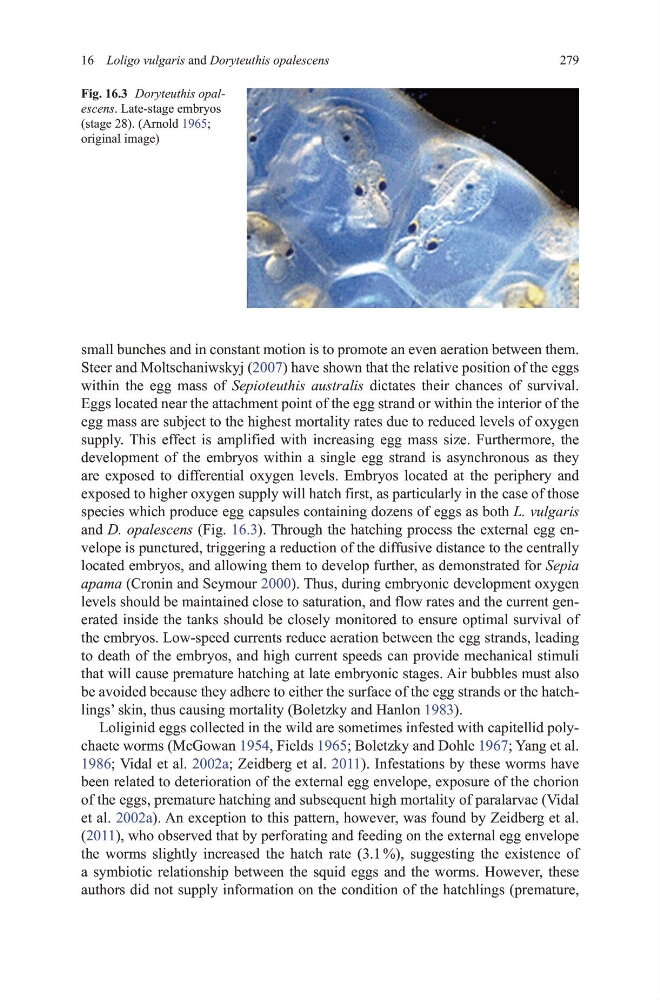
and D. opalescens (Fig. 16.3). Through the hatching process the external egg envelope is punctured, triggering a reduction of the diffusive distance to the centrally
located embryos, and allowing them to develop further, as demonstrated for Sepia
apama (Cronin and Seymour 2000). Thus, during embryonic development oxygen
levels should be maintained close to saturation, and flow rates and the current generated inside the tanks should be closely monitored to ensure optimal survival of
the embryos. Low-speed currents reduce aeration between the egg strands, leading
to death of the embryos, and high current speeds can provide mechanical stimuli
that will cause premature hatching at late embryonic stages. Air bubbles must also
be avoided because they adhere to either the surface of the egg strands or the hatchlings’ skin, thus causing mortality (Boletzky and Hanlon 1983).
Loliginid eggs collected in the wild are sometimes infested with capitellid polychaete worms (McGowan 1954, Fields 1965; Boletzky and Dohle 1967; Yang et al.
1986; Vidal et al. 2002a; Zeidberg et al. 2011). Infestations by these worms have
been related to deterioration of the external egg envelope, exposure of the chorion
of the eggs, premature hatching and subsequent high mortality of paralarvae (Vidal
et al. 2002a). An exception to this pattern, however, was found by Zeidberg et al.
(2011), who observed that by perforating and feeding on the external egg envelope
the worms slightly increased the hatch rate (3.1 %), suggesting the existence of
a symbiotic relationship between the squid eggs and the worms. However, these
authors did not supply information on the condition of the hatchlings (premature,
Fig. 16.3 Doryteuthis opalescens. Late-stage embryos
(stage 28). (Arnold 1965;
original image)
16 Loligo vulgaris and Doryteuthis opalescens
small bunches and in constant motion is to promote an even aeration between them.
Steer and Moltschaniwskyj (2007) have shown that the relative position of the eggs
within the egg mass of Sepioteuthis australis dictates their chances of survival.
Eggs located near the attachment point of the egg strand or within the interior of the
egg mass are subject to the highest mortality rates due to reduced levels of oxygen
supply. This effect is amplified with increasing egg mass size. Furthermore, the
development of the embryos within a single egg strand is asynchronous as they
are exposed to differential oxygen levels. Embryos located at the periphery and
exposed to higher oxygen supply will hatch first, as particularly in the case of those
species which produce egg capsules containing dozens of eggs as both L. vulgaris
and D. opalescens (Fig. 16.3). Through the hatching process the external egg envelope is punctured, triggering a reduction of the diffusive distance to the centrally
located embryos, and allowing them to develop further, as demonstrated for Sepia
apama (Cronin and Seymour 2000). Thus, during embryonic development oxygen
levels should be maintained close to saturation, and flow rates and the current generated inside the tanks should be closely monitored to ensure optimal survival of
the embryos. Low-speed currents reduce aeration between the egg strands, leading
to death of the embryos, and high current speeds can provide mechanical stimuli
that will cause premature hatching at late embryonic stages. Air bubbles must also
be avoided because they adhere to either the surface of the egg strands or the hatchlings’ skin, thus causing mortality (Boletzky and Hanlon 1983).
Loliginid eggs collected in the wild are sometimes infested with capitellid polychaete worms (McGowan 1954, Fields 1965; Boletzky and Dohle 1967; Yang et al.
1986; Vidal et al. 2002a; Zeidberg et al. 2011). Infestations by these worms have
been related to deterioration of the external egg envelope, exposure of the chorion
of the eggs, premature hatching and subsequent high mortality of paralarvae (Vidal
et al. 2002a). An exception to this pattern, however, was found by Zeidberg et al.
(2011), who observed that by perforating and feeding on the external egg envelope
the worms slightly increased the hatch rate (3.1 %), suggesting the existence of
a symbiotic relationship between the squid eggs and the worms. However, these
authors did not supply information on the condition of the hatchlings (premature,
Fig. 16.3 Doryteuthis opalescens. Late-stage embryos
(stage 28). (Arnold 1965;
original image)