

254
J. Nabhitabhata and M. K. Nishiguchi
neritic and strictly nektobenthic, inhabiting coastal waters in a similar manner to
its congeners that occur in the Indo-west Pacific region (Summers 1985; Norman
and Lu 1997; Reid and Jereb 2005). E� tasmanica (Pfeffer 1884), otherwise known
as the “southern dumpling squid”, is a species that resides around the continent of
Australia and is found in similar habitats as E� hyllebergi (Reid and Jereb 2005). E�
tasmanica is somewhat larger in size than E� hyllebergi, with an approximate ML
of 30–40 mm (Norman and Lu 1997). In Thailand, E� hyllebergi and congeners are
captured as by-catch of commercial fishing, particularly push netting and trawling
(Nateewathana 1997). The yields are discarded as trash fishes due to their small size
and low economic value. Because of this, fishing statistics of both species are not
available (Nateewathana et al. 2001; Reid and Norman 1998; Reid and Jereb 2005).
Although the economic value of Euprymna as human food is low, there is a
growing importance of the animals as scientific experimental models. The unique
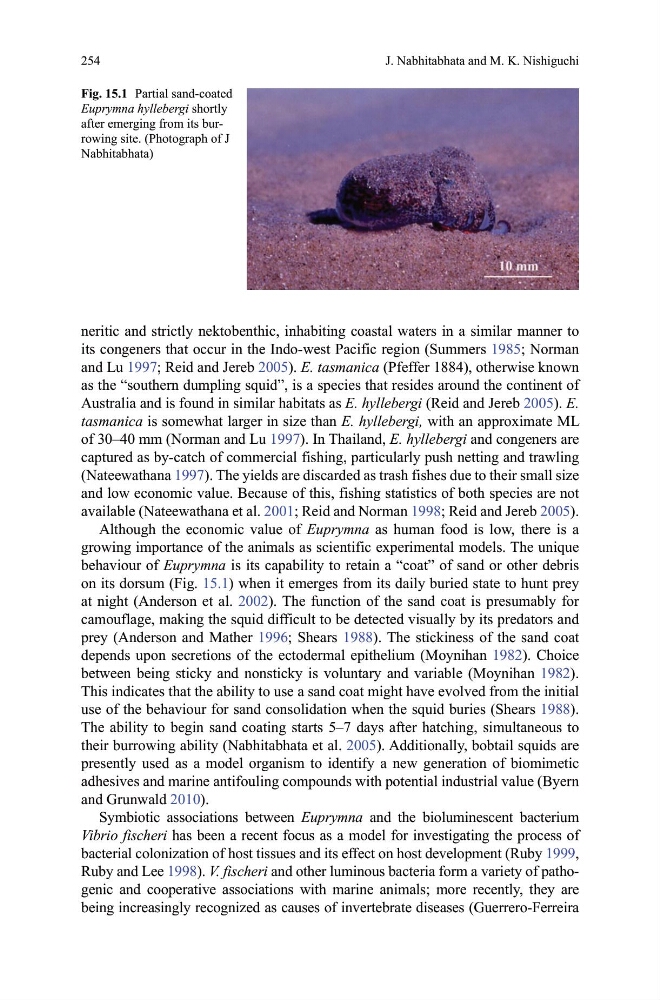
behaviour of Euprymna is its capability to retain a “coat” of sand or other debris
on its dorsum (Fig. 15.1) when it emerges from its daily buried state to hunt prey
at night (Anderson et al. 2002). The function of the sand coat is presumably for
camouflage, making the squid difficult to be detected visually by its predators and
prey (Anderson and Mather 1996; Shears 1988). The stickiness of the sand coat
depends upon secretions of the ectodermal epithelium (Moynihan 1982). Choice
between being sticky and nonsticky is voluntary and variable (Moynihan 1982).
This indicates that the ability to use a sand coat might have evolved from the initial
use of the behaviour for sand consolidation when the squid buries (Shears 1988).
The ability to begin sand coating starts 5–7 days after hatching, simultaneous to
their burrowing ability (Nabhitabhata et al. 2005). Additionally, bobtail squids are
presently used as a model organism to identify a new generation of biomimetic
adhesives and marine antifouling compounds with potential industrial value (Byern
and Grunwald 2010).
Symbiotic associations between Euprymna and the bioluminescent bacterium
Vibrio fischeri has been a recent focus as a model for investigating the process of
bacterial colonization of host tissues and its effect on host development (Ruby 1999,
Ruby and Lee 1998). V� fischeri and other luminous bacteria form a variety of pathogenic and cooperative associations with marine animals; more recently, they are
being increasingly recognized as causes of invertebrate diseases (Guerrero-Ferreira
Fig. 15.1 Partial sand-coated
Euprymna hyllebergi shortly
after emerging from its burrowing site. (Photograph of J
Nabhitabhata)
J. Nabhitabhata and M. K. Nishiguchi
neritic and strictly nektobenthic, inhabiting coastal waters in a similar manner to
its congeners that occur in the Indo-west Pacific region (Summers 1985; Norman
and Lu 1997; Reid and Jereb 2005). E� tasmanica (Pfeffer 1884), otherwise known
as the “southern dumpling squid”, is a species that resides around the continent of
Australia and is found in similar habitats as E� hyllebergi (Reid and Jereb 2005). E�
tasmanica is somewhat larger in size than E� hyllebergi, with an approximate ML
of 30–40 mm (Norman and Lu 1997). In Thailand, E� hyllebergi and congeners are
captured as by-catch of commercial fishing, particularly push netting and trawling
(Nateewathana 1997). The yields are discarded as trash fishes due to their small size
and low economic value. Because of this, fishing statistics of both species are not
available (Nateewathana et al. 2001; Reid and Norman 1998; Reid and Jereb 2005).
Although the economic value of Euprymna as human food is low, there is a
growing importance of the animals as scientific experimental models. The unique
behaviour of Euprymna is its capability to retain a “coat” of sand or other debris
on its dorsum (Fig. 15.1) when it emerges from its daily buried state to hunt prey
at night (Anderson et al. 2002). The function of the sand coat is presumably for
camouflage, making the squid difficult to be detected visually by its predators and
prey (Anderson and Mather 1996; Shears 1988). The stickiness of the sand coat
depends upon secretions of the ectodermal epithelium (Moynihan 1982). Choice
between being sticky and nonsticky is voluntary and variable (Moynihan 1982).
This indicates that the ability to use a sand coat might have evolved from the initial
use of the behaviour for sand consolidation when the squid buries (Shears 1988).
The ability to begin sand coating starts 5–7 days after hatching, simultaneous to
their burrowing ability (Nabhitabhata et al. 2005). Additionally, bobtail squids are
presently used as a model organism to identify a new generation of biomimetic
adhesives and marine antifouling compounds with potential industrial value (Byern
and Grunwald 2010).
Symbiotic associations between Euprymna and the bioluminescent bacterium
Vibrio fischeri has been a recent focus as a model for investigating the process of
bacterial colonization of host tissues and its effect on host development (Ruby 1999,
Ruby and Lee 1998). V� fischeri and other luminous bacteria form a variety of pathogenic and cooperative associations with marine animals; more recently, they are
being increasingly recognized as causes of invertebrate diseases (Guerrero-Ferreira
Fig. 15.1 Partial sand-coated
Euprymna hyllebergi shortly
after emerging from its burrowing site. (Photograph of J
Nabhitabhata)