

248
X.-D. Zheng et al.
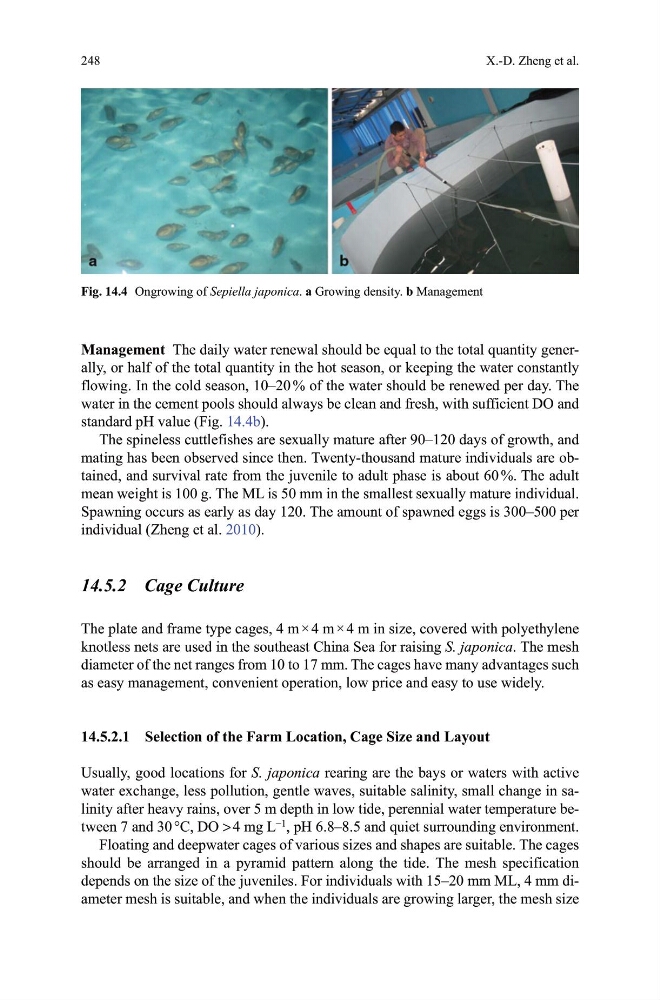
Management The daily water renewal should be equal to the total quantity generally, or half of the total quantity in the hot season, or keeping the water constantly
flowing. In the cold season, 10–20 % of the water should be renewed per day. The
water in the cement pools should always be clean and fresh, with sufficient DO and
standard pH value (Fig. 14.4b).
The spineless cuttlefishes are sexually mature after 90–120 days of growth, and
mating has been observed since then. Twenty-thousand mature individuals are obtained, and survival rate from the juvenile to adult phase is about 60 %. The adult
mean weight is 100 g. The ML is 50 mm in the smallest sexually mature individual.
Spawning occurs as early as day 120. The amount of spawned eggs is 300–500 per
individual (Zheng et al. 2010).
14.5.2 Cage Culture
The plate and frame type cages, 4 m × 4 m × 4 m in size, covered with polyethylene
knotless nets are used in the southeast China Sea for raising S� japonica. The mesh
diameter of the net ranges from 10 to 17 mm. The cages have many advantages such
as easy management, convenient operation, low price and easy to use widely.
14.5.2.1 Selection of the Farm Location, Cage Size and Layout
Usually, good locations for S� japonica rearing are the bays or waters with active
water exchange, less pollution, gentle waves, suitable salinity, small change in salinity after heavy rains, over 5 m depth in low tide, perennial water temperature between 7 and 30 °C, DO > 4 mg L
−1
, pH 6.8–8.5 and quiet surrounding environment.
Floating and deepwater cages of various sizes and shapes are suitable. The cages
should be arranged in a pyramid pattern along the tide. The mesh specification
depends on the size of the juveniles. For individuals with 15–20 mm ML, 4 mm diameter mesh is suitable, and when the individuals are growing larger, the mesh size
Fig. 14.4 Ongrowing of Sepiella japonica. a Growing density. b Management
X.-D. Zheng et al.
Management The daily water renewal should be equal to the total quantity generally, or half of the total quantity in the hot season, or keeping the water constantly
flowing. In the cold season, 10–20 % of the water should be renewed per day. The
water in the cement pools should always be clean and fresh, with sufficient DO and
standard pH value (Fig. 14.4b).
The spineless cuttlefishes are sexually mature after 90–120 days of growth, and
mating has been observed since then. Twenty-thousand mature individuals are obtained, and survival rate from the juvenile to adult phase is about 60 %. The adult
mean weight is 100 g. The ML is 50 mm in the smallest sexually mature individual.
Spawning occurs as early as day 120. The amount of spawned eggs is 300–500 per
individual (Zheng et al. 2010).
14.5.2 Cage Culture
The plate and frame type cages, 4 m × 4 m × 4 m in size, covered with polyethylene
knotless nets are used in the southeast China Sea for raising S� japonica. The mesh
diameter of the net ranges from 10 to 17 mm. The cages have many advantages such
as easy management, convenient operation, low price and easy to use widely.
14.5.2.1 Selection of the Farm Location, Cage Size and Layout
Usually, good locations for S� japonica rearing are the bays or waters with active
water exchange, less pollution, gentle waves, suitable salinity, small change in salinity after heavy rains, over 5 m depth in low tide, perennial water temperature between 7 and 30 °C, DO > 4 mg L
−1
, pH 6.8–8.5 and quiet surrounding environment.
Floating and deepwater cages of various sizes and shapes are suitable. The cages
should be arranged in a pyramid pattern along the tide. The mesh specification
depends on the size of the juveniles. For individuals with 15–20 mm ML, 4 mm diameter mesh is suitable, and when the individuals are growing larger, the mesh size
Fig. 14.4 Ongrowing of Sepiella japonica. a Growing density. b Management