

243
14 Sepiella japonica
process can be done under the ambient water temperature with illumination intensity below 1,000 Lx and salinity over 20 psu.
S� japonica is very sensitive to environmental changes, which will result in stress
reaction and ink ejecting. Therefore, before introducing them to the new environment, the water temperature and salinity should be adjusted to almost the same as
under the transit conditions. Besides, the density should be kept at 2–3 individuals
m
−3
. The top of the pools should be shaded and the illumination intensity on the
water surface should be 200–800 Lx. The water should be sand-filtered with salinity
of 18–32 psu, dissolved oxygen (DO) > 4 mg L
−1
and pH 7.8–8.4. The daily water
renewal should be one to two times of the total quantity. Sex ratio of broodstock
should be 1:1.
The feed can be fresh shellfish, fish or shrimps, such as Sardinella lemuru and
Sinonovacula constricta. The feeding rate should be about 10 % of the broodstock
total weight. Observation must be done every day and record should be maintained
to get a clear knowledge of their activities, ingestion and growth.
14.3 Spawning Process
14.3.1 Mating
The broodstock can be forced to mature by increasing the water temperature little
by little, i.e. 1 °C in 2–4 days. After some days, they become agitated swimming
or even fighting violently, indicating that they are sexually matured. A male only
approaches one female, and where there are more males than females, there are usually fierce fights between the males. Only the winners can get access to the female.
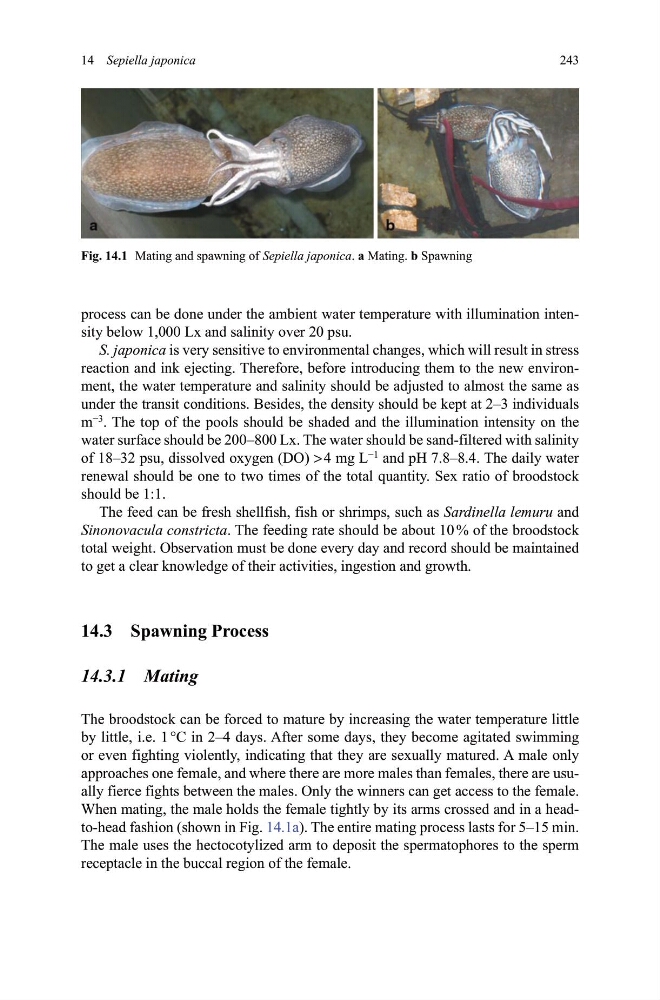
When mating, the male holds the female tightly by its arms crossed and in a headto-head fashion (shown in Fig. 14.1a). The entire mating process lasts for 5–15 min.
The male uses the hectocotylized arm to deposit the spermatophores to the sperm
receptacle in the buccal region of the female.
Fig. 14.1 Mating and spawning of Sepiella japonica. a Mating. b Spawning
14 Sepiella japonica
process can be done under the ambient water temperature with illumination intensity below 1,000 Lx and salinity over 20 psu.
S� japonica is very sensitive to environmental changes, which will result in stress
reaction and ink ejecting. Therefore, before introducing them to the new environment, the water temperature and salinity should be adjusted to almost the same as
under the transit conditions. Besides, the density should be kept at 2–3 individuals
m
−3
. The top of the pools should be shaded and the illumination intensity on the
water surface should be 200–800 Lx. The water should be sand-filtered with salinity
of 18–32 psu, dissolved oxygen (DO) > 4 mg L
−1
and pH 7.8–8.4. The daily water
renewal should be one to two times of the total quantity. Sex ratio of broodstock
should be 1:1.
The feed can be fresh shellfish, fish or shrimps, such as Sardinella lemuru and
Sinonovacula constricta. The feeding rate should be about 10 % of the broodstock
total weight. Observation must be done every day and record should be maintained
to get a clear knowledge of their activities, ingestion and growth.
14.3 Spawning Process
14.3.1 Mating
The broodstock can be forced to mature by increasing the water temperature little
by little, i.e. 1 °C in 2–4 days. After some days, they become agitated swimming
or even fighting violently, indicating that they are sexually matured. A male only
approaches one female, and where there are more males than females, there are usually fierce fights between the males. Only the winners can get access to the female.
When mating, the male holds the female tightly by its arms crossed and in a headto-head fashion (shown in Fig. 14.1a). The entire mating process lasts for 5–15 min.
The male uses the hectocotylized arm to deposit the spermatophores to the sperm
receptacle in the buccal region of the female.
Fig. 14.1 Mating and spawning of Sepiella japonica. a Mating. b Spawning