

219
ML
T
T
T
=
+
×
+
×
−
×
−
−
−
0 077 2 995 10
3 584 10
1 109 10
3
5 2
73
.
.
.
.
.
(12.3)
The second growth phase in terms of the weight–age relationship is from 50 to 260
days of age, with the inflection point at about 60 days, and this can be fitted by the
following equation (Fig. 12.4):
W
T
T
=
×
+
×
−
−
−
6 433 10
5 224 10
16 583
2
3 2
.
.
. .
(12.4)
12.7 Trends in Research and Industrial Level
The low growth rate and small final weight of about 400 g at 210 days (7 months)
are disadvantageous for aquaculture in terms of quantitative production compared
with the larger weight of more than 1,000 g from the fisheries ground (Nabhitabhata
1995, 2000). However, this happens because the technology might need optimization, and more knowledge regarding the species physiology is required. Culture for
a larger final size is feasible at low density, low temperature, longer periods and
high nutritive feeding. Such production comes at a cost that does not attract any
investment for commercial production. Another point of concern is the feasibility
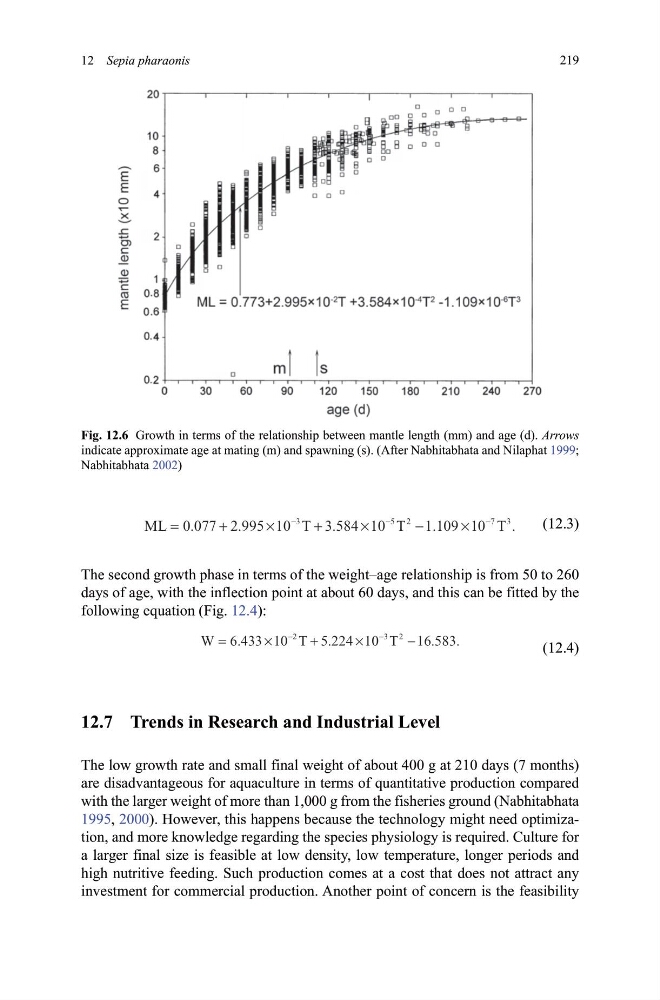
Fig. 12.6 Growth in terms of the relationship between mantle length (mm) and age (d). Arrows
indicate approximate age at mating (m) and spawning (s). (After Nabhitabhata and Nilaphat 1999;
Nabhitabhata 2002)
12 Sepia pharaonis
ML
T
T
T
=
+
×
+
×
−
×
−
−
−
0 077 2 995 10
3 584 10
1 109 10
3
5 2
73
.
.
.
.
.
(12.3)
The second growth phase in terms of the weight–age relationship is from 50 to 260
days of age, with the inflection point at about 60 days, and this can be fitted by the
following equation (Fig. 12.4):
W
T
T
=
×
+
×
−
−
−
6 433 10
5 224 10
16 583
2
3 2
.
.
. .
(12.4)
12.7 Trends in Research and Industrial Level
The low growth rate and small final weight of about 400 g at 210 days (7 months)
are disadvantageous for aquaculture in terms of quantitative production compared
with the larger weight of more than 1,000 g from the fisheries ground (Nabhitabhata
1995, 2000). However, this happens because the technology might need optimization, and more knowledge regarding the species physiology is required. Culture for
a larger final size is feasible at low density, low temperature, longer periods and
high nutritive feeding. Such production comes at a cost that does not attract any
investment for commercial production. Another point of concern is the feasibility
Fig. 12.6 Growth in terms of the relationship between mantle length (mm) and age (d). Arrows
indicate approximate age at mating (m) and spawning (s). (After Nabhitabhata and Nilaphat 1999;
Nabhitabhata 2002)
12 Sepia pharaonis