

216
J. Nabhitabhata
again to 1,000-L tanks at a density of 20 individuals m
−3
and then to 10 individuals
m
−3
after 180 days when the cuttlefish attained a mantle length of 145 mm and a
weight of 325 g. In contrast, Nabhitabhata and Nilaphat (1999) use a different rearing methodology to avoid injuring the animals. After 30 days, cuttlefish at about
20 mm in mantle length are not transferred and the ongrowing is continued in the
nursing tanks (3,000 L), but their density is decreased from 500 individuals m
−2
to
200 individuals m
−2
, with another 20 % decrease every 10 days thereafter.
Many abiotic and biotic factors have been reported to affect growth in culture
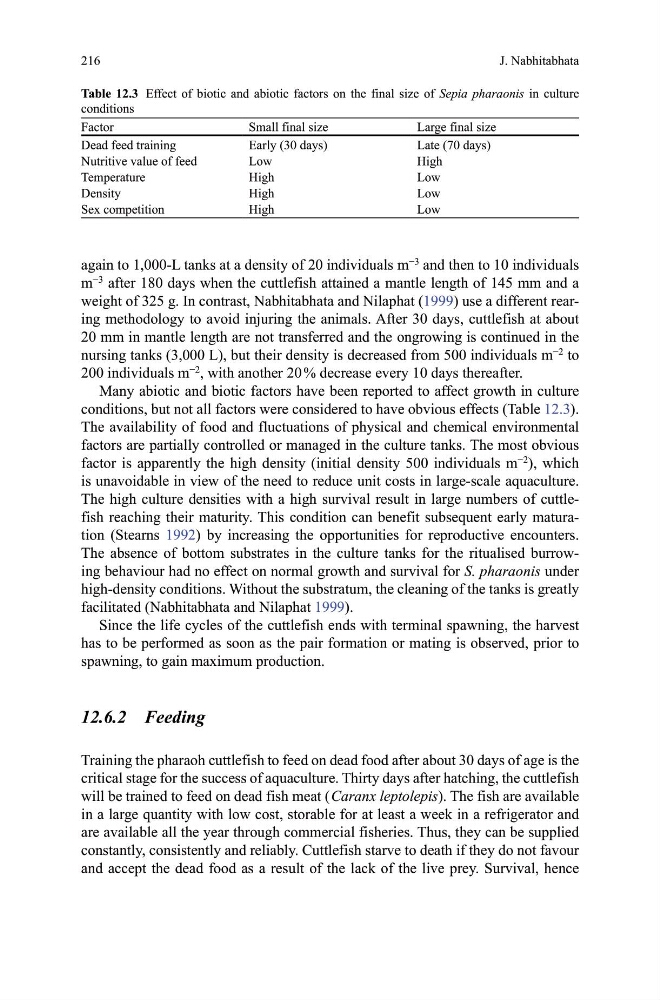
conditions, but not all factors were considered to have obvious effects (Table 12.3).
The availability of food and fluctuations of physical and chemical environmental
factors are partially controlled or managed in the culture tanks. The most obvious
factor is apparently the high density (initial density 500 individuals m
−2
), which
is unavoidable in view of the need to reduce unit costs in large-scale aquaculture.
The high culture densities with a high survival result in large numbers of cuttlefish reaching their maturity. This condition can benefit subsequent early maturation (Stearns 1992) by increasing the opportunities for reproductive encounters.
The absence of bottom substrates in the culture tanks for the ritualised burrowing behaviour had no effect on normal growth and survival for S� pharaonis under
high-density conditions. Without the substratum, the cleaning of the tanks is greatly
facilitated (Nabhitabhata and Nilaphat 1999).
Since the life cycles of the cuttlefish ends with terminal spawning, the harvest
has to be performed as soon as the pair formation or mating is observed, prior to
spawning, to gain maximum production.
12.6.2 Feeding
Training the pharaoh cuttlefish to feed on dead food after about 30 days of age is the
critical stage for the success of aquaculture. Thirty days after hatching, the cuttlefish
will be trained to feed on dead fish meat ( Caranx leptolepis). The fish are available
in a large quantity with low cost, storable for at least a week in a refrigerator and
are available all the year through commercial fisheries. Thus, they can be supplied
constantly, consistently and reliably. Cuttlefish starve to death if they do not favour
and accept the dead food as a result of the lack of the live prey. Survival, hence
Table 12.3 Effect of biotic and abiotic factors on the final size of Sepia pharaonis in culture
conditions
Factor
Small final size
Large final size
Dead feed training
Early (30 days)
Late (70 days)
Nutritive value of feed
Low
High
Temperature
High
Low
Density
High
Low
Sex competition
High
Low
J. Nabhitabhata
again to 1,000-L tanks at a density of 20 individuals m
−3
and then to 10 individuals
m
−3
after 180 days when the cuttlefish attained a mantle length of 145 mm and a
weight of 325 g. In contrast, Nabhitabhata and Nilaphat (1999) use a different rearing methodology to avoid injuring the animals. After 30 days, cuttlefish at about
20 mm in mantle length are not transferred and the ongrowing is continued in the
nursing tanks (3,000 L), but their density is decreased from 500 individuals m
−2
to
200 individuals m
−2
, with another 20 % decrease every 10 days thereafter.
Many abiotic and biotic factors have been reported to affect growth in culture
conditions, but not all factors were considered to have obvious effects (Table 12.3).
The availability of food and fluctuations of physical and chemical environmental
factors are partially controlled or managed in the culture tanks. The most obvious
factor is apparently the high density (initial density 500 individuals m
−2
), which
is unavoidable in view of the need to reduce unit costs in large-scale aquaculture.
The high culture densities with a high survival result in large numbers of cuttlefish reaching their maturity. This condition can benefit subsequent early maturation (Stearns 1992) by increasing the opportunities for reproductive encounters.
The absence of bottom substrates in the culture tanks for the ritualised burrowing behaviour had no effect on normal growth and survival for S� pharaonis under
high-density conditions. Without the substratum, the cleaning of the tanks is greatly
facilitated (Nabhitabhata and Nilaphat 1999).
Since the life cycles of the cuttlefish ends with terminal spawning, the harvest
has to be performed as soon as the pair formation or mating is observed, prior to
spawning, to gain maximum production.
12.6.2 Feeding
Training the pharaoh cuttlefish to feed on dead food after about 30 days of age is the
critical stage for the success of aquaculture. Thirty days after hatching, the cuttlefish
will be trained to feed on dead fish meat ( Caranx leptolepis). The fish are available
in a large quantity with low cost, storable for at least a week in a refrigerator and
are available all the year through commercial fisheries. Thus, they can be supplied
constantly, consistently and reliably. Cuttlefish starve to death if they do not favour
and accept the dead food as a result of the lack of the live prey. Survival, hence
Table 12.3 Effect of biotic and abiotic factors on the final size of Sepia pharaonis in culture
conditions
Factor
Small final size
Large final size
Dead feed training
Early (30 days)
Late (70 days)
Nutritive value of feed
Low
High
Temperature
High
Low
Density
High
Low
Sex competition
High
Low