

214
J. Nabhitabhata
et al. 2003; Nabhitabhata et al. 1996). The survival of cuttlefish hatchlings fed with
P� merguiensis for 10 days averages 94 % (81–100). The feeding rate is 28 % and
the feeding efficiency is 48 %. The unit cost in Thailand is estimated to be US$ 20
for 100 cuttlefish with a feed cost of about 85 % in 1996 (Nabhitabhata et al. 1996),
when US$ 1 approximately equal Thai Baht 25 (US$ 1 equal Thai Baht 30 in 2013).
12.5.4 Growth
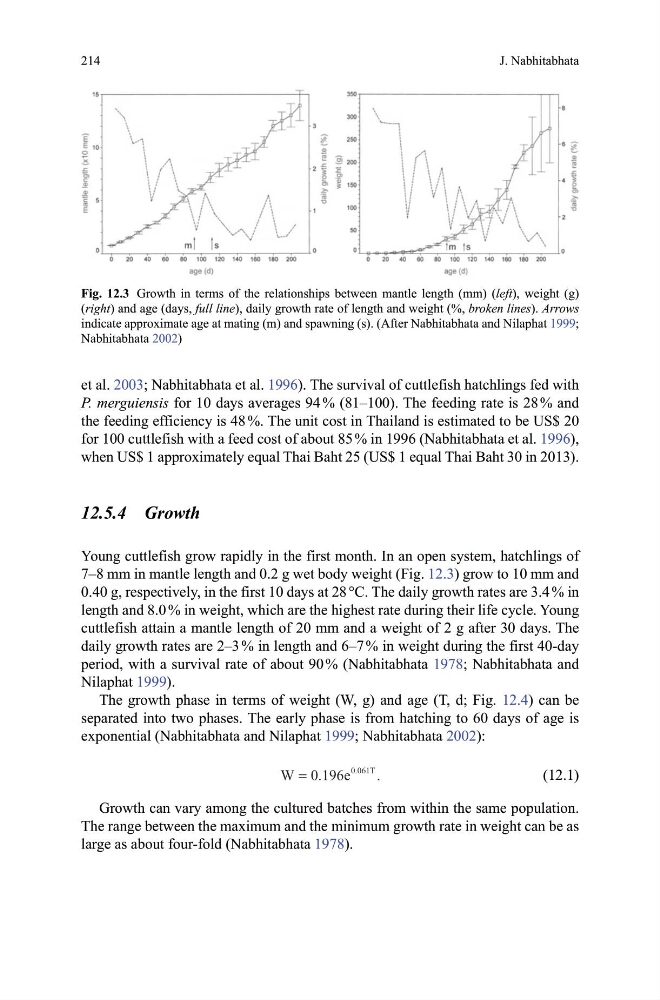
Young cuttlefish grow rapidly in the first month. In an open system, hatchlings of
7–8 mm in mantle length and 0.2 g wet body weight (Fig. 12.3) grow to 10 mm and
0.40 g, respectively, in the first 10 days at 28 °C. The daily growth rates are 3.4 % in
length and 8.0 % in weight, which are the highest rate during their life cycle. Young
cuttlefish attain a mantle length of 20 mm and a weight of 2 g after 30 days. The
daily growth rates are 2–3 % in length and 6–7 % in weight during the first 40-day
period, with a survival rate of about 90 % (Nabhitabhata 1978; Nabhitabhata and
Nilaphat 1999).
The growth phase in terms of weight (W, g) and age (T, d; Fig. 12.4) can be
separated into two phases. The early phase is from hatching to 60 days of age is
exponential (Nabhitabhata and Nilaphat 1999; Nabhitabhata 2002):
(12.1)
Growth can vary among the cultured batches from within the same population.
The range between the maximum and the minimum growth rate in weight can be as
large as about four-fold (Nabhitabhata 1978).
W
e
T
= 0 196
0 061
.
.
.
Fig. 12.3 Growth in terms of the relationships between mantle length (mm) (left), weight (g)
(right) and age (days, full line), daily growth rate of length and weight (%, broken lines). Arrows
indicate approximate age at mating (m) and spawning (s). (After Nabhitabhata and Nilaphat 1999;
Nabhitabhata 2002)
J. Nabhitabhata
et al. 2003; Nabhitabhata et al. 1996). The survival of cuttlefish hatchlings fed with
P� merguiensis for 10 days averages 94 % (81–100). The feeding rate is 28 % and
the feeding efficiency is 48 %. The unit cost in Thailand is estimated to be US$ 20
for 100 cuttlefish with a feed cost of about 85 % in 1996 (Nabhitabhata et al. 1996),
when US$ 1 approximately equal Thai Baht 25 (US$ 1 equal Thai Baht 30 in 2013).
12.5.4 Growth
Young cuttlefish grow rapidly in the first month. In an open system, hatchlings of
7–8 mm in mantle length and 0.2 g wet body weight (Fig. 12.3) grow to 10 mm and
0.40 g, respectively, in the first 10 days at 28 °C. The daily growth rates are 3.4 % in
length and 8.0 % in weight, which are the highest rate during their life cycle. Young
cuttlefish attain a mantle length of 20 mm and a weight of 2 g after 30 days. The
daily growth rates are 2–3 % in length and 6–7 % in weight during the first 40-day
period, with a survival rate of about 90 % (Nabhitabhata 1978; Nabhitabhata and
Nilaphat 1999).
The growth phase in terms of weight (W, g) and age (T, d; Fig. 12.4) can be
separated into two phases. The early phase is from hatching to 60 days of age is
exponential (Nabhitabhata and Nilaphat 1999; Nabhitabhata 2002):
(12.1)
Growth can vary among the cultured batches from within the same population.
The range between the maximum and the minimum growth rate in weight can be as
large as about four-fold (Nabhitabhata 1978).
W
e
T
= 0 196
0 061
.
.
.
Fig. 12.3 Growth in terms of the relationships between mantle length (mm) (left), weight (g)
(right) and age (days, full line), daily growth rate of length and weight (%, broken lines). Arrows
indicate approximate age at mating (m) and spawning (s). (After Nabhitabhata and Nilaphat 1999;
Nabhitabhata 2002)