

212
J. Nabhitabhata
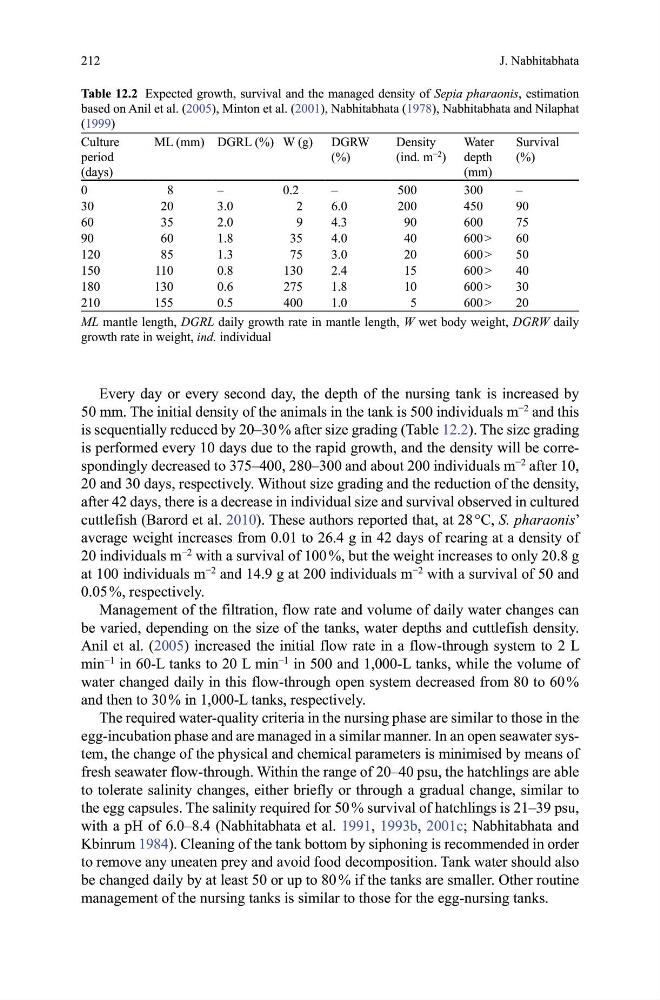
Every day or every second day, the depth of the nursing tank is increased by
50 mm. The initial density of the animals in the tank is 500 individuals m
−2
and this
is sequentially reduced by 20–30 % after size grading (Table 12.2). The size grading
is performed every 10 days due to the rapid growth, and the density will be correspondingly decreased to 375–400, 280–300 and about 200 individuals m
−2
after 10,
20 and 30 days, respectively. Without size grading and the reduction of the density,
after 42 days, there is a decrease in individual size and survival observed in cultured
cuttlefish (Barord et al. 2010). These authors reported that, at 28 °C, S� pharaonis’
average weight increases from 0.01 to 26.4 g in 42 days of rearing at a density of
20 individuals m
−2
with a survival of 100 %, but the weight increases to only 20.8 g
at 100 individuals m
−2
and 14.9 g at 200 individuals m
−2
with a survival of 50 and
0.05 %, respectively.
Management of the filtration, flow rate and volume of daily water changes can
be varied, depending on the size of the tanks, water depths and cuttlefish density.
Anil et al. (2005) increased the initial flow rate in a flow-through system to 2 L
min
−1
in 60-L tanks to 20 L min
−1
in 500 and 1,000-L tanks, while the volume of
water changed daily in this flow-through open system decreased from 80 to 60 %
and then to 30 % in 1,000-L tanks, respectively.
The required water-quality criteria in the nursing phase are similar to those in the
egg-incubation phase and are managed in a similar manner. In an open seawater system, the change of the physical and chemical parameters is minimised by means of
fresh seawater flow-through. Within the range of 20–40 psu, the hatchlings are able
to tolerate salinity changes, either briefly or through a gradual change, similar to
the egg capsules. The salinity required for 50 % survival of hatchlings is 21–39 psu,
with a pH of 6.0–8.4 (Nabhitabhata et al. 1991, 1993b, 2001c; Nabhitabhata and
Kbinrum 1984). Cleaning of the tank bottom by siphoning is recommended in order
to remove any uneaten prey and avoid food decomposition. Tank water should also
be changed daily by at least 50 or up to 80 % if the tanks are smaller. Other routine
management of the nursing tanks is similar to those for the egg-nursing tanks.
Table 12.2 Expected growth, survival and the managed density of Sepia pharaonis, estimation
based on Anil et al. (2005), Minton et al. (2001), Nabhitabhata (1978), Nabhitabhata and Nilaphat
(1999)
Culture
period
(days)
ML (mm) DGRL (%) W (g) DGRW
(%)
Density
(ind. m
−2
)
Water
depth
(mm)
Survival
(%)
0
8
–
0.2
–
500
300
–
30
20
3.0
2
6.0
200
450
90
60
35
2.0
9
4.3
90
600
75
90
60
1.8
35
4.0
40
600 >
60
120
85
1.3
75
3.0
20
600 >
50
150
110
0.8
130
2.4
15
600 >
40
180
130
0.6
275
1.8
10
600 >
30
210
155
0.5
400
1.0
5
600 >
20
ML mantle length, DGRL daily growth rate in mantle length, W wet body weight, DGRW daily
growth rate in weight, ind� individual
J. Nabhitabhata
Every day or every second day, the depth of the nursing tank is increased by
50 mm. The initial density of the animals in the tank is 500 individuals m
−2
and this
is sequentially reduced by 20–30 % after size grading (Table 12.2). The size grading
is performed every 10 days due to the rapid growth, and the density will be correspondingly decreased to 375–400, 280–300 and about 200 individuals m
−2
after 10,
20 and 30 days, respectively. Without size grading and the reduction of the density,
after 42 days, there is a decrease in individual size and survival observed in cultured
cuttlefish (Barord et al. 2010). These authors reported that, at 28 °C, S� pharaonis’
average weight increases from 0.01 to 26.4 g in 42 days of rearing at a density of
20 individuals m
−2
with a survival of 100 %, but the weight increases to only 20.8 g
at 100 individuals m
−2
and 14.9 g at 200 individuals m
−2
with a survival of 50 and
0.05 %, respectively.
Management of the filtration, flow rate and volume of daily water changes can
be varied, depending on the size of the tanks, water depths and cuttlefish density.
Anil et al. (2005) increased the initial flow rate in a flow-through system to 2 L
min
−1
in 60-L tanks to 20 L min
−1
in 500 and 1,000-L tanks, while the volume of
water changed daily in this flow-through open system decreased from 80 to 60 %
and then to 30 % in 1,000-L tanks, respectively.
The required water-quality criteria in the nursing phase are similar to those in the
egg-incubation phase and are managed in a similar manner. In an open seawater system, the change of the physical and chemical parameters is minimised by means of
fresh seawater flow-through. Within the range of 20–40 psu, the hatchlings are able
to tolerate salinity changes, either briefly or through a gradual change, similar to
the egg capsules. The salinity required for 50 % survival of hatchlings is 21–39 psu,
with a pH of 6.0–8.4 (Nabhitabhata et al. 1991, 1993b, 2001c; Nabhitabhata and
Kbinrum 1984). Cleaning of the tank bottom by siphoning is recommended in order
to remove any uneaten prey and avoid food decomposition. Tank water should also
be changed daily by at least 50 or up to 80 % if the tanks are smaller. Other routine
management of the nursing tanks is similar to those for the egg-nursing tanks.
Table 12.2 Expected growth, survival and the managed density of Sepia pharaonis, estimation
based on Anil et al. (2005), Minton et al. (2001), Nabhitabhata (1978), Nabhitabhata and Nilaphat
(1999)
Culture
period
(days)
ML (mm) DGRL (%) W (g) DGRW
(%)
Density
(ind. m
−2
)
Water
depth
(mm)
Survival
(%)
0
8
–
0.2
–
500
300
–
30
20
3.0
2
6.0
200
450
90
60
35
2.0
9
4.3
90
600
75
90
60
1.8
35
4.0
40
600 >
60
120
85
1.3
75
3.0
20
600 >
50
150
110
0.8
130
2.4
15
600 >
40
180
130
0.6
275
1.8
10
600 >
30
210
155
0.5
400
1.0
5
600 >
20
ML mantle length, DGRL daily growth rate in mantle length, W wet body weight, DGRW daily
growth rate in weight, ind� individual