

192
The conditions presented in this section are based on pilot projects performed in
Portugal and Spain with the objective of determining the viability and conditions of
a commercial operation. These studies were performed both in aquaculture research
stations and in earthen ponds belonging to aquaculture companies, which have
expressed interest in cuttlefish culture as an alternative species for diversification.
After going through the hatchling stage in the hatchery, cuttlefish should have
attained full development of the digestive system and a mean weight of 5 g. At this
point, depending on the facilities and the rearing objectives, cuttlefish may be relocated
to tanks of different types (either in fibreglass or in concrete with increased size) or
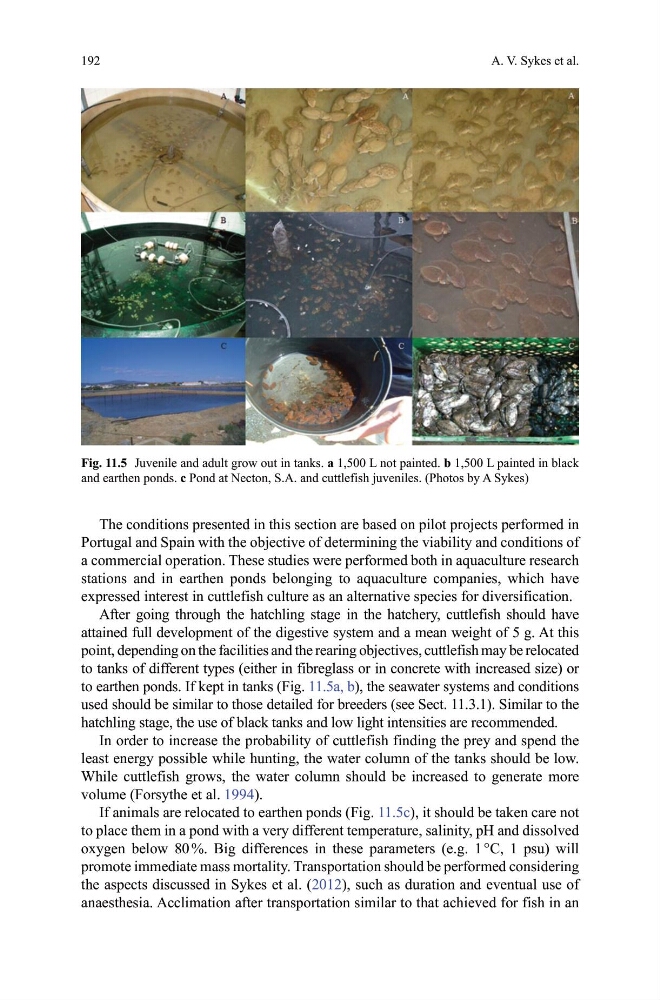
to earthen ponds. If kept in tanks (Fig. 11.5a, b), the seawater systems and conditions
used should be similar to those detailed for breeders (see Sect. 11.3.1). Similar to the
hatchling stage, the use of black tanks and low light intensities are recommended.
In order to increase the probability of cuttlefish finding the prey and spend the
least energy possible while hunting, the water column of the tanks should be low.
While cuttlefish grows, the water column should be increased to generate more
volume (Forsythe et al. 1994).
If animals are relocated to earthen ponds (Fig. 11.5c), it should be taken care not
to place them in a pond with a very different temperature, salinity, pH and dissolved
oxygen below 80 %. Big differences in these parameters (e.g. 1 °C, 1 psu) will
promote immediate mass mortality. Transportation should be performed considering
the aspects discussed in Sykes et al. (2012), such as duration and eventual use of
anaesthesia. Acclimation after transportation similar to that achieved for fish in an
A. V. Sykes et al.
Fig. 11.5 Juvenile and adult grow out in tanks. a 1,500 L not painted. b 1,500 L painted in black
and earthen ponds. c Pond at Necton, S.A. and cuttlefish juveniles. (Photos by A Sykes)
The conditions presented in this section are based on pilot projects performed in
Portugal and Spain with the objective of determining the viability and conditions of
a commercial operation. These studies were performed both in aquaculture research
stations and in earthen ponds belonging to aquaculture companies, which have
expressed interest in cuttlefish culture as an alternative species for diversification.
After going through the hatchling stage in the hatchery, cuttlefish should have
attained full development of the digestive system and a mean weight of 5 g. At this
point, depending on the facilities and the rearing objectives, cuttlefish may be relocated
to tanks of different types (either in fibreglass or in concrete with increased size) or
to earthen ponds. If kept in tanks (Fig. 11.5a, b), the seawater systems and conditions
used should be similar to those detailed for breeders (see Sect. 11.3.1). Similar to the
hatchling stage, the use of black tanks and low light intensities are recommended.
In order to increase the probability of cuttlefish finding the prey and spend the
least energy possible while hunting, the water column of the tanks should be low.
While cuttlefish grows, the water column should be increased to generate more
volume (Forsythe et al. 1994).
If animals are relocated to earthen ponds (Fig. 11.5c), it should be taken care not
to place them in a pond with a very different temperature, salinity, pH and dissolved
oxygen below 80 %. Big differences in these parameters (e.g. 1 °C, 1 psu) will
promote immediate mass mortality. Transportation should be performed considering
the aspects discussed in Sykes et al. (2012), such as duration and eventual use of
anaesthesia. Acclimation after transportation similar to that achieved for fish in an
A. V. Sykes et al.
Fig. 11.5 Juvenile and adult grow out in tanks. a 1,500 L not painted. b 1,500 L painted in black
and earthen ponds. c Pond at Necton, S.A. and cuttlefish juveniles. (Photos by A Sykes)