

186
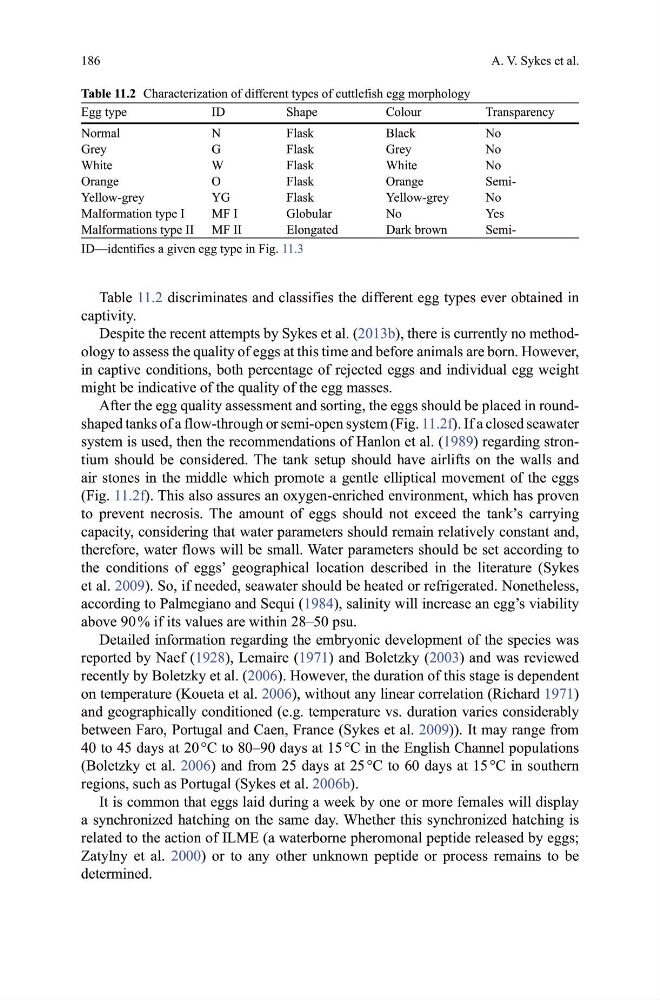
Table 11.2 discriminates and classifies the different egg types ever obtained in
captivity.
Despite the recent attempts by Sykes et al. (2013b), there is currently no methodology to assess the quality of eggs at this time and before animals are born. However,
in captive conditions, both percentage of rejected eggs and individual egg weight
might be indicative of the quality of the egg masses.
After the egg quality assessment and sorting, the eggs should be placed in roundshaped tanks of a flow-through or semi-open system (Fig. 11.2f). If a closed seawater
system is used, then the recommendations of Hanlon et al. (1989) regarding strontium should be considered. The tank setup should have airlifts on the walls and
air stones in the middle which promote a gentle elliptical movement of the eggs
(Fig. 11.2f). This also assures an oxygen-enriched environment, which has proven
to prevent necrosis. The amount of eggs should not exceed the tank’s carrying
capacity, considering that water parameters should remain relatively constant and,
therefore, water flows will be small. Water parameters should be set according to
the conditions of eggs’ geographical location described in the literature (Sykes
et al. 2009). So, if needed, seawater should be heated or refrigerated. Nonetheless,
according to Palmegiano and Sequi (1984), salinity will increase an egg’s viability
above 90 % if its values are within 28–50 psu.
Detailed information regarding the embryonic development of the species was
reported by Naef (1928), Lemaire (1971) and Boletzky (2003) and was reviewed
recently by Boletzky et al. (2006). However, the duration of this stage is dependent
on temperature (Koueta et al. 2006), without any linear correlation (Richard 1971)
and geographically conditioned (e.g. temperature vs. duration varies considerably
between Faro, Portugal and Caen, France (Sykes et al. 2009)). It may range from
40 to 45 days at 20 °C to 80–90 days at 15 °C in the English Channel populations
(Boletzky et al. 2006) and from 25 days at 25 °C to 60 days at 15 °C in southern
regions, such as Portugal (Sykes et al. 2006b).
It is common that eggs laid during a week by one or more females will display
a synchronized hatching on the same day. Whether this synchronized hatching is
related to the action of ILME (a waterborne pheromonal peptide released by eggs;
Zatylny et al. 2000) or to any other unknown peptide or process remains to be
determined.
Table 11.2 Characterization of different types of cuttlefish egg morphology
Egg type
ID
Shape
Colour
Transparency
Normal
N
Flask
Black
No
Grey
G
Flask
Grey
No
White
W
Flask
White
No
Orange
O
Flask
Orange
SemiYellow-grey
YG
Flask
Yellow-grey
No
Malformation type I
MF I
Globular
No
Yes
Malformations type II MF II
Elongated
Dark brown
SemiID—identifies a given egg type in Fig. 11.3
A. V. Sykes et al.
Table 11.2 discriminates and classifies the different egg types ever obtained in
captivity.
Despite the recent attempts by Sykes et al. (2013b), there is currently no methodology to assess the quality of eggs at this time and before animals are born. However,
in captive conditions, both percentage of rejected eggs and individual egg weight
might be indicative of the quality of the egg masses.
After the egg quality assessment and sorting, the eggs should be placed in roundshaped tanks of a flow-through or semi-open system (Fig. 11.2f). If a closed seawater
system is used, then the recommendations of Hanlon et al. (1989) regarding strontium should be considered. The tank setup should have airlifts on the walls and
air stones in the middle which promote a gentle elliptical movement of the eggs
(Fig. 11.2f). This also assures an oxygen-enriched environment, which has proven
to prevent necrosis. The amount of eggs should not exceed the tank’s carrying
capacity, considering that water parameters should remain relatively constant and,
therefore, water flows will be small. Water parameters should be set according to
the conditions of eggs’ geographical location described in the literature (Sykes
et al. 2009). So, if needed, seawater should be heated or refrigerated. Nonetheless,
according to Palmegiano and Sequi (1984), salinity will increase an egg’s viability
above 90 % if its values are within 28–50 psu.
Detailed information regarding the embryonic development of the species was
reported by Naef (1928), Lemaire (1971) and Boletzky (2003) and was reviewed
recently by Boletzky et al. (2006). However, the duration of this stage is dependent
on temperature (Koueta et al. 2006), without any linear correlation (Richard 1971)
and geographically conditioned (e.g. temperature vs. duration varies considerably
between Faro, Portugal and Caen, France (Sykes et al. 2009)). It may range from
40 to 45 days at 20 °C to 80–90 days at 15 °C in the English Channel populations
(Boletzky et al. 2006) and from 25 days at 25 °C to 60 days at 15 °C in southern
regions, such as Portugal (Sykes et al. 2006b).
It is common that eggs laid during a week by one or more females will display
a synchronized hatching on the same day. Whether this synchronized hatching is
related to the action of ILME (a waterborne pheromonal peptide released by eggs;
Zatylny et al. 2000) or to any other unknown peptide or process remains to be
determined.
Table 11.2 Characterization of different types of cuttlefish egg morphology
Egg type
ID
Shape
Colour
Transparency
Normal
N
Flask
Black
No
Grey
G
Flask
Grey
No
White
W
Flask
White
No
Orange
O
Flask
Orange
SemiYellow-grey
YG
Flask
Yellow-grey
No
Malformation type I
MF I
Globular
No
Yes
Malformations type II MF II
Elongated
Dark brown
SemiID—identifies a given egg type in Fig. 11.3
A. V. Sykes et al.