

184
In nature, cuttlefish females lay their eggs on hydrodynamic locations, attached
to wild flora and fauna or to human-related structures (Boletzky 1983). Egg masses
are commonly found on sea grass, seaweeds, polychaetes, buoys, fishnets, traps,
boat ropes, etc. Based on this knowledge, Sequi and Palmegiano (1984) and Blanc
and Daguzan (1998) described man-made egg collectors that use floating ropes to
collect eggs on spawning grounds. However, it is recommended to obtain eggs in
the wild directly from the beaches, when they are stranded by storms or other hydrodynamic conditions. The impact of man on wild populations is therefore reduced,
considering that these correspond to a percentage of eggs that normally would not
hatch because of being exposed to dry conditions.
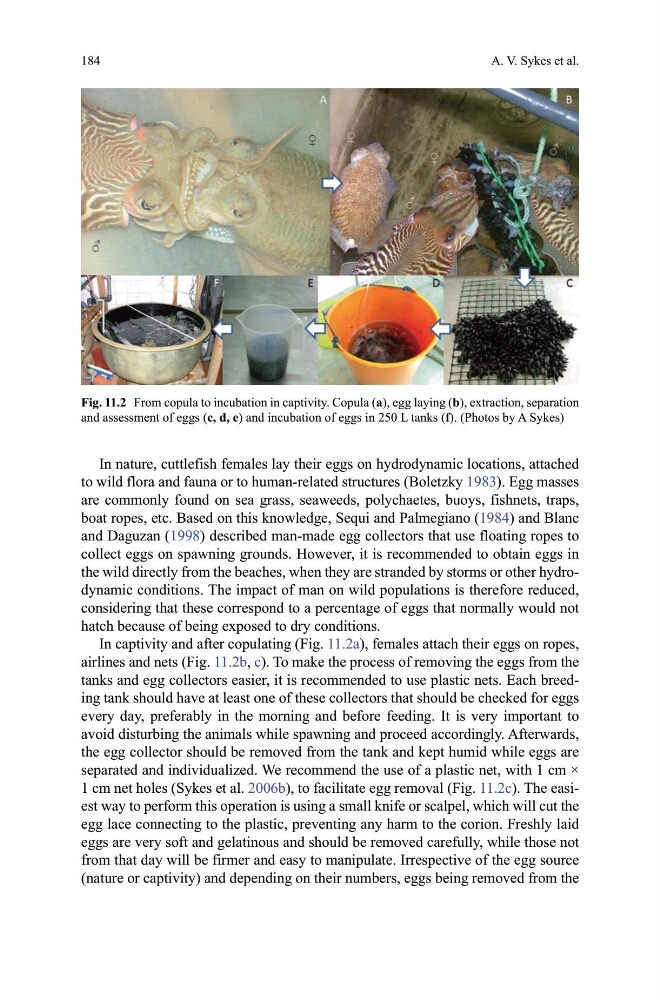
In captivity and after copulating (Fig. 11.2a), females attach their eggs on ropes,
airlines and nets (Fig. 11.2b, c). To make the process of removing the eggs from the
tanks and egg collectors easier, it is recommended to use plastic nets. Each breeding tank should have at least one of these collectors that should be checked for eggs
every day, preferably in the morning and before feeding. It is very important to
avoid disturbing the animals while spawning and proceed accordingly. Afterwards,
the egg collector should be removed from the tank and kept humid while eggs are
separated and individualized. We recommend the use of a plastic net, with 1 cm ×
1 cm net holes (Sykes et al. 2006b), to facilitate egg removal (Fig. 11.2c). The easiest way to perform this operation is using a small knife or scalpel, which will cut the
egg lace connecting to the plastic, preventing any harm to the corion. Freshly laid
eggs are very soft and gelatinous and should be removed carefully, while those not
from that day will be firmer and easy to manipulate. Irrespective of the egg source
(nature or captivity) and depending on their numbers, eggs being removed from the
Fig. 11.2 From copula to incubation in captivity. Copula (a), egg laying (b), extraction, separation
and assessment of eggs (c, d, e) and incubation of eggs in 250 L tanks (f). (Photos by A Sykes)
A. V. Sykes et al.
In nature, cuttlefish females lay their eggs on hydrodynamic locations, attached
to wild flora and fauna or to human-related structures (Boletzky 1983). Egg masses
are commonly found on sea grass, seaweeds, polychaetes, buoys, fishnets, traps,
boat ropes, etc. Based on this knowledge, Sequi and Palmegiano (1984) and Blanc
and Daguzan (1998) described man-made egg collectors that use floating ropes to
collect eggs on spawning grounds. However, it is recommended to obtain eggs in
the wild directly from the beaches, when they are stranded by storms or other hydrodynamic conditions. The impact of man on wild populations is therefore reduced,
considering that these correspond to a percentage of eggs that normally would not
hatch because of being exposed to dry conditions.
In captivity and after copulating (Fig. 11.2a), females attach their eggs on ropes,
airlines and nets (Fig. 11.2b, c). To make the process of removing the eggs from the
tanks and egg collectors easier, it is recommended to use plastic nets. Each breeding tank should have at least one of these collectors that should be checked for eggs
every day, preferably in the morning and before feeding. It is very important to
avoid disturbing the animals while spawning and proceed accordingly. Afterwards,
the egg collector should be removed from the tank and kept humid while eggs are
separated and individualized. We recommend the use of a plastic net, with 1 cm ×
1 cm net holes (Sykes et al. 2006b), to facilitate egg removal (Fig. 11.2c). The easiest way to perform this operation is using a small knife or scalpel, which will cut the
egg lace connecting to the plastic, preventing any harm to the corion. Freshly laid
eggs are very soft and gelatinous and should be removed carefully, while those not
from that day will be firmer and easy to manipulate. Irrespective of the egg source
(nature or captivity) and depending on their numbers, eggs being removed from the
Fig. 11.2 From copula to incubation in captivity. Copula (a), egg laying (b), extraction, separation
and assessment of eggs (c, d, e) and incubation of eggs in 250 L tanks (f). (Photos by A Sykes)
A. V. Sykes et al.