

170
G. J. Barord and J. A. Basil
Common prey items for trapping live nautiluses include chicken and tuna though
several other different kinds of meats have been used. The primary diet of captive
nautiluses includes frozen shrimp with the shell on (Carlson 1987), lobster molts,
and sometimes fish heads. The addition of live prey items to nautilus systems has
shown mixed results. Deep-sea crab species have been consumed by nautiluses in
captivity (Carlson 1987) but hermit crabs have not been preyed upon (Barord 2007).
The feeding protocols also vary from place to place (Carlson 1987). It is unknown
how growth is affected by different feeding protocols. However, a diet with increased calcium resulted in increased growth rates in N� pompilius (Barord 2007)
though whether this is a positive or negative outcome is unknown. Growth data are
available on captive nautiluses and are summarized in Westermann et al. (2004).
10.5 Captive Reproduction
The first nautilus embryos were observed in 1985 at the Waikiki Aquarium (USA);
however, the eggs did not hatch (Arnold and Carlson 1986). The first successful
hatching occurred in 1988 at the Kagoshima Aquarium (Japan) when three N� belauensis hatched after 12 months of incubation at 25 °C (Okubo 1989). In 1990,
ten N� belauensis eggs hatched at the Waikiki Aquarium (Arnold et al. 1990). The
Henry Doorly Zoo (USA) was successful in hatching N� pompilius eggs in a closed
artificial seawater system (Fields 2006). There have been several other instances of
Nautilus sp. hatching in captivity but none of the hatchlings have survived past 1
year. From these varied results, it is difficult to ascertain the most successful method
of inducing captive reproduction, successful copulation, and egg fertilization, and
finally getting the eggs to hatch. One key variable that is difficult to control is the
sex ratio of nautiluses in an aquarium. There is no way of predicting the number
of males and females that would be received in a shipment. The limiting factor in
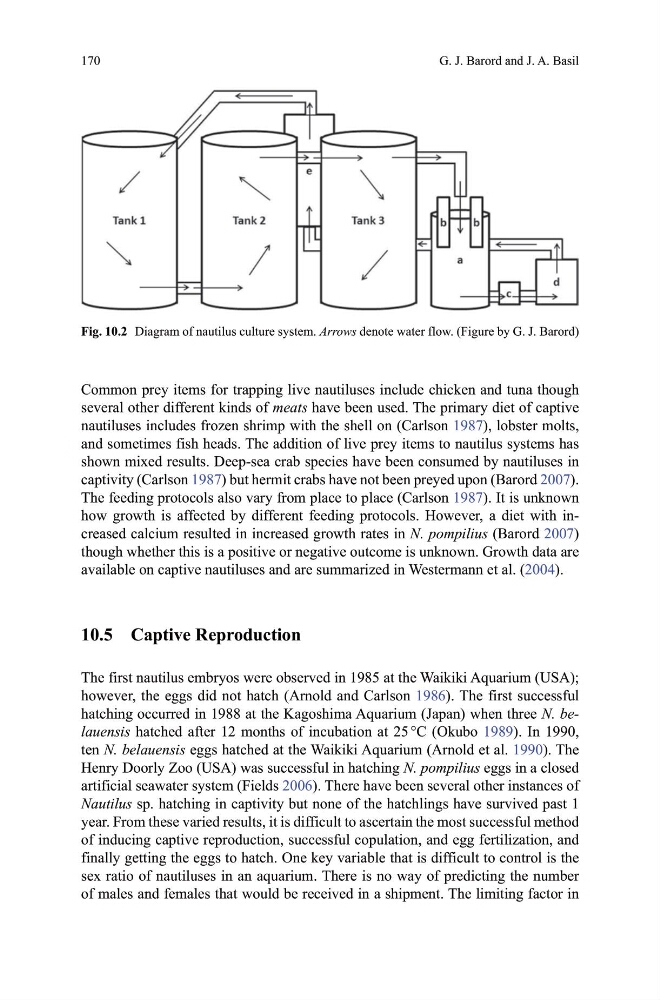
Fig. 10.2 Diagram of nautilus culture system. Arrows denote water flow. (Figure by G. J. Barord)
G. J. Barord and J. A. Basil
Common prey items for trapping live nautiluses include chicken and tuna though
several other different kinds of meats have been used. The primary diet of captive
nautiluses includes frozen shrimp with the shell on (Carlson 1987), lobster molts,
and sometimes fish heads. The addition of live prey items to nautilus systems has
shown mixed results. Deep-sea crab species have been consumed by nautiluses in
captivity (Carlson 1987) but hermit crabs have not been preyed upon (Barord 2007).
The feeding protocols also vary from place to place (Carlson 1987). It is unknown
how growth is affected by different feeding protocols. However, a diet with increased calcium resulted in increased growth rates in N� pompilius (Barord 2007)
though whether this is a positive or negative outcome is unknown. Growth data are
available on captive nautiluses and are summarized in Westermann et al. (2004).
10.5 Captive Reproduction
The first nautilus embryos were observed in 1985 at the Waikiki Aquarium (USA);
however, the eggs did not hatch (Arnold and Carlson 1986). The first successful
hatching occurred in 1988 at the Kagoshima Aquarium (Japan) when three N� belauensis hatched after 12 months of incubation at 25 °C (Okubo 1989). In 1990,
ten N� belauensis eggs hatched at the Waikiki Aquarium (Arnold et al. 1990). The
Henry Doorly Zoo (USA) was successful in hatching N� pompilius eggs in a closed
artificial seawater system (Fields 2006). There have been several other instances of
Nautilus sp. hatching in captivity but none of the hatchlings have survived past 1
year. From these varied results, it is difficult to ascertain the most successful method
of inducing captive reproduction, successful copulation, and egg fertilization, and
finally getting the eggs to hatch. One key variable that is difficult to control is the
sex ratio of nautiluses in an aquarium. There is no way of predicting the number
of males and females that would be received in a shipment. The limiting factor in
Fig. 10.2 Diagram of nautilus culture system. Arrows denote water flow. (Figure by G. J. Barord)