

166
G. J. Barord and J. A. Basil
and specific species will be referred by species name. Six species are commonly
referred to in the literature: Nautilus pompilius, N� stenomphalus, N� belauensis,
N� repertus, N� macromphalus, and Allonautilus scrobiculatus (Saunders 2010).
However, recent phylogenetic analysis suggests there are only two distinct species:
N� macromphalus and A� scrobiculatus (Bonacum et al. 2011). Genetic analysis of
local populations (Sinclair et al. 2007) and DNA bar coding efforts of local and
distant populations (Williams et al. 2012) will provide information critical to future
management of nautiluses. All nautiluses are found only in the Indo-Pacific region
along coral reef slopes, ranging in depths from 0 to 700 m (Ward and Martin 1980;
Dunstan et al. 2011a). Their habitat is regulated by both depth and temperature
(Saunders and Ward 1987). Shells of nautilus will implode at depths greater than
800 m (Ward et al. 1980; Kanie et al. 1980; Hewitt 2010) which limits their lower
depth range. Nautiluses are also sensitive to temperature and do not survive in seawater of 28 °C for longer than 48 h. As such, nautiluses do not inhabit shallow water
where temperatures can approach 28 °C.
The general anatomy of nautiluses has been described in detail (Owen 1843;
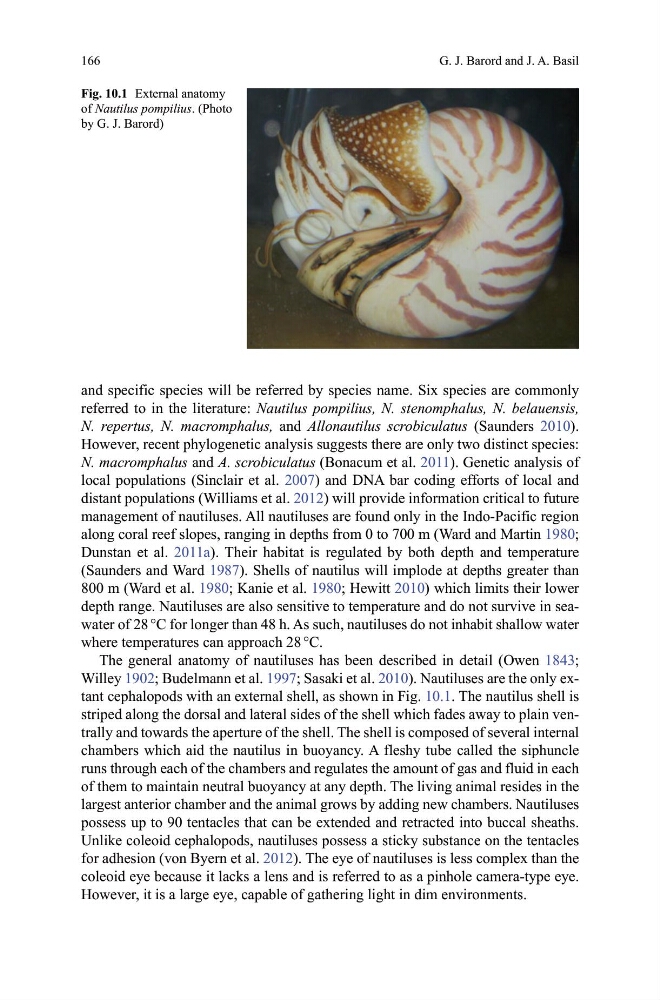
Willey 1902; Budelmann et al. 1997; Sasaki et al. 2010). Nautiluses are the only extant cephalopods with an external shell, as shown in Fig. 10.1. The nautilus shell is
striped along the dorsal and lateral sides of the shell which fades away to plain ventrally and towards the aperture of the shell. The shell is composed of several internal
chambers which aid the nautilus in buoyancy. A fleshy tube called the siphuncle
runs through each of the chambers and regulates the amount of gas and fluid in each
of them to maintain neutral buoyancy at any depth. The living animal resides in the
largest anterior chamber and the animal grows by adding new chambers. Nautiluses
possess up to 90 tentacles that can be extended and retracted into buccal sheaths.
Unlike coleoid cephalopods, nautiluses possess a sticky substance on the tentacles
for adhesion (von Byern et al. 2012). The eye of nautiluses is less complex than the
coleoid eye because it lacks a lens and is referred to as a pinhole camera-type eye.
However, it is a large eye, capable of gathering light in dim environments.
Fig. 10.1 External anatomy
of Nautilus pompilius. (Photo
by G. J. Barord)
G. J. Barord and J. A. Basil
and specific species will be referred by species name. Six species are commonly
referred to in the literature: Nautilus pompilius, N� stenomphalus, N� belauensis,
N� repertus, N� macromphalus, and Allonautilus scrobiculatus (Saunders 2010).
However, recent phylogenetic analysis suggests there are only two distinct species:
N� macromphalus and A� scrobiculatus (Bonacum et al. 2011). Genetic analysis of
local populations (Sinclair et al. 2007) and DNA bar coding efforts of local and
distant populations (Williams et al. 2012) will provide information critical to future
management of nautiluses. All nautiluses are found only in the Indo-Pacific region
along coral reef slopes, ranging in depths from 0 to 700 m (Ward and Martin 1980;
Dunstan et al. 2011a). Their habitat is regulated by both depth and temperature
(Saunders and Ward 1987). Shells of nautilus will implode at depths greater than
800 m (Ward et al. 1980; Kanie et al. 1980; Hewitt 2010) which limits their lower
depth range. Nautiluses are also sensitive to temperature and do not survive in seawater of 28 °C for longer than 48 h. As such, nautiluses do not inhabit shallow water
where temperatures can approach 28 °C.
The general anatomy of nautiluses has been described in detail (Owen 1843;
Willey 1902; Budelmann et al. 1997; Sasaki et al. 2010). Nautiluses are the only extant cephalopods with an external shell, as shown in Fig. 10.1. The nautilus shell is
striped along the dorsal and lateral sides of the shell which fades away to plain ventrally and towards the aperture of the shell. The shell is composed of several internal
chambers which aid the nautilus in buoyancy. A fleshy tube called the siphuncle
runs through each of the chambers and regulates the amount of gas and fluid in each
of them to maintain neutral buoyancy at any depth. The living animal resides in the
largest anterior chamber and the animal grows by adding new chambers. Nautiluses
possess up to 90 tentacles that can be extended and retracted into buccal sheaths.
Unlike coleoid cephalopods, nautiluses possess a sticky substance on the tentacles
for adhesion (von Byern et al. 2012). The eye of nautiluses is less complex than the
coleoid eye because it lacks a lens and is referred to as a pinhole camera-type eye.
However, it is a large eye, capable of gathering light in dim environments.
Fig. 10.1 External anatomy
of Nautilus pompilius. (Photo
by G. J. Barord)