

152
J. G. García et al.
octopus as shelter to prevent contact with other congeners and for protection until
its entrance into the culture system. Individual bags are also placed inside a bigger mesh bag that is left hanging overboard while the fishing efforts finish. The
transfer from the extraction area to the culture system is made with the octopus bag
outside the water, for short routes, or submerged in a tank with an open circulation
of seawater. The legal minimum size of octopus, as well as the extraction seasons,
undergoe a high variability depending on the legal provisions of each removal zone.
The octopus-ongrowing process in Galicia is only allowed if it has the legal size for
extraction and commercial sale; the minimum size until May of 2007 was 0.75 kg,
increasing to 1 kg henceforward, with variable close seasons which in the later
years have passed from 1 to 2 months (usually in May and June). This rise of the
legal minimum size and the close seasons, added to the fishermen’s reluctance to
promote the development of an activity that will possibly cause a fall in octopus
prices by increased supply, are some of the main causes that make the development
of this activity difficult.
9.2.3 Ongrowing Process
As already stated, the ongrowing stock is obtained from the capture of wild subadults. The initial culture density is around 10 kg m
−3
, with the average of the initial
size being about 750–1,000 g per individual. The fattening process takes place over
a period of 3–4 months, reaching final weights of around 2,500–3,000 g, and loads
of roughly 40 kg m
−3
, while exhibiting a variable mortality rate. According to the
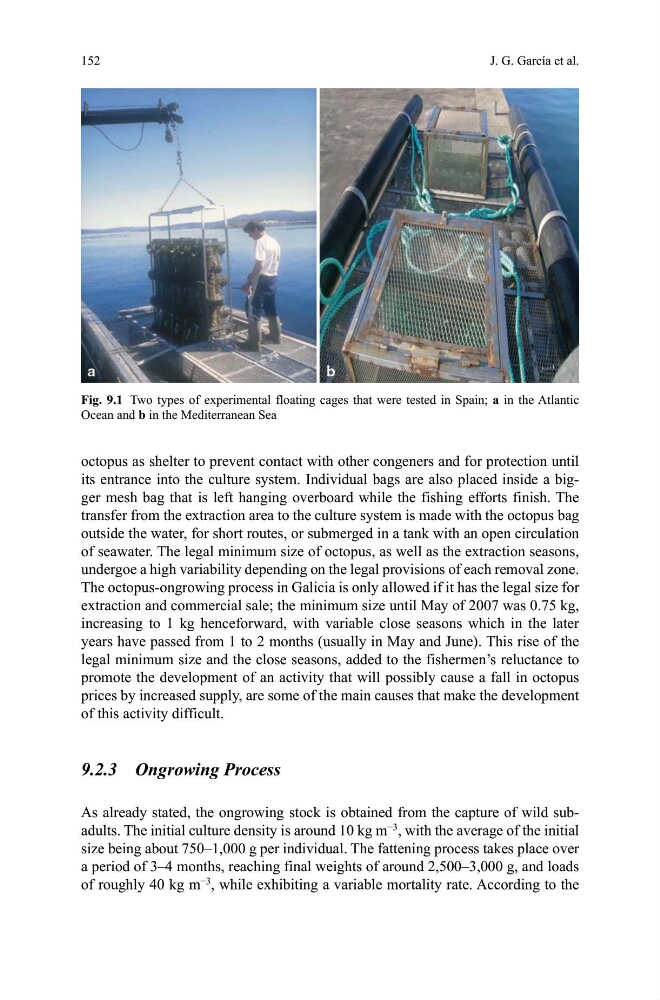
Fig. 9.1 Two types of experimental floating cages that were tested in Spain; a in the Atlantic
Ocean and b in the Mediterranean Sea
J. G. García et al.
octopus as shelter to prevent contact with other congeners and for protection until
its entrance into the culture system. Individual bags are also placed inside a bigger mesh bag that is left hanging overboard while the fishing efforts finish. The
transfer from the extraction area to the culture system is made with the octopus bag
outside the water, for short routes, or submerged in a tank with an open circulation
of seawater. The legal minimum size of octopus, as well as the extraction seasons,
undergoe a high variability depending on the legal provisions of each removal zone.
The octopus-ongrowing process in Galicia is only allowed if it has the legal size for
extraction and commercial sale; the minimum size until May of 2007 was 0.75 kg,
increasing to 1 kg henceforward, with variable close seasons which in the later
years have passed from 1 to 2 months (usually in May and June). This rise of the
legal minimum size and the close seasons, added to the fishermen’s reluctance to
promote the development of an activity that will possibly cause a fall in octopus
prices by increased supply, are some of the main causes that make the development
of this activity difficult.
9.2.3 Ongrowing Process
As already stated, the ongrowing stock is obtained from the capture of wild subadults. The initial culture density is around 10 kg m
−3
, with the average of the initial
size being about 750–1,000 g per individual. The fattening process takes place over
a period of 3–4 months, reaching final weights of around 2,500–3,000 g, and loads
of roughly 40 kg m
−3
, while exhibiting a variable mortality rate. According to the
Fig. 9.1 Two types of experimental floating cages that were tested in Spain; a in the Atlantic
Ocean and b in the Mediterranean Sea