

319
17 Working with Principles and Visions
The profession of facilitation, as it relates to whole systems change, includes a
wide array of processes to encourage group effectiveness and participation (Holman
et al. 2007 ). Open Space Technology, Bohmian dialogue, Appreciative Inquiry,
Dynamic Facilitation, Future Search, Scenario Thinking are among the many processes that could have been considered for this symposium. However, a method
adapted from a strategic planning model was selected because of its emphasis on
developing a vision, values and action steps to reach the vision. A conversational
method known as World Café was also chosen, because the informal process promotes networking among stakeholders that would ultimately be necessary to collectively make EBM a reality.
The visioning process of the Participatory Strategic Planning method developed
by the Institute of Cultural Affairs
1 was used due to its ability to draw out individual
ideas and synthesize these into a cohesive group consensus.
The process of World Café would provide small focused conversations in sequentially different con fi gurations of participants. The intent of this approach was to put
people at ease in a mock ‘café situation’, promote open conversation about issues
important to them, and – as participants change their seats during the ‘rounds’ of conversation – allow new insights to emerge from listening to a variety of perspectives.
The facilitated processes discussed above accentuate the principles of inclusivity
and participation, bringing out the best thinking on the issue of EBM with this particular group of regional stakeholders. The chosen methods had to be tailored to a
large group and composition. The need for concurrent sessions and the use of additional facilitators was therefore included in the fi nal design.
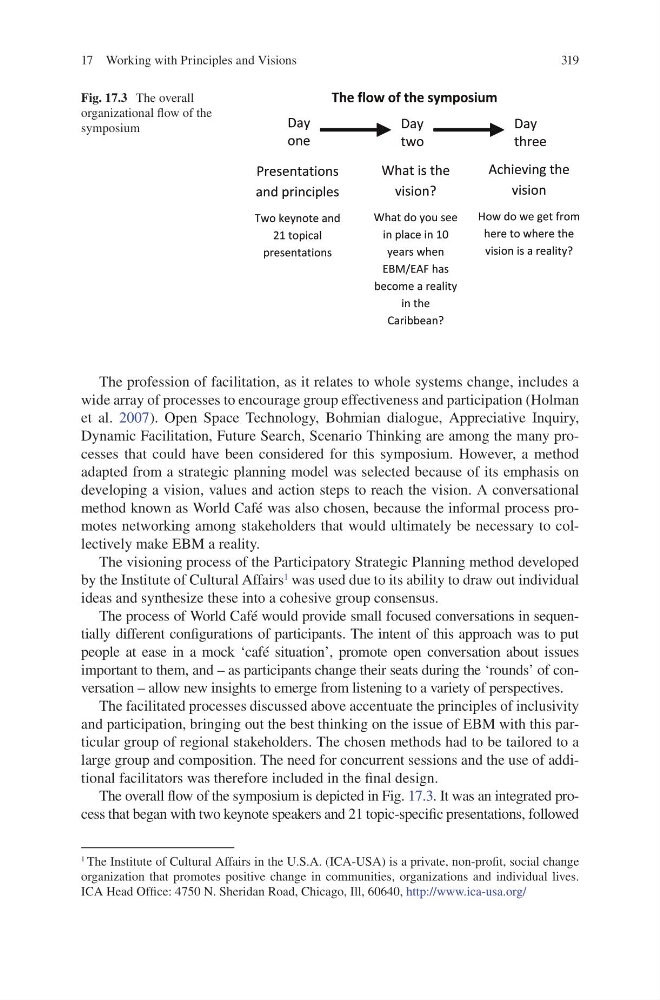
The overall fl ow of the symposium is depicted in Fig. 17.3 . It was an integrated process that began with two keynote speakers and 21 topic-speci fi c presentations, followed
1 The Institute of Cultural Affairs in the U.S.A. (ICA-USA) is a private, non-pro fi t, social change
organization that promotes positive change in communities, organizations and individual lives.
ICA Head Of fi ce: 4750 N. Sheridan Road, Chicago, Ill, 60640, http://www.ica-usa.org/
Fig. 17.3 The overall
organizational fl ow of the
symposium
17 Working with Principles and Visions
The profession of facilitation, as it relates to whole systems change, includes a
wide array of processes to encourage group effectiveness and participation (Holman
et al. 2007 ). Open Space Technology, Bohmian dialogue, Appreciative Inquiry,
Dynamic Facilitation, Future Search, Scenario Thinking are among the many processes that could have been considered for this symposium. However, a method
adapted from a strategic planning model was selected because of its emphasis on
developing a vision, values and action steps to reach the vision. A conversational
method known as World Café was also chosen, because the informal process promotes networking among stakeholders that would ultimately be necessary to collectively make EBM a reality.
The visioning process of the Participatory Strategic Planning method developed
by the Institute of Cultural Affairs
1 was used due to its ability to draw out individual
ideas and synthesize these into a cohesive group consensus.
The process of World Café would provide small focused conversations in sequentially different con fi gurations of participants. The intent of this approach was to put
people at ease in a mock ‘café situation’, promote open conversation about issues
important to them, and – as participants change their seats during the ‘rounds’ of conversation – allow new insights to emerge from listening to a variety of perspectives.
The facilitated processes discussed above accentuate the principles of inclusivity
and participation, bringing out the best thinking on the issue of EBM with this particular group of regional stakeholders. The chosen methods had to be tailored to a
large group and composition. The need for concurrent sessions and the use of additional facilitators was therefore included in the fi nal design.
The overall fl ow of the symposium is depicted in Fig. 17.3 . It was an integrated process that began with two keynote speakers and 21 topic-speci fi c presentations, followed
1 The Institute of Cultural Affairs in the U.S.A. (ICA-USA) is a private, non-pro fi t, social change
organization that promotes positive change in communities, organizations and individual lives.
ICA Head Of fi ce: 4750 N. Sheridan Road, Chicago, Ill, 60640, http://www.ica-usa.org/
Fig. 17.3 The overall
organizational fl ow of the
symposium