

311
16 A Network Perspective on Governing Interactions
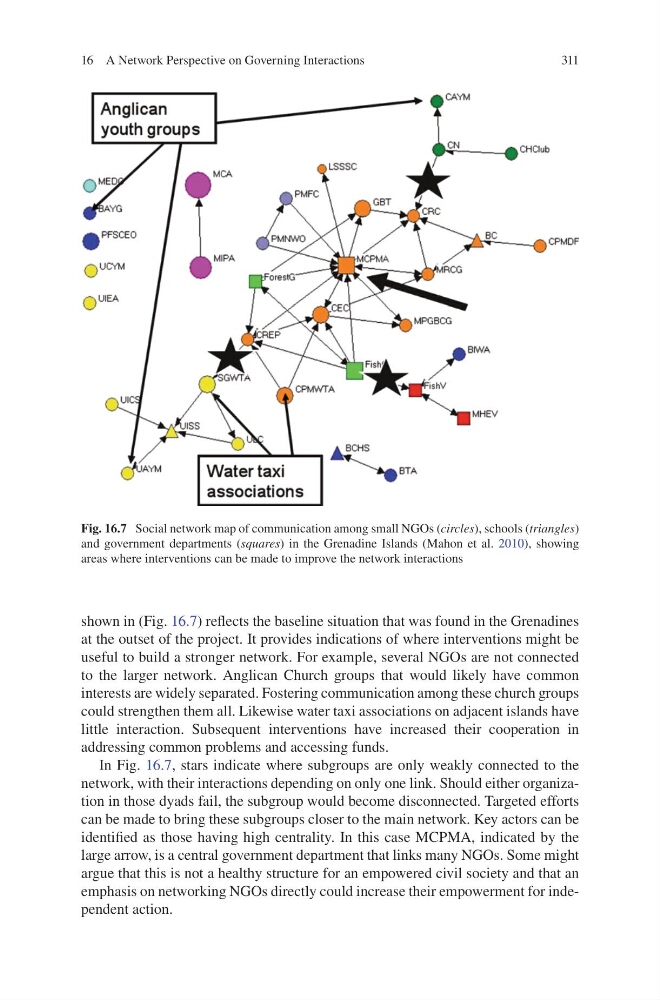
shown in (Fig. 16.7 ) re fl ects the baseline situation that was found in the Grenadines
at the outset of the project. It provides indications of where interventions might be
useful to build a stronger network. For example, several NGOs are not connected
to the larger network. Anglican Church groups that would likely have common
interests are widely separated. Fostering communication among these church groups
could strengthen them all. Likewise water taxi associations on adjacent islands have
little interaction. Subsequent interventions have increased their cooperation in
addressing common problems and accessing funds.
In Fig. 16.7 , stars indicate where subgroups are only weakly connected to the
network, with their interactions depending on only one link. Should either organization in those dyads fail, the subgroup would become disconnected. Targeted efforts
can be made to bring these subgroups closer to the main network. Key actors can be
identi fi ed as those having high centrality. In this case MCPMA, indicated by the
large arrow, is a central government department that links many NGOs. Some might
argue that this is not a healthy structure for an empowered civil society and that an
emphasis on networking NGOs directly could increase their empowerment for independent action.
Fig. 16.7 Social network map of communication among small NGOs ( circles ), schools ( triangles )
and government departments ( squares ) in the Grenadine Islands (Mahon et al. 2010 ) , showing
areas where interventions can be made to improve the network interactions
16 A Network Perspective on Governing Interactions
shown in (Fig. 16.7 ) re fl ects the baseline situation that was found in the Grenadines
at the outset of the project. It provides indications of where interventions might be
useful to build a stronger network. For example, several NGOs are not connected
to the larger network. Anglican Church groups that would likely have common
interests are widely separated. Fostering communication among these church groups
could strengthen them all. Likewise water taxi associations on adjacent islands have
little interaction. Subsequent interventions have increased their cooperation in
addressing common problems and accessing funds.
In Fig. 16.7 , stars indicate where subgroups are only weakly connected to the
network, with their interactions depending on only one link. Should either organization in those dyads fail, the subgroup would become disconnected. Targeted efforts
can be made to bring these subgroups closer to the main network. Key actors can be
identi fi ed as those having high centrality. In this case MCPMA, indicated by the
large arrow, is a central government department that links many NGOs. Some might
argue that this is not a healthy structure for an empowered civil society and that an
emphasis on networking NGOs directly could increase their empowerment for independent action.
Fig. 16.7 Social network map of communication among small NGOs ( circles ), schools ( triangles )
and government departments ( squares ) in the Grenadine Islands (Mahon et al. 2010 ) , showing
areas where interventions can be made to improve the network interactions