

305
16 A Network Perspective on Governing Interactions
a fl ow of fi sh along various pathways that take the resource from the sea to the
consumer. Each category of actor is comprised of several types.
The network diagram in Fig. 16.2b also shows a number of government departments and an NGO that, while part of the network, are not in the marketing/distribution
fi sh chain. The leftmost government department (20) is a fi sheries department working
with fi shers and on resource and habitat problems. The central one (21) is a market
oriented or local trade department working with middlemen and retailers. At the bottom is a foreign trade department (22) working with an exporter. In the upper right hand
corner is a tourism department (23) concerned with retailers, including restaurants and
consumers. The NGO shown (24) interacts with fi shers and the resource. These nodes
that are not directly involved in the distributive fi sh chain may wield considerable
power over how the chain and its institutions function, creating enabling or constraining environments for various actors. For example, government departments exercise
control through legislation, regulations and the allocation of funds. NGOs exercise
control directly through allocation of funds or by in fl uencing public opinion.
It is important to recognize that although Fig. 16.2b shows groups of actors,
these groups are comprised of individuals. Each group will therefore have a subnetwork within the overall network (Fig. 16.3 ). There may be many links among the
individuals within each category, as well as links between individuals in different
categories. In taking a network approach to the fi sh chain, it is necessary to decide
on the level of unpacking required in order to address a particular governability
issue. For example, when fi shers are to be fully engaged in governance processes
through representatives, it is useful to understand the network structure at the individual level to determine whether the representative is legitimate and truly capable
of representing the group.
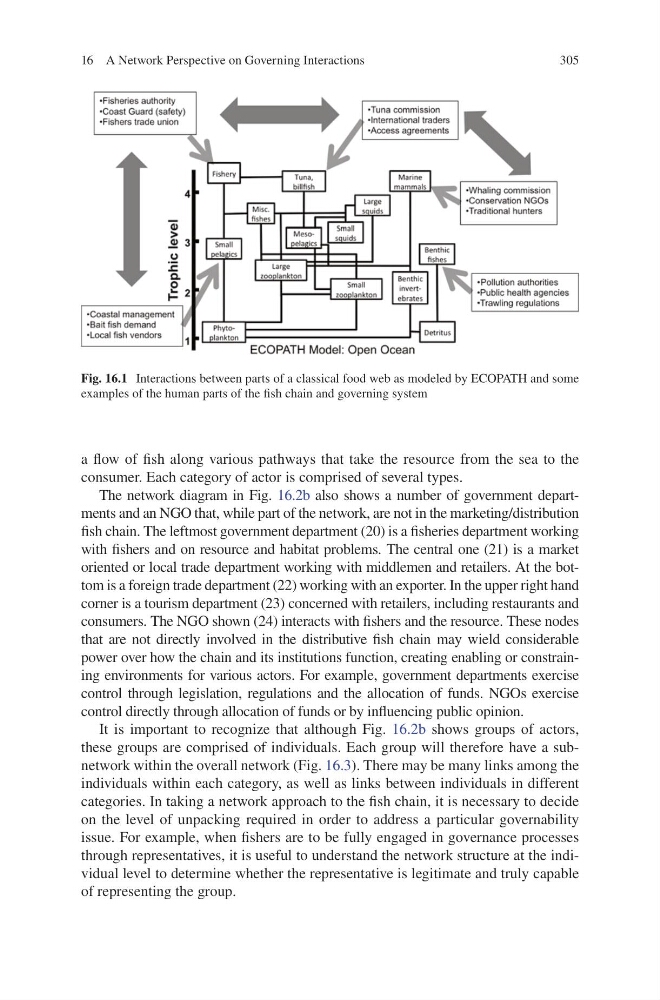
Fig. 16.1 Interactions between parts of a classical food web as modeled by ECOPATH and some
examples of the human parts of the fi sh chain and governing system
16 A Network Perspective on Governing Interactions
a fl ow of fi sh along various pathways that take the resource from the sea to the
consumer. Each category of actor is comprised of several types.
The network diagram in Fig. 16.2b also shows a number of government departments and an NGO that, while part of the network, are not in the marketing/distribution
fi sh chain. The leftmost government department (20) is a fi sheries department working
with fi shers and on resource and habitat problems. The central one (21) is a market
oriented or local trade department working with middlemen and retailers. At the bottom is a foreign trade department (22) working with an exporter. In the upper right hand
corner is a tourism department (23) concerned with retailers, including restaurants and
consumers. The NGO shown (24) interacts with fi shers and the resource. These nodes
that are not directly involved in the distributive fi sh chain may wield considerable
power over how the chain and its institutions function, creating enabling or constraining environments for various actors. For example, government departments exercise
control through legislation, regulations and the allocation of funds. NGOs exercise
control directly through allocation of funds or by in fl uencing public opinion.
It is important to recognize that although Fig. 16.2b shows groups of actors,
these groups are comprised of individuals. Each group will therefore have a subnetwork within the overall network (Fig. 16.3 ). There may be many links among the
individuals within each category, as well as links between individuals in different
categories. In taking a network approach to the fi sh chain, it is necessary to decide
on the level of unpacking required in order to address a particular governability
issue. For example, when fi shers are to be fully engaged in governance processes
through representatives, it is useful to understand the network structure at the individual level to determine whether the representative is legitimate and truly capable
of representing the group.
Fig. 16.1 Interactions between parts of a classical food web as modeled by ECOPATH and some
examples of the human parts of the fi sh chain and governing system