

236
R. De la Cruz Modino and J.J. Pascual-Fernández
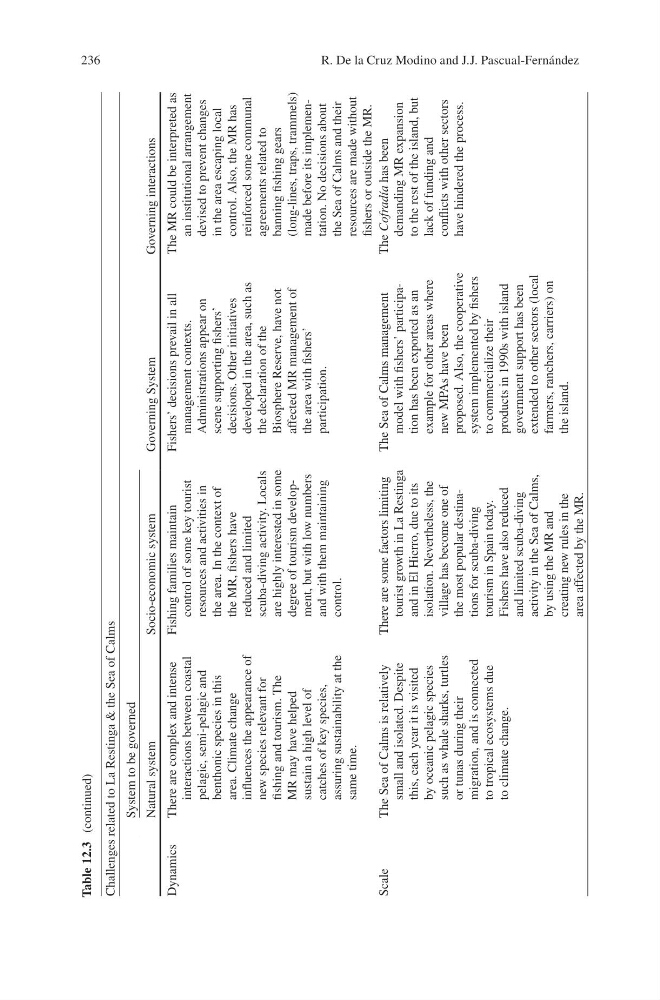
Table 12.3
(continued)
Challenges related to La Restinga & the Sea of Calms
System to be governed
Governing System
Governing interactions
Natural system
Socio-economic system
Dynamics
There are complex and intense
interactions between coastal
pelagic, semi-pelagic and
benthonic species in this
area. Climate change
in fl uences the appearance of
new species relevant for
fi shing and tourism. The
MR may have helped
sustain a high level of
catches of key species,
assuring sustainability at the
same time.
Fishing families maintain
control of some key tourist
resources and activities in
the area. In the context of
the MR, fi shers have
reduced and limited
scuba-diving activity. Locals
are highly interested in some
degree of tourism development, but with low numbers
and with them maintaining
control.
Fishers’ decisions prevail in all
management contexts.
Administrations appear on
scene supporting fi shers’
decisions. Other initiatives
developed in the area, such as
the declaration of the
Biosphere Reserve, have not
affected MR management of
the area with fi shers’
participation.
The MR could be interpreted as
an institutional arrangement
devised to prevent changes
in the area escaping local
control. Also, the MR has
reinforced some communal
agreements related to
banning fi shing gears
(long-lines, traps, trammels)
made before its implementation. No decisions about
the Sea of Calms and their
resources are made without
fi shers or outside the MR.
Scale
The Sea of Calms is relatively
small and isolated. Despite
this, each year it is visited
by oceanic pelagic species
such as whale sharks, turtles
or tunas during their
migration, and is connected
to tropical ecosystems due
to climate change.
There are some factors limiting
tourist growth in La Restinga
and in El Hierro, due to its
isolation. Nevertheless, the
village has become one of
the most popular destinations for scuba-diving
tourism in Spain today.
Fishers have also reduced
and limited scuba-diving
activity in the Sea of Calms,
by using the MR and
creating new rules in the
area affected by the MR.
The Sea of Calms management
model with fi shers’ participation has been exported as an
example for other areas where
new MPAs have been
proposed. Also, the cooperative
system implemented by fi shers
to commercialize their
products in 1990s with island
government support has been
extended to other sectors (local
farmers, ranchers, carriers) on
the island.
The Cofradía
has been
demanding MR expansion
to the rest of the island, but
lack of funding and
con fl icts with other sectors
have hindered the process.
R. De la Cruz Modino and J.J. Pascual-Fernández
Table 12.3
(continued)
Challenges related to La Restinga & the Sea of Calms
System to be governed
Governing System
Governing interactions
Natural system
Socio-economic system
Dynamics
There are complex and intense
interactions between coastal
pelagic, semi-pelagic and
benthonic species in this
area. Climate change
in fl uences the appearance of
new species relevant for
fi shing and tourism. The
MR may have helped
sustain a high level of
catches of key species,
assuring sustainability at the
same time.
Fishing families maintain
control of some key tourist
resources and activities in
the area. In the context of
the MR, fi shers have
reduced and limited
scuba-diving activity. Locals
are highly interested in some
degree of tourism development, but with low numbers
and with them maintaining
control.
Fishers’ decisions prevail in all
management contexts.
Administrations appear on
scene supporting fi shers’
decisions. Other initiatives
developed in the area, such as
the declaration of the
Biosphere Reserve, have not
affected MR management of
the area with fi shers’
participation.
The MR could be interpreted as
an institutional arrangement
devised to prevent changes
in the area escaping local
control. Also, the MR has
reinforced some communal
agreements related to
banning fi shing gears
(long-lines, traps, trammels)
made before its implementation. No decisions about
the Sea of Calms and their
resources are made without
fi shers or outside the MR.
Scale
The Sea of Calms is relatively
small and isolated. Despite
this, each year it is visited
by oceanic pelagic species
such as whale sharks, turtles
or tunas during their
migration, and is connected
to tropical ecosystems due
to climate change.
There are some factors limiting
tourist growth in La Restinga
and in El Hierro, due to its
isolation. Nevertheless, the
village has become one of
the most popular destinations for scuba-diving
tourism in Spain today.
Fishers have also reduced
and limited scuba-diving
activity in the Sea of Calms,
by using the MR and
creating new rules in the
area affected by the MR.
The Sea of Calms management
model with fi shers’ participation has been exported as an
example for other areas where
new MPAs have been
proposed. Also, the cooperative
system implemented by fi shers
to commercialize their
products in 1990s with island
government support has been
extended to other sectors (local
farmers, ranchers, carriers) on
the island.
The Cofradía
has been
demanding MR expansion
to the rest of the island, but
lack of funding and
con fl icts with other sectors
have hindered the process.