

210
Y. Liu et al.
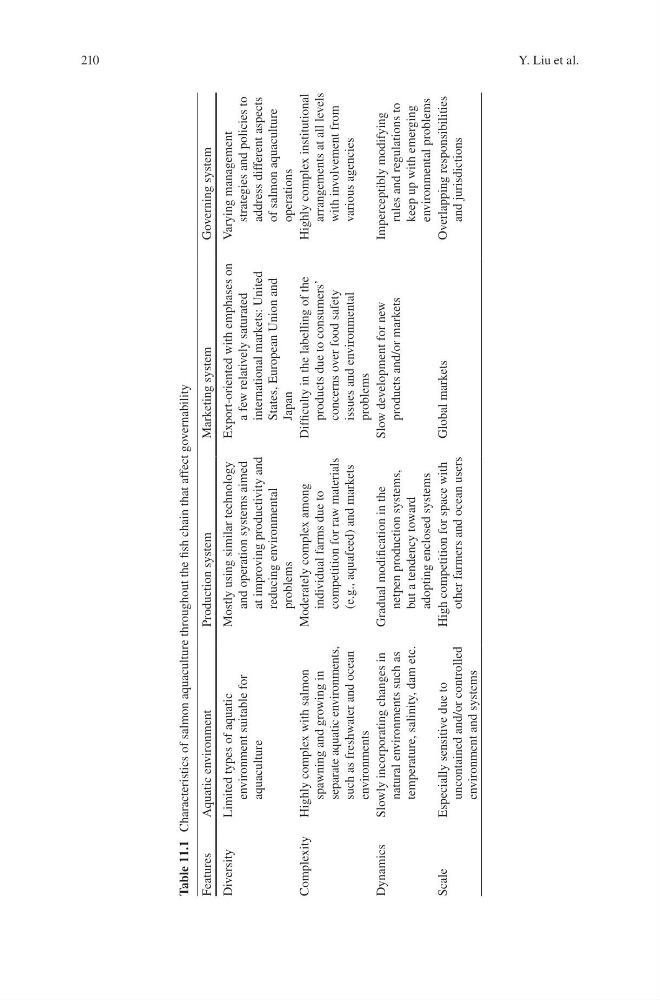
Table 11.1
Characteristics of salmon aquaculture throughout the fi sh chain that affect governability
Features
Aquatic environment
Production system
Marketing system
Governing system
Diversity
Limited types of aquatic
environment suitable for
aquaculture
Mostly using similar technology
and operation systems aimed
at improving productivity and
reducing environmental
problems
Export-oriented with emphases on
a few relatively saturated
international markets: United
States, European Union and
Japan
Varying management
strategies and policies to
address different aspects
of salmon aquaculture
operations
Complexity Highly complex with salmon
spawning and growing in
separate aquatic environments,
such as freshwater and ocean
environments
Moderately complex among
individual farms due to
competition for raw materials
(e.g., aquafeed) and markets
Dif fi culty in the labelling of the
products due to consumers’
concerns over food safety
issues and environmental
problems
Highly complex institutional
arrangements at all levels
with involvement from
various agencies
Dynamics
Slowly incorporating changes in
natural environments such as
temperature, salinity, dam etc.
Gradual modi fi cation in the
netpen production systems,
but a tendency toward
adopting enclosed systems
Slow development for new
products and/or markets
Imperceptibly modifying
rules and regulations to
keep up with emerging
environmental problems
Scale
Especially sensitive due to
uncontained and/or controlled
environment and systems
High competition for space with
other farmers and ocean users
Global markets
Overlapping responsibilities
and jurisdictions
Y. Liu et al.
Table 11.1
Characteristics of salmon aquaculture throughout the fi sh chain that affect governability
Features
Aquatic environment
Production system
Marketing system
Governing system
Diversity
Limited types of aquatic
environment suitable for
aquaculture
Mostly using similar technology
and operation systems aimed
at improving productivity and
reducing environmental
problems
Export-oriented with emphases on
a few relatively saturated
international markets: United
States, European Union and
Japan
Varying management
strategies and policies to
address different aspects
of salmon aquaculture
operations
Complexity Highly complex with salmon
spawning and growing in
separate aquatic environments,
such as freshwater and ocean
environments
Moderately complex among
individual farms due to
competition for raw materials
(e.g., aquafeed) and markets
Dif fi culty in the labelling of the
products due to consumers’
concerns over food safety
issues and environmental
problems
Highly complex institutional
arrangements at all levels
with involvement from
various agencies
Dynamics
Slowly incorporating changes in
natural environments such as
temperature, salinity, dam etc.
Gradual modi fi cation in the
netpen production systems,
but a tendency toward
adopting enclosed systems
Slow development for new
products and/or markets
Imperceptibly modifying
rules and regulations to
keep up with emerging
environmental problems
Scale
Especially sensitive due to
uncontained and/or controlled
environment and systems
High competition for space with
other farmers and ocean users
Global markets
Overlapping responsibilities
and jurisdictions