

170
P. Onyango and S. Jentoft
then help to alleviate poverty in the long run, but, in the short run, may take food out
of the mouth of the poor, so to speak, if they do not have other ways of compensating for reduced fi sh supply or income lost.
Harris ( 2010 ) argues that making decisions (or hard choices) re fl ects the values
and preferences of the decision maker. In this case, each poverty alleviation governor in the Lake Victoria fi sheries system will be guided by the values that he or she
embodies or that have been established by the organizations that they belong to and
represent. In the next instance, these values are converted into which concerns
should have priority over others and into operating goals for the governing system.
For the Ministry of Livestock and Fisheries Development, ECOVIC and LANESO,
the goal of sustainable fi sheries goal takes precedence, while giving opportunity to
fi shers through credit and savings facilities is the primary interest of, for instance,
the FINCA and Mwanza Women Development Association (MWADA).
Decision-making involves a process whereby the decisions made should generate the highest utility, while at the same time fi t with values and aspirations of the
people concerned. This is also to say that value judgments are at play when decisions are being made (Jentoft and Midré 2011 ) . Our empirical information about
the various governance levels discussed under the systems-to-be-governed shows
that governors listed are guided by values that focus on sustainability of the fi sh
resources, wealth generation, empowerment and fairness as they set priorities and
actions to address poverty. This has crucial policy and governance implications.
In the second order governance, where institutions are established to provide
mechanisms for decision-making, the assessment of governability involves examining how power is distributed within and among the poverty alleviation governors
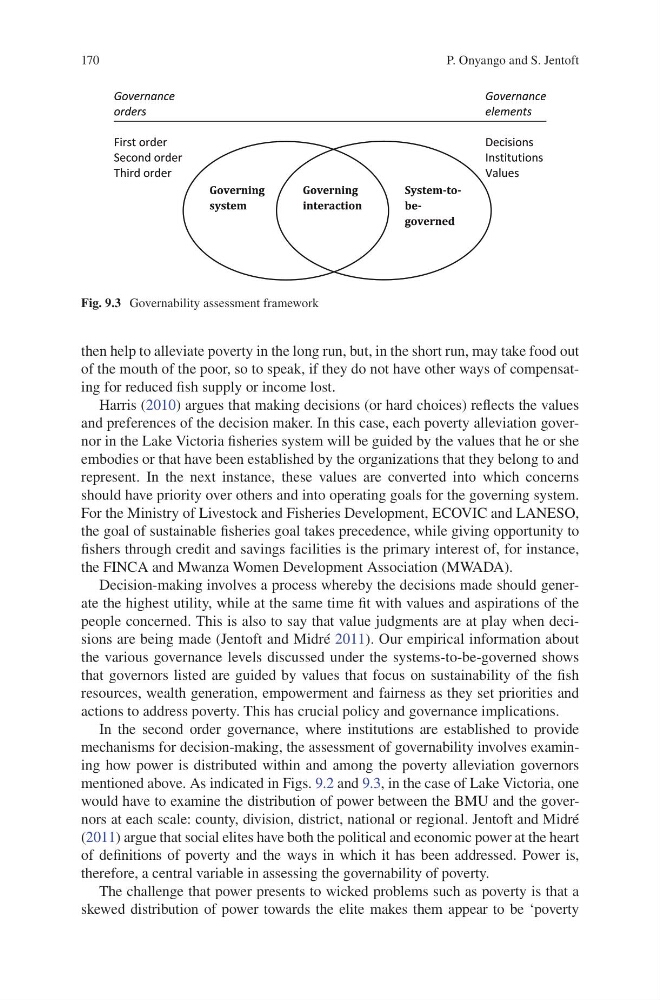
mentioned above. As indicated in Figs. 9.2 and 9.3 , in the case of Lake Victoria, one
would have to examine the distribution of power between the BMU and the governors at each scale: county, division, district, national or regional. Jentoft and Midré
( 2011 ) argue that social elites have both the political and economic power at the heart
of de fi nitions of poverty and the ways in which it has been addressed. Power is,
therefore, a central variable in assessing the governability of poverty.
The challenge that power presents to wicked problems such as poverty is that a
skewed distribution of power towards the elite makes them appear to be ‘poverty
Fig. 9.3 Governability assessment framework
P. Onyango and S. Jentoft
then help to alleviate poverty in the long run, but, in the short run, may take food out
of the mouth of the poor, so to speak, if they do not have other ways of compensating for reduced fi sh supply or income lost.
Harris ( 2010 ) argues that making decisions (or hard choices) re fl ects the values
and preferences of the decision maker. In this case, each poverty alleviation governor in the Lake Victoria fi sheries system will be guided by the values that he or she
embodies or that have been established by the organizations that they belong to and
represent. In the next instance, these values are converted into which concerns
should have priority over others and into operating goals for the governing system.
For the Ministry of Livestock and Fisheries Development, ECOVIC and LANESO,
the goal of sustainable fi sheries goal takes precedence, while giving opportunity to
fi shers through credit and savings facilities is the primary interest of, for instance,
the FINCA and Mwanza Women Development Association (MWADA).
Decision-making involves a process whereby the decisions made should generate the highest utility, while at the same time fi t with values and aspirations of the
people concerned. This is also to say that value judgments are at play when decisions are being made (Jentoft and Midré 2011 ) . Our empirical information about
the various governance levels discussed under the systems-to-be-governed shows
that governors listed are guided by values that focus on sustainability of the fi sh
resources, wealth generation, empowerment and fairness as they set priorities and
actions to address poverty. This has crucial policy and governance implications.
In the second order governance, where institutions are established to provide
mechanisms for decision-making, the assessment of governability involves examining how power is distributed within and among the poverty alleviation governors
mentioned above. As indicated in Figs. 9.2 and 9.3 , in the case of Lake Victoria, one
would have to examine the distribution of power between the BMU and the governors at each scale: county, division, district, national or regional. Jentoft and Midré
( 2011 ) argue that social elites have both the political and economic power at the heart
of de fi nitions of poverty and the ways in which it has been addressed. Power is,
therefore, a central variable in assessing the governability of poverty.
The challenge that power presents to wicked problems such as poverty is that a
skewed distribution of power towards the elite makes them appear to be ‘poverty
Fig. 9.3 Governability assessment framework