

Denitrification
(3.31)
but it should be remembered that the maximum yield constant is changed, in this
case, however, only to 0.44 kg biomass/kg organic matter. If ammonium is present,
the bacteria will always use it as the nitrogen source. This will be the case in (almost)
all types of ordinary wastewater.
88
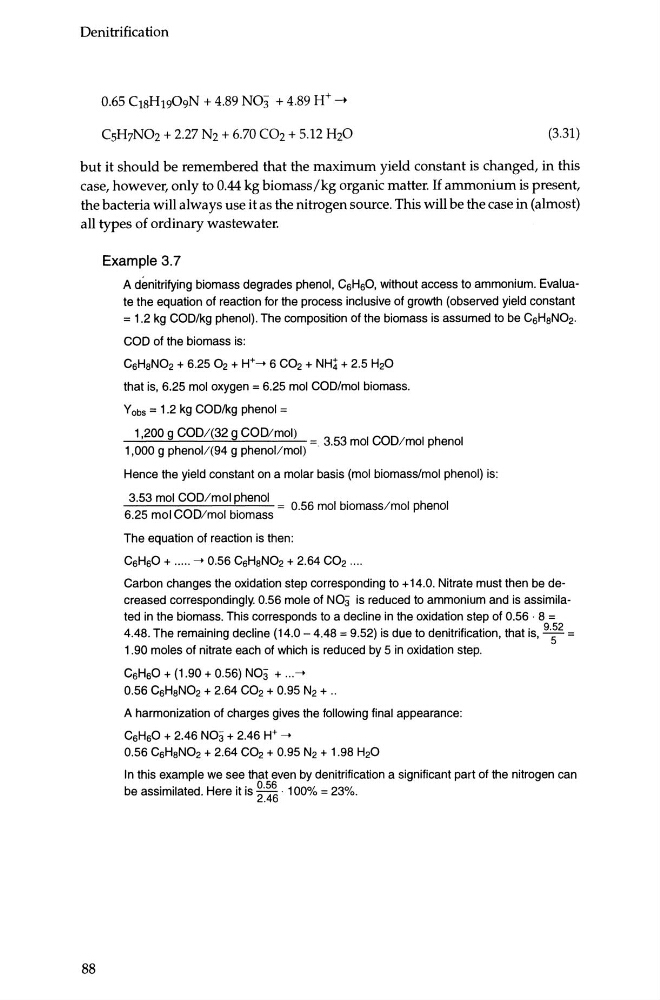
Example 3.7
A demitrifying biomass degrades phenol, C6H60, without access to ammonium. Evaluate the equation of reaction for the process inclusive of growth (observed yield constant
= 1.2 kg COD/kg phenol). The composition of the biomass is assumed to be C6H8N02.
COD of the biomass is:
CsHaN02 + 6.25 02 + W--> 6 C02 + NH! + 2.5 H20
that is, 6.25 mol oxygen = 6.25 mol COD/mol biomass.
Y obs = 1.2 kg COD/kg phenol =
- _1 '-,2_00_g,.__C_O_D/-'('-32---"'-g _C_O_D_Vm_o~l)~ 3 53
I COD
I h
I
= . mo
lmo p eno
1 ,000 g phenol/(94 g phenol/mol)
Hence the yield constant on a molar basis (mol biomass/mol phenol) is:
3.53 mol COD/mol phenol
6.25 mol COD/mol biomass
0.56 mol biomass/mol phenol
The equation of reaction is then:
CsHsO + ..... --> 0.56 CsHaN02 + 2.64 C02 ....
Carbon changes the oxidation step corresponding to + 14.0. Nitrate must then be decreased correspondingly. 0.56 mole of N03 is reduced to ammonium and is assimilated in the biomass. This corresponds to a decline in the oxidation step of 0.56 · 8 =
4.48. The remaining decline (14.0- 4.48 = 9.52) is due to denitrification, that is, 9 ·~ 2 =
1.90 moles of nitrate each of which is reduced by 5 in oxidation step.
CsHsO + (1.90 + 0.56) N03 + ... -->
0.56 CsHaN02 + 2.64 C02 + 0.95 N2 + ..
A harmonization of charges gives the following final appearance:
CsHsO + 2.46 N03 + 2.46 W -->
0.56 C6H8N02 + 2.64 C02 + 0.95 N2 + 1.98 H20
In this example we see that even by denitrification a significant part of the nitrogen can
be assimilated. Here it is ~:~~ · 1 00% = 23%.
(3.31)
but it should be remembered that the maximum yield constant is changed, in this
case, however, only to 0.44 kg biomass/kg organic matter. If ammonium is present,
the bacteria will always use it as the nitrogen source. This will be the case in (almost)
all types of ordinary wastewater.
88
Example 3.7
A demitrifying biomass degrades phenol, C6H60, without access to ammonium. Evaluate the equation of reaction for the process inclusive of growth (observed yield constant
= 1.2 kg COD/kg phenol). The composition of the biomass is assumed to be C6H8N02.
COD of the biomass is:
CsHaN02 + 6.25 02 + W--> 6 C02 + NH! + 2.5 H20
that is, 6.25 mol oxygen = 6.25 mol COD/mol biomass.
Y obs = 1.2 kg COD/kg phenol =
- _1 '-,2_00_g,.__C_O_D/-'('-32---"'-g _C_O_D_Vm_o~l)~ 3 53
I COD
I h
I
= . mo
lmo p eno
1 ,000 g phenol/(94 g phenol/mol)
Hence the yield constant on a molar basis (mol biomass/mol phenol) is:
3.53 mol COD/mol phenol
6.25 mol COD/mol biomass
0.56 mol biomass/mol phenol
The equation of reaction is then:
CsHsO + ..... --> 0.56 CsHaN02 + 2.64 C02 ....
Carbon changes the oxidation step corresponding to + 14.0. Nitrate must then be decreased correspondingly. 0.56 mole of N03 is reduced to ammonium and is assimilated in the biomass. This corresponds to a decline in the oxidation step of 0.56 · 8 =
4.48. The remaining decline (14.0- 4.48 = 9.52) is due to denitrification, that is, 9 ·~ 2 =
1.90 moles of nitrate each of which is reduced by 5 in oxidation step.
CsHsO + (1.90 + 0.56) N03 + ... -->
0.56 CsHaN02 + 2.64 C02 + 0.95 N2 + ..
A harmonization of charges gives the following final appearance:
CsHsO + 2.46 N03 + 2.46 W -->
0.56 C6H8N02 + 2.64 C02 + 0.95 N2 + 1.98 H20
In this example we see that even by denitrification a significant part of the nitrogen can
be assimilated. Here it is ~:~~ · 1 00% = 23%.