

Denitrification
3.5. Denitrification
By denitrification, micro-organisms convert nitrate into atmospheric nitrogen. The
process is anaerobic as nitrate is the oxidizing agent.
Ared + N03 --+ Aox + 0.5 Nz
When nitrate is the oxidizing agent, the process is called anoxic. Denitrification is
widespread in nature; it occurs anywhere where nitrate is present, provided that no
oxygen (or not too much) is present at the same time. Most denitrifying microorganisms are facultative and hence they use oxygen as an oxidizing agent, provided it is present.
Many of the commonest bacteria have the ability to change their metabolism from
using oxygen as the final electron acceptor, to using nitrate instead. The electron
transport system in a denitrifying organism is identical with the electron transport
system under aerobic conditions, with the exception of the last step, the nitrate (or
nitrite) reductase. The "choice" made by the bacteria of the definitive terminal
acceptor depends on the redox potential between the last cytochrome in the electron
transport system and oxygen or nitrate. This choice favours oxygen, so that in a
situation, where both oxygen and nitrate are present, the bacterium will not denitrify but instead respire with oxygen.
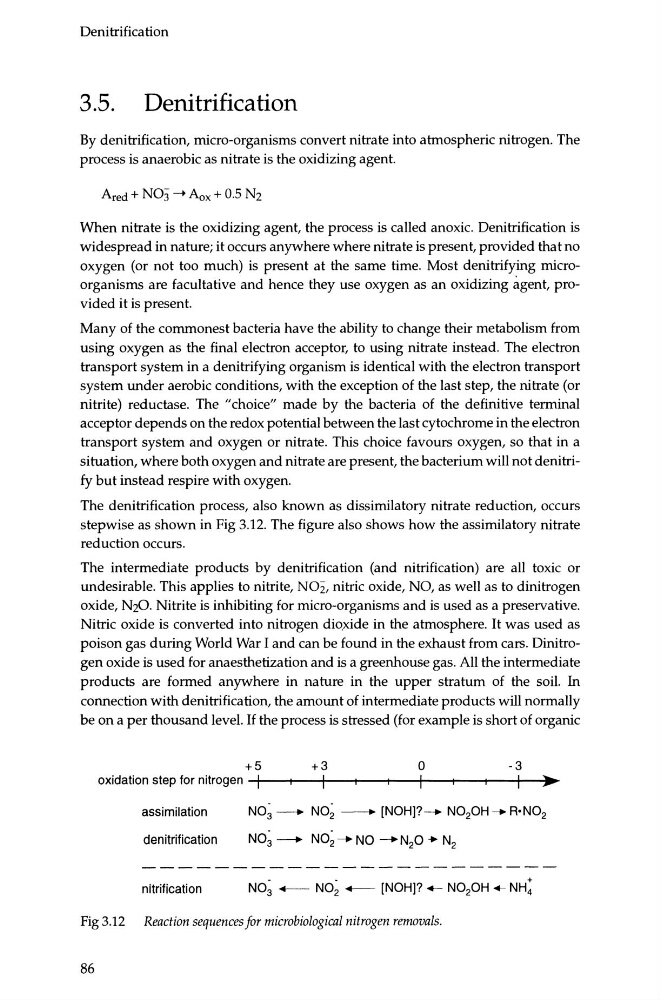
The denitrification process, also known as dissimilatory nitrate reduction, occurs
stepwise as shown in Fig 3.12. The figure also shows how the assimilatory nitrate
reduction occurs.
The intermediate products by denitrification (and nitrification) are all toxic or
undesirable. This applies to nitrite, N02, nitric oxide, NO, as well as to dinitrogen
oxide, NzO. Nitrite is inhibiting for micro-organisms and is used as a preservative.
Nitric oxide is converted into nitrogen dio.xide in the atmosphere. It was used as
poison gas during World War I and can be found in the exhaust from cars. Dinitrogen oxide is used for anaesthetization and is a greenhouse gas. All the intermediate
products are formed anywhere in nature in the upper stratum of the soil. In
connection with denitrification, the amount of intermediate products will normally
be on a per thousand level. If the process is stressed (for example is short of organic
+5
+3
0
-3
oxidation step for nitrogen -+-1 --r---+1--r---t---llr-----t--r--+-1 --~~•~
assimilation
denitrification
nitrification
No; -
NO; - - [NOH]?- N020H- R•N02
No;- No;- NO -N 2 0 + N 2
Fig 3.12 Reaction sequences for microbiological nitrogen removals.
86
3.5. Denitrification
By denitrification, micro-organisms convert nitrate into atmospheric nitrogen. The
process is anaerobic as nitrate is the oxidizing agent.
Ared + N03 --+ Aox + 0.5 Nz
When nitrate is the oxidizing agent, the process is called anoxic. Denitrification is
widespread in nature; it occurs anywhere where nitrate is present, provided that no
oxygen (or not too much) is present at the same time. Most denitrifying microorganisms are facultative and hence they use oxygen as an oxidizing agent, provided it is present.
Many of the commonest bacteria have the ability to change their metabolism from
using oxygen as the final electron acceptor, to using nitrate instead. The electron
transport system in a denitrifying organism is identical with the electron transport
system under aerobic conditions, with the exception of the last step, the nitrate (or
nitrite) reductase. The "choice" made by the bacteria of the definitive terminal
acceptor depends on the redox potential between the last cytochrome in the electron
transport system and oxygen or nitrate. This choice favours oxygen, so that in a
situation, where both oxygen and nitrate are present, the bacterium will not denitrify but instead respire with oxygen.
The denitrification process, also known as dissimilatory nitrate reduction, occurs
stepwise as shown in Fig 3.12. The figure also shows how the assimilatory nitrate
reduction occurs.
The intermediate products by denitrification (and nitrification) are all toxic or
undesirable. This applies to nitrite, N02, nitric oxide, NO, as well as to dinitrogen
oxide, NzO. Nitrite is inhibiting for micro-organisms and is used as a preservative.
Nitric oxide is converted into nitrogen dio.xide in the atmosphere. It was used as
poison gas during World War I and can be found in the exhaust from cars. Dinitrogen oxide is used for anaesthetization and is a greenhouse gas. All the intermediate
products are formed anywhere in nature in the upper stratum of the soil. In
connection with denitrification, the amount of intermediate products will normally
be on a per thousand level. If the process is stressed (for example is short of organic
+5
+3
0
-3
oxidation step for nitrogen -+-1 --r---+1--r---t---llr-----t--r--+-1 --~~•~
assimilation
denitrification
nitrification
No; -
NO; - - [NOH]?- N020H- R•N02
No;- No;- NO -N 2 0 + N 2
Fig 3.12 Reaction sequences for microbiological nitrogen removals.
86