

Nitrification
large amounts when the considered process is non-stationary, for example because
of varying loads, start-up and washout, or other operational problems in the
treatment plant.
Temperature dependency
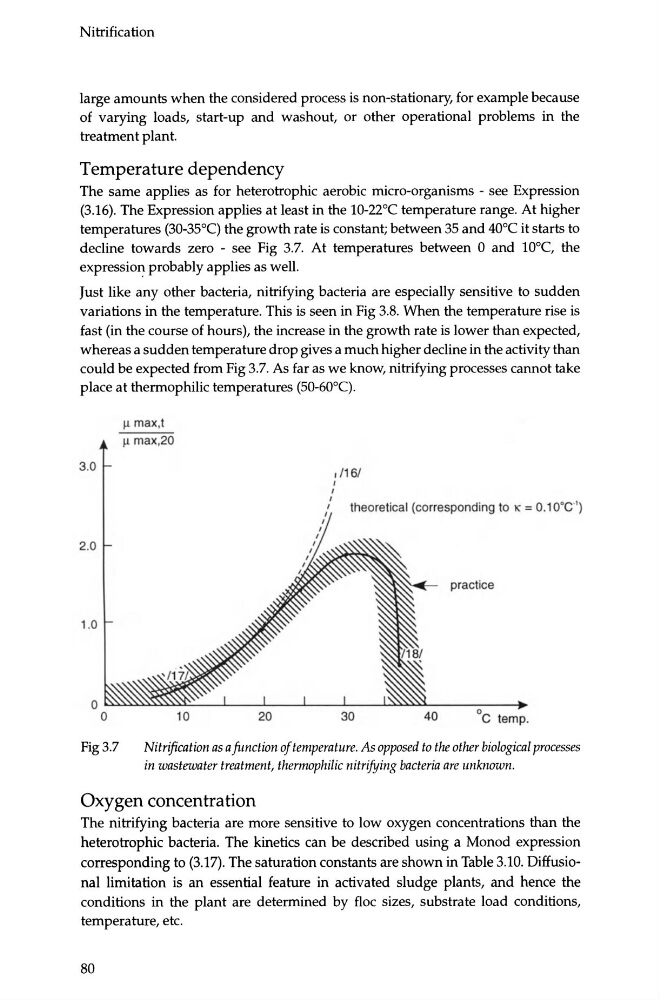
The same applies as for heterotrophic aerobic micro-organisms - see Expression
(3.16). The Expression applies at least in the 10-22°C temperature range. At higher
temperatures (30-35°C) the growth rate is constant; between 35 and 40°C it starts to
decline towards zero - see Fig 3.7. At temperatures between 0 and 10oc, the
expression probably applies as well.
Just like any other bacteria, nitrifying bacteria are especially sensitive to sudden
variations in the temperature. This is seen in Fig 3.8. When the temperature rise is
fast (in the course of hours), the increase in the growth rate is lower than expected,
whereas a sudden temperature drop gives a much higher decline in the activity than
could be expected from Fig 3.7. As far as we know, nitrifying processes cannot take
place at thermophilic temperatures (50-60°C).
3.0
2.0
1.0
Fig 3.7
11 max,!
Jl max,20
10
20
I /16/
theoretical (corresponding to K = 0.1 O"C ' )
30
40
°C temp.
Nitrification as a function of temperature. As opposed to the other biological processes
in wastewater treatment, thermophilic nitrifying bacteria are unknown.
Oxygen concentration
The nitrifying bacteria are more sensitive to low oxygen concentrations than the
heterotrophic bacteria. The kinetics can be described using a Monod expression
corresponding to (3.17). The saturation constants are shown in Table 3.10. Diffusional limitation is an essential feature in activated sludge plants, and hence the
conditions in the plant are determined by floc sizes, substrate load conditions,
temperature, etc.
80
large amounts when the considered process is non-stationary, for example because
of varying loads, start-up and washout, or other operational problems in the
treatment plant.
Temperature dependency
The same applies as for heterotrophic aerobic micro-organisms - see Expression
(3.16). The Expression applies at least in the 10-22°C temperature range. At higher
temperatures (30-35°C) the growth rate is constant; between 35 and 40°C it starts to
decline towards zero - see Fig 3.7. At temperatures between 0 and 10oc, the
expression probably applies as well.
Just like any other bacteria, nitrifying bacteria are especially sensitive to sudden
variations in the temperature. This is seen in Fig 3.8. When the temperature rise is
fast (in the course of hours), the increase in the growth rate is lower than expected,
whereas a sudden temperature drop gives a much higher decline in the activity than
could be expected from Fig 3.7. As far as we know, nitrifying processes cannot take
place at thermophilic temperatures (50-60°C).
3.0
2.0
1.0
Fig 3.7
11 max,!
Jl max,20
10
20
I /16/
theoretical (corresponding to K = 0.1 O"C ' )
30
40
°C temp.
Nitrification as a function of temperature. As opposed to the other biological processes
in wastewater treatment, thermophilic nitrifying bacteria are unknown.
Oxygen concentration
The nitrifying bacteria are more sensitive to low oxygen concentrations than the
heterotrophic bacteria. The kinetics can be described using a Monod expression
corresponding to (3.17). The saturation constants are shown in Table 3.10. Diffusional limitation is an essential feature in activated sludge plants, and hence the
conditions in the plant are determined by floc sizes, substrate load conditions,
temperature, etc.
80