

Aerobic heterotrophic conversion of organic matter
CtsHt909N + 17.5 02 + H+ _.18 C02 + 8 H20 + NH!
(without nitrification)
CtslftgOgN + 19.5 02--.18 C02 + 9 H20 + H+ + N03
(with nitrification)
(3.6)
(3.7)
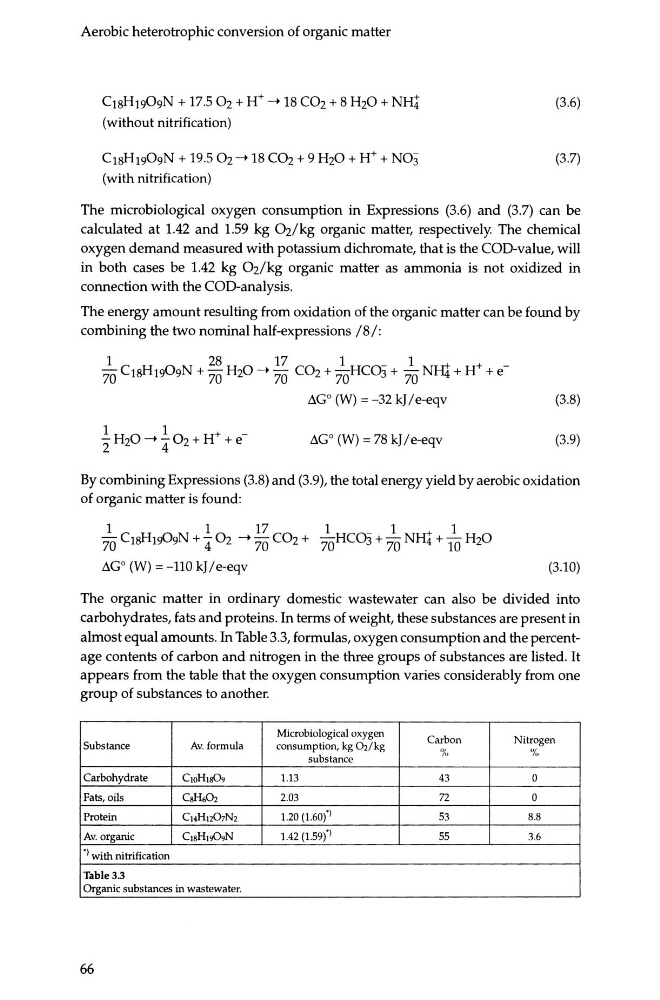
The microbiological oxygen consumption in Expressions (3.6) and (3.7) can be
calculated at 1.42 and 1.59 kg 02/kg organic matter, respectively. The chemical
oxygen demand measured with potassium dichromate, that is the COD-value, will
in both cases be 1.42 kg 02/kg organic matter as ammonia is not oxidized in
connection with the COD-analysis.
The energy amount resulting from oxidation of the organic matter can be found by
combining the two nominal half-expressions /8/:
1
28
17
1
-
1 "rrrl
+ -
70 CtslftgOgN + 70 H20 __. 70 C02 + 70 HCOJ + 70 l"r:J.4 + H + e
8G 0 (W) = -32 kJ I e-eqv
(3.8)
8G 0 (W) = 78 kJ I e-eqv
(3.9)
By combining Expressions (3.8) and (3.9), the total energy yield by aerobic oxidation
of organic matter is found:
1
1
17
70 CtsHtg09N + 4 02 __. 70 C02 +
8G 0 (W) = -110 kJie-eqv
(3.10)
The organic matter in ordinary domestic wastewater can also be divided into
carbohydrates, fats and proteins. In terms of weight, these substances are present in
almost equal amounts. In Table 3.3, formulas, oxygen consumption and the percentage contents of carbon and nitrogen in the three groups of substances are listed. It
appears from the table that the oxygen consumption varies considerably from one
group of substances to another.
Microbiological oxygen
Carbon
Nitrogen
Substance
Av.formula
consumption, kg Oz/kg
1 Yo
%
substance
Carbohydrate
CtoHts09
1.13
43
0
Fats, oils
CsH60z
2.03
72
0
Protein
Ct4Htz07Nz
1.20 (1.60) ')
53
8.8
Av. organic
CtsHt!!09N
1.42 (1.59) ')
55
3.6
')with nitrification
Table3.3
Organic substances in wastewater.
66
CtsHt909N + 17.5 02 + H+ _.18 C02 + 8 H20 + NH!
(without nitrification)
CtslftgOgN + 19.5 02--.18 C02 + 9 H20 + H+ + N03
(with nitrification)
(3.6)
(3.7)
The microbiological oxygen consumption in Expressions (3.6) and (3.7) can be
calculated at 1.42 and 1.59 kg 02/kg organic matter, respectively. The chemical
oxygen demand measured with potassium dichromate, that is the COD-value, will
in both cases be 1.42 kg 02/kg organic matter as ammonia is not oxidized in
connection with the COD-analysis.
The energy amount resulting from oxidation of the organic matter can be found by
combining the two nominal half-expressions /8/:
1
28
17
1
-
1 "rrrl
+ -
70 CtslftgOgN + 70 H20 __. 70 C02 + 70 HCOJ + 70 l"r:J.4 + H + e
8G 0 (W) = -32 kJ I e-eqv
(3.8)
8G 0 (W) = 78 kJ I e-eqv
(3.9)
By combining Expressions (3.8) and (3.9), the total energy yield by aerobic oxidation
of organic matter is found:
1
1
17
70 CtsHtg09N + 4 02 __. 70 C02 +
8G 0 (W) = -110 kJie-eqv
(3.10)
The organic matter in ordinary domestic wastewater can also be divided into
carbohydrates, fats and proteins. In terms of weight, these substances are present in
almost equal amounts. In Table 3.3, formulas, oxygen consumption and the percentage contents of carbon and nitrogen in the three groups of substances are listed. It
appears from the table that the oxygen consumption varies considerably from one
group of substances to another.
Microbiological oxygen
Carbon
Nitrogen
Substance
Av.formula
consumption, kg Oz/kg
1 Yo
%
substance
Carbohydrate
CtoHts09
1.13
43
0
Fats, oils
CsH60z
2.03
72
0
Protein
Ct4Htz07Nz
1.20 (1.60) ')
53
8.8
Av. organic
CtsHt!!09N
1.42 (1.59) ')
55
3.6
')with nitrification
Table3.3
Organic substances in wastewater.
66