

Conversions in biological treahnent plants
Not much is known about the hydrolysis processes /9 I, but they are often described as a simple first order process in respect of hydrolyzable materials, for example
suspended solids, Xs:
rv,xs = kh · Xs
(3.3a)
A similar expression for the hydrolysis of dissolved organic matter is:
(3.3b)
It should be noted that the hydrolysis constants, k11, are not identical in Expressions
(3.3a} and {3.3b).
Several models use more complicated expressions of the saturation type where a
given biomass, Xs, has a maximum hydrolysis capacity:
Xs/Xs
rv,xs = kttx . Kx + (Xs/Xs) . Xs
(3.4)
where khX is the hydrolysis constant (dimension Mxs · Mxs- 1 · T-\
Kx
is the hydrolysis saturation constant (dimension Mxs · Mx8 1 ).
In respect of the ratio between hydrolyzable matter, Xs, and biomass, Xs, corresponding to Kx, the hydrolysis rate is half of the maximum rate.
As regards the release of dissolved substrate:
rv,s = rv,xs · vx,s
where vx,s is the stoichiometric coefficient which converts suspended solids (X) into
dissolved solids (S). If both substances are calculated in the same unit, v = 1, for
example 1 kg COD(S)/kg COD(B).
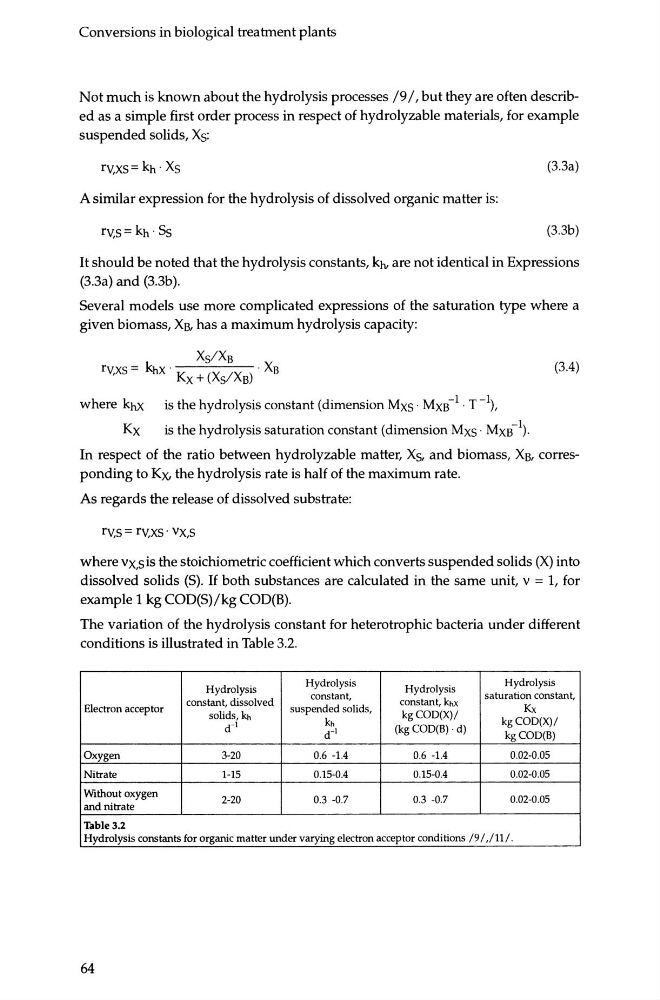
The variation of the hydrolysis constant for heterotrophic bacteria under different
conditions is illustrated in Table 3.2.
Hydrolysis
Hydrolysis
Hydrolysis
Hydrolysis
constant, dissolved
constant,
constant, khX
saturation constant,
Electron acceptor
solids, kt,
suspended solids,
kgCOD(X)/
Kx
d-1
kh
(kg COD(B) ·d)
kgCOD(X)/
d-1
kgCOD(B)
Oxygen
3-20
0.6 -1.4
0.6 -1.4
0.02-0.05
Nitrate
1-15
0.15-0.4
0.15-0.4
0.02-0.05
Without oxygen
2-20
0.3 -0.7
0.3 -0.7
0.02-0.05
and nitrate
Thble 3.2
Hydrolysis constants for organic matter under varying electron acceptor conditions /9 I ,/11/.
64
Not much is known about the hydrolysis processes /9 I, but they are often described as a simple first order process in respect of hydrolyzable materials, for example
suspended solids, Xs:
rv,xs = kh · Xs
(3.3a)
A similar expression for the hydrolysis of dissolved organic matter is:
(3.3b)
It should be noted that the hydrolysis constants, k11, are not identical in Expressions
(3.3a} and {3.3b).
Several models use more complicated expressions of the saturation type where a
given biomass, Xs, has a maximum hydrolysis capacity:
Xs/Xs
rv,xs = kttx . Kx + (Xs/Xs) . Xs
(3.4)
where khX is the hydrolysis constant (dimension Mxs · Mxs- 1 · T-\
Kx
is the hydrolysis saturation constant (dimension Mxs · Mx8 1 ).
In respect of the ratio between hydrolyzable matter, Xs, and biomass, Xs, corresponding to Kx, the hydrolysis rate is half of the maximum rate.
As regards the release of dissolved substrate:
rv,s = rv,xs · vx,s
where vx,s is the stoichiometric coefficient which converts suspended solids (X) into
dissolved solids (S). If both substances are calculated in the same unit, v = 1, for
example 1 kg COD(S)/kg COD(B).
The variation of the hydrolysis constant for heterotrophic bacteria under different
conditions is illustrated in Table 3.2.
Hydrolysis
Hydrolysis
Hydrolysis
Hydrolysis
constant, dissolved
constant,
constant, khX
saturation constant,
Electron acceptor
solids, kt,
suspended solids,
kgCOD(X)/
Kx
d-1
kh
(kg COD(B) ·d)
kgCOD(X)/
d-1
kgCOD(B)
Oxygen
3-20
0.6 -1.4
0.6 -1.4
0.02-0.05
Nitrate
1-15
0.15-0.4
0.15-0.4
0.02-0.05
Without oxygen
2-20
0.3 -0.7
0.3 -0.7
0.02-0.05
and nitrate
Thble 3.2
Hydrolysis constants for organic matter under varying electron acceptor conditions /9 I ,/11/.
64