

Characterization of Wastewaters and Sludges
2.7. Respiration rate of sludge
The oxygen uptake rate for sludge, OUR (or nitrate utilization rate, NUR) may give
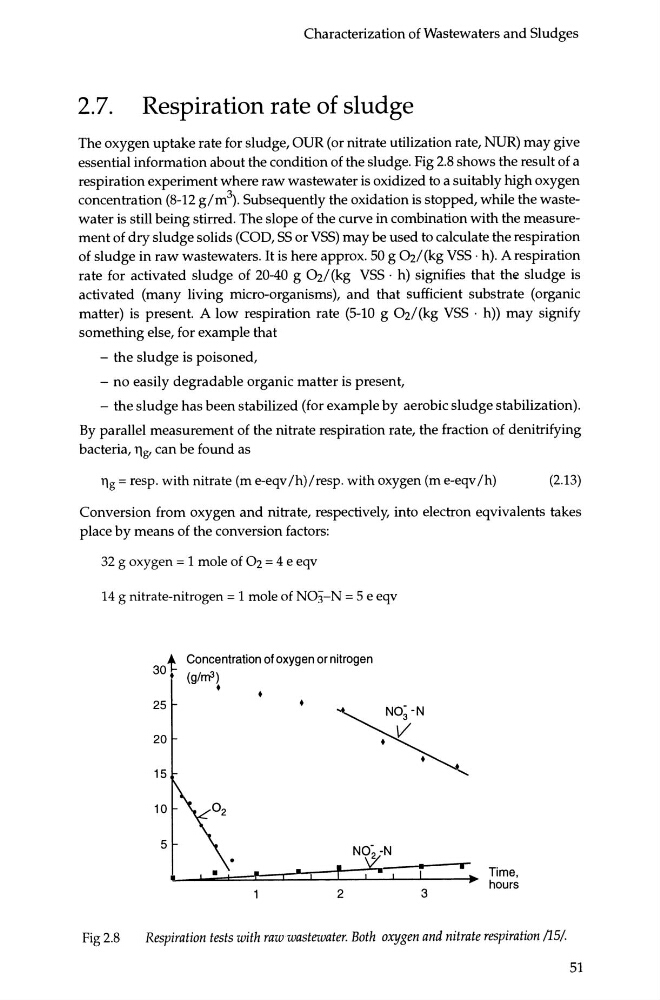
essential information about the condition of the sludge. Fig 2.8 shows the result of a
respiration experiment where raw wastewater is oxidized to a suitably high oxygen
concentration (8-12 g/m 3 ). Subsequently the oxidation is stopped, while the wastewater is still being stirred. The slope of the curve in combination with the measurement of dry sludge solids (COD, SS or VSS) may be used to calculate the respiration
of sludge in raw wastewaters. It is here approx. 50 g 02/ (kg VSS · h). A respiration
rate for activated sludge of 20-40 g 02/ (kg VSS · h) signifies that the sludge is
activated (many living micro-organisms), and that sufficient substrate (organic
matter) is present. A low respiration rate (5-10 g 02/(kg VSS · h)) may signify
something else, for example that
- the sludge is poisoned,
- no easily degradable organic matter is present,
- the sludge has been stabilized (for example by aerobic sludge stabilization).
By parallel measurement of the nitrate respiration rate, the fraction of denitrifying
bacteria, 11& can be found as
llg = resp. with nitrate (m e-eqv /h)/resp. with oxygen (m e-eqv /h)
(2.13)
Conversion from oxygen and nitrate, respectively, into electron eqvivalents takes
place by means of the conversion factors:
32 g oxygen = 1 mole of 02 = 4 e eqv
14 g nitrate-nitrogen= 1 mole of N03-N = 5 e eqv
t_ Concentration of oxygen or nitrogen
30
(g/m3)
•
25
20
15
10
5
No; -N
3--;-r .p
. r
Time,
,.. hours
2
3
Fig2.8
Respiration tests with raw wastewater. Both oxygen and nitrate respiration !15/.
51
2.7. Respiration rate of sludge
The oxygen uptake rate for sludge, OUR (or nitrate utilization rate, NUR) may give
essential information about the condition of the sludge. Fig 2.8 shows the result of a
respiration experiment where raw wastewater is oxidized to a suitably high oxygen
concentration (8-12 g/m 3 ). Subsequently the oxidation is stopped, while the wastewater is still being stirred. The slope of the curve in combination with the measurement of dry sludge solids (COD, SS or VSS) may be used to calculate the respiration
of sludge in raw wastewaters. It is here approx. 50 g 02/ (kg VSS · h). A respiration
rate for activated sludge of 20-40 g 02/ (kg VSS · h) signifies that the sludge is
activated (many living micro-organisms), and that sufficient substrate (organic
matter) is present. A low respiration rate (5-10 g 02/(kg VSS · h)) may signify
something else, for example that
- the sludge is poisoned,
- no easily degradable organic matter is present,
- the sludge has been stabilized (for example by aerobic sludge stabilization).
By parallel measurement of the nitrate respiration rate, the fraction of denitrifying
bacteria, 11& can be found as
llg = resp. with nitrate (m e-eqv /h)/resp. with oxygen (m e-eqv /h)
(2.13)
Conversion from oxygen and nitrate, respectively, into electron eqvivalents takes
place by means of the conversion factors:
32 g oxygen = 1 mole of 02 = 4 e eqv
14 g nitrate-nitrogen= 1 mole of N03-N = 5 e eqv
t_ Concentration of oxygen or nitrogen
30
(g/m3)
•
25
20
15
10
5
No; -N
3--;-r .p
. r
Time,
,.. hours
2
3
Fig2.8
Respiration tests with raw wastewater. Both oxygen and nitrate respiration !15/.
51