

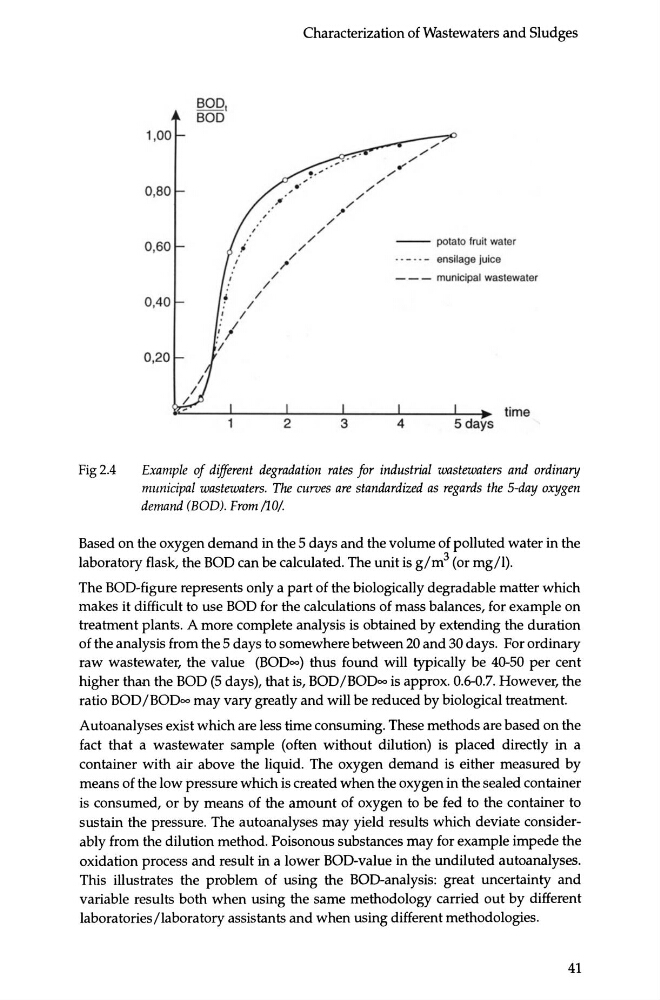
Fig 2.4
0,20
BOD 1
BOD
/
' I
: /
:'
'!
/
.1'
/
/
/
Characterization of Wastewaters and Sludges
/
/
/
/
/
.1'
/
/
/
w'
/
/
/
/
- - potato fruit water
• ·- · ·- ensilage juice
- - - municipal wastewater
time
Example of different degradation rates for industrial wastewaters and ordinary
municipal wastewaters. The curves are standardized as regards the 5-day oxygen
demand (BOD). From/10/.
Based on the oxygen demand in the 5 days and the volume of polluted water in the
laboratory flask, the BOD can be calculated. The unit is g/m 3 (or mg/1).
The BOD-figure represents only a part of the biologically degradable matter which
makes it difficult to use BOD for the calculations of mass balances, for example on
treatment plants. A more complete analysis is obtained by extending the duration
of the analysis from the 5 days to somewhere between 20 and 30 days. For ordinary
raw wastewater, the value (BODoo) thus found will typically be 40-50 per cent
higher than the BOD (5 days), that is, BOD/BODoo is approx. 0.6-0.7. However, the
ratio BOD /BODoo may vary greatly and will be reduced by biological treatment.
Autoanalyses exist which are less time consuming. These methods are based on the
fact that a wastewater sample (often without dilution) is placed directly in a
container with air above the liquid. The oxygen demand is either measured by
means of the low pressure which is created when the oxygen in the sealed container
is consumed, or by means of the amount of oxygen to be fed to the container to
sustain the pressure. The autoanalyses may yield results which deviate considerably from the dilution method. Poisonous substances may for example impede the
oxidation process and result in a lower BOD-value in the undiluted autoanalyses.
This illustrates the problem of using the BOD-analysis: great uncertainty and
variable results both when using the same methodology carried out by different
laboratories/laboratory assistants and when using different methodologies.
41
0,20
BOD 1
BOD
/
' I
: /
:'
'!
/
.1'
/
/
/
Characterization of Wastewaters and Sludges
/
/
/
/
/
.1'
/
/
/
w'
/
/
/
/
- - potato fruit water
• ·- · ·- ensilage juice
- - - municipal wastewater
time
Example of different degradation rates for industrial wastewaters and ordinary
municipal wastewaters. The curves are standardized as regards the 5-day oxygen
demand (BOD). From/10/.
Based on the oxygen demand in the 5 days and the volume of polluted water in the
laboratory flask, the BOD can be calculated. The unit is g/m 3 (or mg/1).
The BOD-figure represents only a part of the biologically degradable matter which
makes it difficult to use BOD for the calculations of mass balances, for example on
treatment plants. A more complete analysis is obtained by extending the duration
of the analysis from the 5 days to somewhere between 20 and 30 days. For ordinary
raw wastewater, the value (BODoo) thus found will typically be 40-50 per cent
higher than the BOD (5 days), that is, BOD/BODoo is approx. 0.6-0.7. However, the
ratio BOD /BODoo may vary greatly and will be reduced by biological treatment.
Autoanalyses exist which are less time consuming. These methods are based on the
fact that a wastewater sample (often without dilution) is placed directly in a
container with air above the liquid. The oxygen demand is either measured by
means of the low pressure which is created when the oxygen in the sealed container
is consumed, or by means of the amount of oxygen to be fed to the container to
sustain the pressure. The autoanalyses may yield results which deviate considerably from the dilution method. Poisonous substances may for example impede the
oxidation process and result in a lower BOD-value in the undiluted autoanalyses.
This illustrates the problem of using the BOD-analysis: great uncertainty and
variable results both when using the same methodology carried out by different
laboratories/laboratory assistants and when using different methodologies.
41