

Treatment Plants for Phosphorus Removal from Wastewater
Precipitant
First chamber
Intermittant chamber
Last chamber
G(s- 1 )
G(s- 1 )
G(s- 1 )
AI+++
40-50
15-25
10
Ca(OH)2
30-40
15-20
10
Fe++ + Ca(OH)2
25-35
10-20
10
At•• + polymer
50-70
30-40
10
Precipitant
e, total hydraulic retention time (min.)
Al+++
40
Ca(OH)2
20
Fe++ + Ca(OH)2
20
At++ + polymer
30
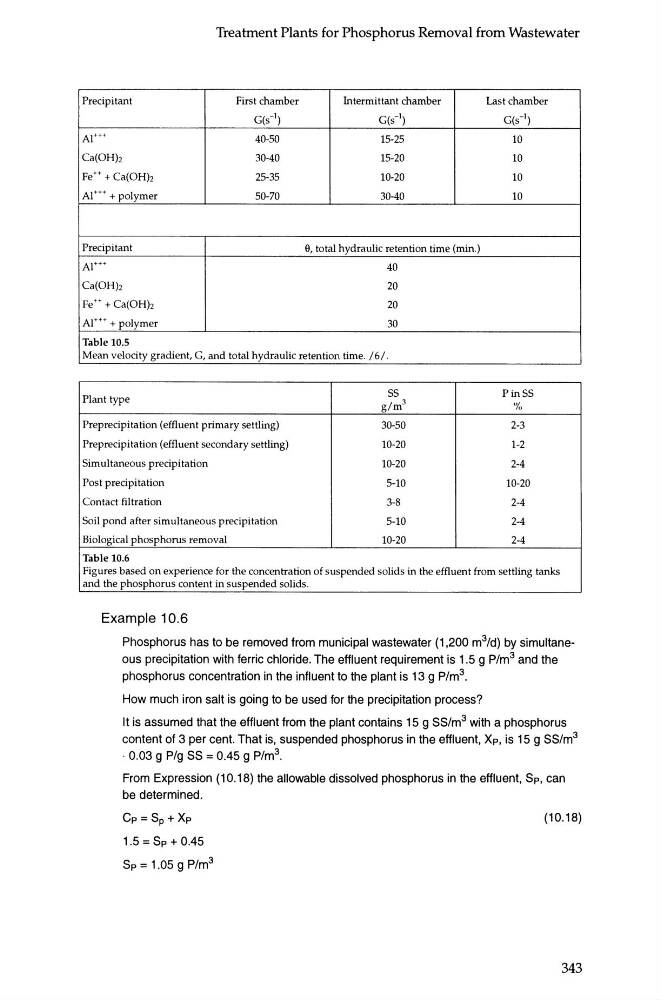
Table 10.5
Mean velocity gradient, G, and total hydraulic retention time. /6/.
Plant type
ss
PinSS
g/m3
(}{)
Preprecipitation (effluent primary settling)
30-50
2-3
Preprecipitation (effluent secondary settling)
10-20
1-2
Simultaneous precipitation
10-20
2-4
Post precipitation
5-10
10-20
Contact filtration
3-8
2-4
Soil pond after simultaneous precipitation
5-10
2-4
Biological phosphorus removal
10-20
2-4
Table 10.6
Figures based on experience for the concentration of suspended solids in the effluent from settling tanks
and the phosphorus content in suspended solids.
Example 10.6
Phosphorus has to be removed from municipal wastewater (1 ,200 m 3 /d) by simultaneous precipitation with ferric chloride. The effluent requirement is 1.5 g P/m 3 and the
phosphorus concentration in the influent to the plant is 13 g P/m 3 .
How much iron salt is going to be used for the precipitation process?
It is assumed that the effluent from the plant contains 15 g SS/m 3 with a phosphorus
content of 3 per cent. That is, suspended phosphorus in the effluent, Xp, is 15 g SS/m 3
· 0.03 g P/g SS = 0.45 g P/m 3 .
From Expression (1 0.18) the allowable dissolved phosphorus in the effluent, Sp, can
be determined.
Cp = Sp + Xp
1.5 = Sp + 0.45
Sp = 1.05 g P/m 3
(10.18)
343
Precipitant
First chamber
Intermittant chamber
Last chamber
G(s- 1 )
G(s- 1 )
G(s- 1 )
AI+++
40-50
15-25
10
Ca(OH)2
30-40
15-20
10
Fe++ + Ca(OH)2
25-35
10-20
10
At•• + polymer
50-70
30-40
10
Precipitant
e, total hydraulic retention time (min.)
Al+++
40
Ca(OH)2
20
Fe++ + Ca(OH)2
20
At++ + polymer
30
Table 10.5
Mean velocity gradient, G, and total hydraulic retention time. /6/.
Plant type
ss
PinSS
g/m3
(}{)
Preprecipitation (effluent primary settling)
30-50
2-3
Preprecipitation (effluent secondary settling)
10-20
1-2
Simultaneous precipitation
10-20
2-4
Post precipitation
5-10
10-20
Contact filtration
3-8
2-4
Soil pond after simultaneous precipitation
5-10
2-4
Biological phosphorus removal
10-20
2-4
Table 10.6
Figures based on experience for the concentration of suspended solids in the effluent from settling tanks
and the phosphorus content in suspended solids.
Example 10.6
Phosphorus has to be removed from municipal wastewater (1 ,200 m 3 /d) by simultaneous precipitation with ferric chloride. The effluent requirement is 1.5 g P/m 3 and the
phosphorus concentration in the influent to the plant is 13 g P/m 3 .
How much iron salt is going to be used for the precipitation process?
It is assumed that the effluent from the plant contains 15 g SS/m 3 with a phosphorus
content of 3 per cent. That is, suspended phosphorus in the effluent, Xp, is 15 g SS/m 3
· 0.03 g P/g SS = 0.45 g P/m 3 .
From Expression (1 0.18) the allowable dissolved phosphorus in the effluent, Sp, can
be determined.
Cp = Sp + Xp
1.5 = Sp + 0.45
Sp = 1.05 g P/m 3
(10.18)
343