

Treatment Plants for Phosphorus Removal from Wastewater
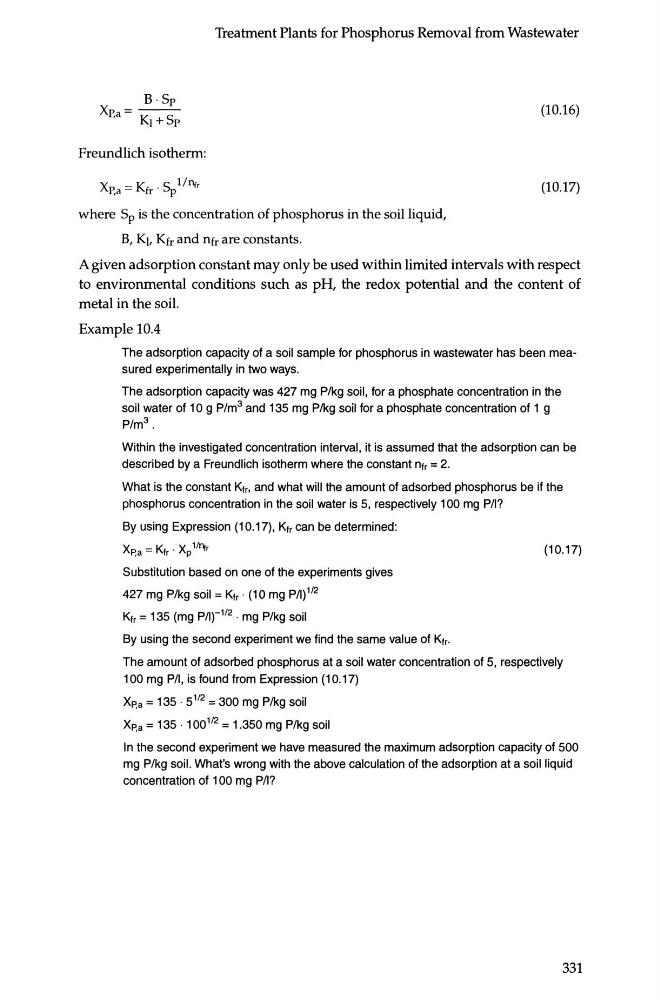
B· Sp
XP.- - -
,a- K1+Sp
Freundlich isotherm:
XP,a == Ktr · Sp l/11f,
where Sp is the concentration of phosphorus in the soil liquid,
B, KJ, Kfr and nfr are constants.
(10.16)
(10.17)
A given adsorption constant may only be used within limited intervals with respect
to environmental conditions such as pH, the redox potential and the content of
metal in the soil.
Example 10.4
The adsorption capacity of a soil sample for phosphorus in wastewater has been measured experimentally in two ways.
The adsorption capacity was 427 mg Plkg soil, for a phosphate concentration in the
soil water of 10 g P/m 3 and 135 mg Plkg soil for a phosphate concentration of 1 g
P/m 3 .
Within the investigated concentration interval, it is assumed that the adsorption can be
described by a Freundlich isotherm where the constant n1, = 2.
What is the constant K1,, and what will the amount of adsorbed phosphorus be if the
phosphorus concentration in the soil water is 5, respectively 100 mg P/1?
By using Expression (1 0.17), K1, can be determined:
XP.a = K,, . Xp 1tnr,
(10.17)
Substitution based on one of the experiments gives
427 mg Plkg soil= K1, · {10 mg P/1) 112
K1, = 135 (mg Pllr 1 ' 2 . mg Plkg soil
By using the second experiment we find the same value of K,,.
The amount of adsorbed phosphorus at a soil water concentration of 5, respectively
100 mg P/1, is found from Expression (10.17)
XP,a = 135 · 5 112 = 300 mg Plkg soil
XP,a = 135 · 100 112 = 1.350 mg P/kg soil
In the second experiment we have measured the maximum adsorption capacity of 500
mg P/kg soil. What's wrong with the above calculation of the adsorption at a soil liquid
concentration of 1 00 mg P/1?
331
B· Sp
XP.- - -
,a- K1+Sp
Freundlich isotherm:
XP,a == Ktr · Sp l/11f,
where Sp is the concentration of phosphorus in the soil liquid,
B, KJ, Kfr and nfr are constants.
(10.16)
(10.17)
A given adsorption constant may only be used within limited intervals with respect
to environmental conditions such as pH, the redox potential and the content of
metal in the soil.
Example 10.4
The adsorption capacity of a soil sample for phosphorus in wastewater has been measured experimentally in two ways.
The adsorption capacity was 427 mg Plkg soil, for a phosphate concentration in the
soil water of 10 g P/m 3 and 135 mg Plkg soil for a phosphate concentration of 1 g
P/m 3 .
Within the investigated concentration interval, it is assumed that the adsorption can be
described by a Freundlich isotherm where the constant n1, = 2.
What is the constant K1,, and what will the amount of adsorbed phosphorus be if the
phosphorus concentration in the soil water is 5, respectively 100 mg P/1?
By using Expression (1 0.17), K1, can be determined:
XP.a = K,, . Xp 1tnr,
(10.17)
Substitution based on one of the experiments gives
427 mg Plkg soil= K1, · {10 mg P/1) 112
K1, = 135 (mg Pllr 1 ' 2 . mg Plkg soil
By using the second experiment we find the same value of K,,.
The amount of adsorbed phosphorus at a soil water concentration of 5, respectively
100 mg P/1, is found from Expression (10.17)
XP,a = 135 · 5 112 = 300 mg Plkg soil
XP,a = 135 · 100 112 = 1.350 mg P/kg soil
In the second experiment we have measured the maximum adsorption capacity of 500
mg P/kg soil. What's wrong with the above calculation of the adsorption at a soil liquid
concentration of 1 00 mg P/1?
331