

Treatment Plants for Phosphorus Removal from Wastewater
After
Raw wastewater
biological treatment
-----Orthophosphate
Orthophosphate
' '
Poly'
Dissolved
phosphate
' \
\
\
\
---~
Organic
Organic
-/
-
Suspended
Organic
-----Sludge
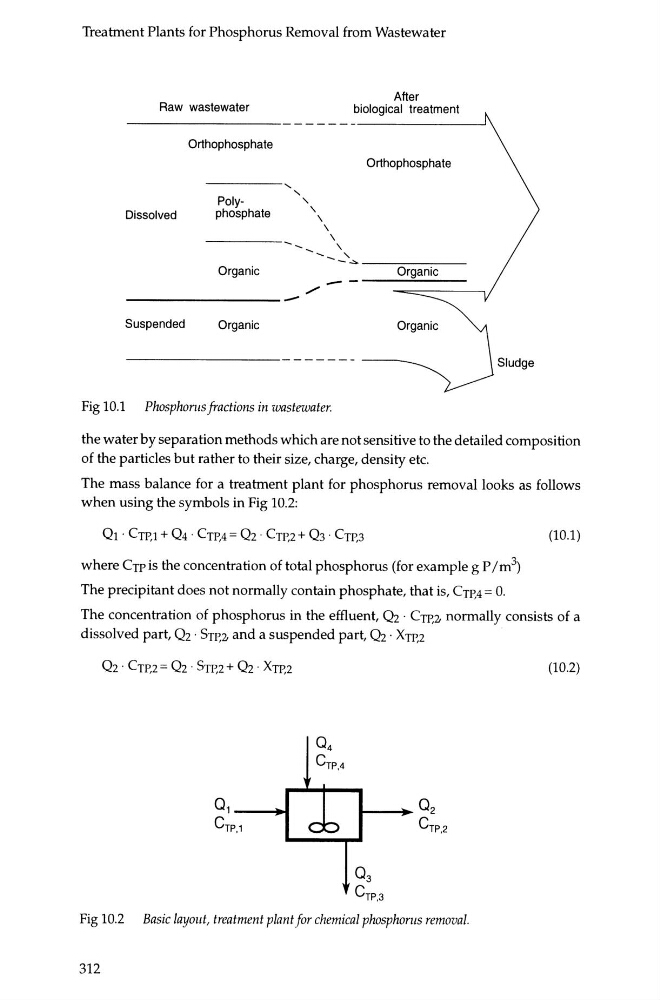
Fig 10.1 Plwsphorus fractions in wastewater.
the water by separation methods which are not sensitive to the detailed composition
of the particles but rather to their size, charge, density etc.
The mass balance for a treatment plant for phosphorus removal looks as follows
when using the symbols in Fig 10.2:
Q1 · CTP,l + Q4 · CTr,4 = Q2 · CTP,2 + Q3 · CTP,3
(10.1)
where CTr is the concentration of total phosphorus (for example g P /m 3 )
The precipitant does not normally contain phosphate, that is, CTP,4 = 0.
The concentration of phosphorus in the effluent, Q2 · CTr,;>, normally consists of a
dissolved part, Q2 · STr,;>, and a suspended part, Q2 · XTP,2
Q2 · CTP,2 = Q2 · STP,2 + Q2 · XTP,2
(10.2)
04
CTP,4
,1
co
03
cTP.3
Fig 10.2 Basic layout, treatment plant for chemical phosphorus removal.
312
After
Raw wastewater
biological treatment
-----Orthophosphate
Orthophosphate
' '
Poly'
Dissolved
phosphate
' \
\
\
\
---~
Organic
Organic
-/
-
Suspended
Organic
-----Sludge
Fig 10.1 Plwsphorus fractions in wastewater.
the water by separation methods which are not sensitive to the detailed composition
of the particles but rather to their size, charge, density etc.
The mass balance for a treatment plant for phosphorus removal looks as follows
when using the symbols in Fig 10.2:
Q1 · CTP,l + Q4 · CTr,4 = Q2 · CTP,2 + Q3 · CTP,3
(10.1)
where CTr is the concentration of total phosphorus (for example g P /m 3 )
The precipitant does not normally contain phosphate, that is, CTP,4 = 0.
The concentration of phosphorus in the effluent, Q2 · CTr,;>, normally consists of a
dissolved part, Q2 · STr,;>, and a suspended part, Q2 · XTP,2
Q2 · CTP,2 = Q2 · STP,2 + Q2 · XTP,2
(10.2)
04
CTP,4
,1
co
03
cTP.3
Fig 10.2 Basic layout, treatment plant for chemical phosphorus removal.
312