

Design of anaerobic plants
By substitution we find:
V2 = (1,200 m 3 /d) · (2.7 kg COD/m 3 )/(6 kg COD/(m 3 ·d))= 540m 3
Design by means of sludge load
The sludge load, Bx,coo is defined as:
Bx,coo= 01 · Ccoo,IIMx
The sludge mass, Mx, is the sludge mass which is found in the biologically active
parts of the plant.
For the plant shown in Fig 9.2 we have:
Mx=Vz·Xz
which, when substituted and after isolation of the tank volume, V2, gives:
Vz = 01 · Ccoo,1/(Xz · Bx,coo)
(9.9)
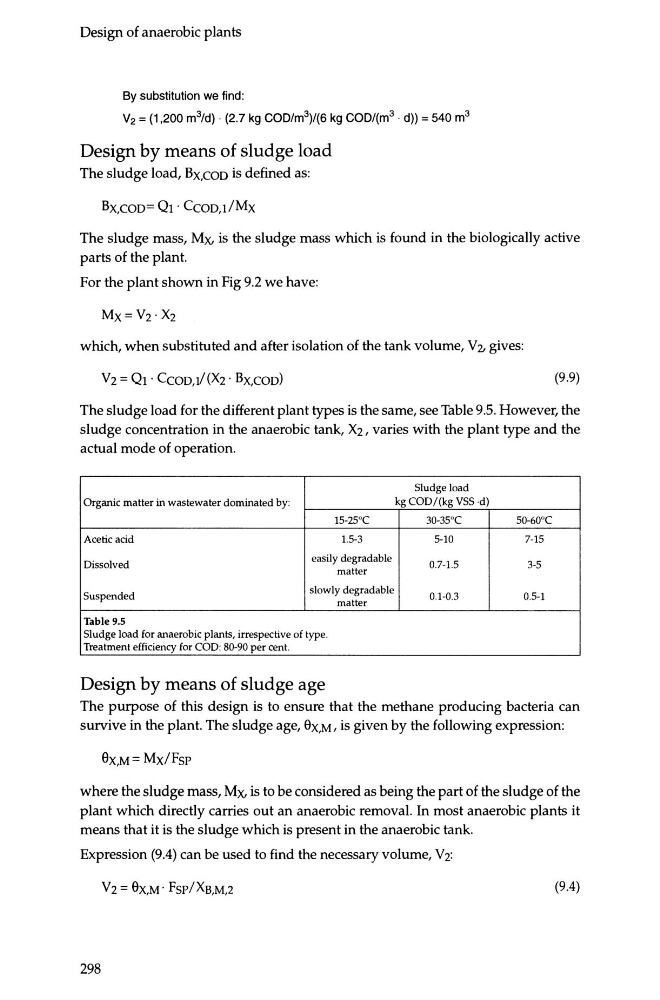
The sludge load for the different plant types is the same, see Table 9.5. However, the
sludge concentration in the anaerobic tank, Xz, varies with the plant type and the
actual mode of operation.
Sludge load
Organic matter in wastewater dominated by:
kg COD/(kg VSS ·d)
15-25°C
30-35°C
50-60°C
Acetic acid
1.5-3
5-10
7-15
Dissolved
easily degradable
0.7-1.5
3-5
matter
Suspended
slowly degradable
0.1-0.3
0.5-1
matter
Table9.5
Sludge load for anaerobic plants, irrespective of type.
Treatment efficiency for COD: 80-90 per cent.
Design by means of sludge age
The purpose of this design is to ensure that the methane producing bacteria can
survive in the plant. The sludge age, 9x,M, is given by the following expression:
9x,M = Mx/Fsp
where the sludge mass, Mx, is to be considered as being the part of the sludge of the
plant which directly carries out an anaerobic removal. In most anaerobic plants it
means that it is the sludge which is present in the anaerobic tank.
Expression (9.4) can be used to find the necessary volume, Vz:
Vz = 9x,M· Fsp/XB,M,2
(9.4)
298
By substitution we find:
V2 = (1,200 m 3 /d) · (2.7 kg COD/m 3 )/(6 kg COD/(m 3 ·d))= 540m 3
Design by means of sludge load
The sludge load, Bx,coo is defined as:
Bx,coo= 01 · Ccoo,IIMx
The sludge mass, Mx, is the sludge mass which is found in the biologically active
parts of the plant.
For the plant shown in Fig 9.2 we have:
Mx=Vz·Xz
which, when substituted and after isolation of the tank volume, V2, gives:
Vz = 01 · Ccoo,1/(Xz · Bx,coo)
(9.9)
The sludge load for the different plant types is the same, see Table 9.5. However, the
sludge concentration in the anaerobic tank, Xz, varies with the plant type and the
actual mode of operation.
Sludge load
Organic matter in wastewater dominated by:
kg COD/(kg VSS ·d)
15-25°C
30-35°C
50-60°C
Acetic acid
1.5-3
5-10
7-15
Dissolved
easily degradable
0.7-1.5
3-5
matter
Suspended
slowly degradable
0.1-0.3
0.5-1
matter
Table9.5
Sludge load for anaerobic plants, irrespective of type.
Treatment efficiency for COD: 80-90 per cent.
Design by means of sludge age
The purpose of this design is to ensure that the methane producing bacteria can
survive in the plant. The sludge age, 9x,M, is given by the following expression:
9x,M = Mx/Fsp
where the sludge mass, Mx, is to be considered as being the part of the sludge of the
plant which directly carries out an anaerobic removal. In most anaerobic plants it
means that it is the sludge which is present in the anaerobic tank.
Expression (9.4) can be used to find the necessary volume, Vz:
Vz = 9x,M· Fsp/XB,M,2
(9.4)
298