

Anaerobic Wastewater Treatment
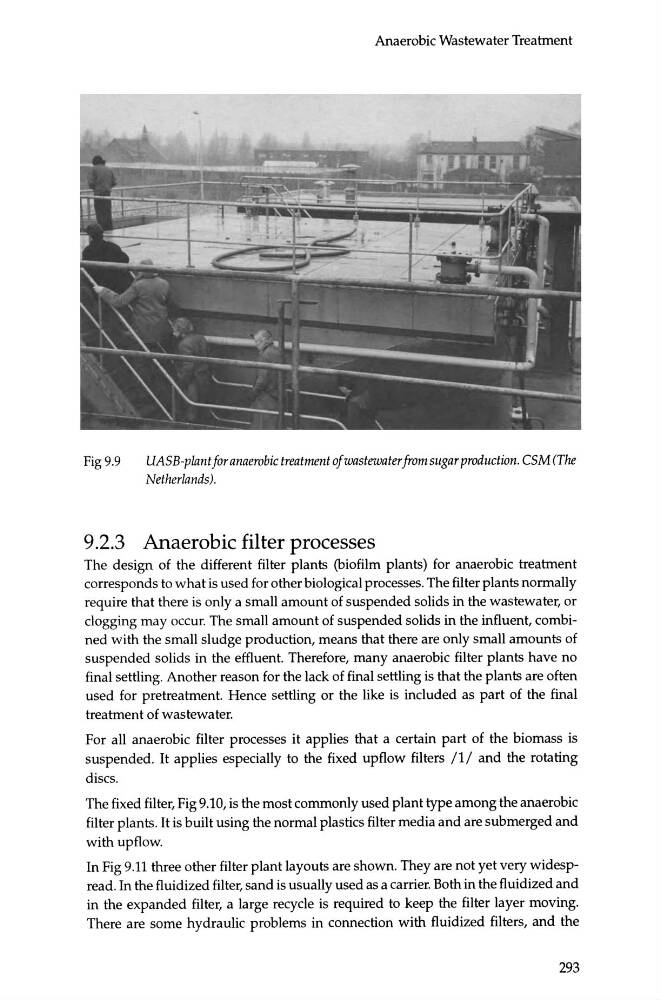
Fig 9. 9
UAS B-plant for anaerobic treatment of wastewater from sugar production. CSM (The
Netherlands).
9 .2.3 Anaerobic filter processes
The design of the different filter plants (biofilm plants) for anaerobic treatment
corresponds to what is used for other biological processes. The filter plants normally
require that there is only a small amount of suspended solids in the wastewater, or
clogging may occur. The small amount of suspended solids in the influent, combined with the small sludge production, means that there are only small amounts of
suspended solids in the effluent. Therefore, many anaerobic filter plants have no
final settling. Another reason for the lack of final settling is that the plants are often
used for pretreatment. Hence settling or the like is included as part of the final
treatment of wastewater.
For all anaerobic filter processes it applies that a certain part of the biomass is
suspended. It applies especially to the fixed upflow filters /1/ and the rotating
discs.
The fixed filter, Fig 9.10, is the most commonly used plant type among the anaerobic
filter plants. It is built using the normal plastics filter media and are submerged and
with upflow.
In Fig 9.11 three other filter plant layouts are shown. They are not yet very widespread. In the fluidized filter, sand is usually used as a carrier. Both in the fluidized and
in the expanded filter, a large recycle is required to keep the filter layer moving.
There are some hydraulic problems in connection with fluidized filters, and the
293
Fig 9. 9
UAS B-plant for anaerobic treatment of wastewater from sugar production. CSM (The
Netherlands).
9 .2.3 Anaerobic filter processes
The design of the different filter plants (biofilm plants) for anaerobic treatment
corresponds to what is used for other biological processes. The filter plants normally
require that there is only a small amount of suspended solids in the wastewater, or
clogging may occur. The small amount of suspended solids in the influent, combined with the small sludge production, means that there are only small amounts of
suspended solids in the effluent. Therefore, many anaerobic filter plants have no
final settling. Another reason for the lack of final settling is that the plants are often
used for pretreatment. Hence settling or the like is included as part of the final
treatment of wastewater.
For all anaerobic filter processes it applies that a certain part of the biomass is
suspended. It applies especially to the fixed upflow filters /1/ and the rotating
discs.
The fixed filter, Fig 9.10, is the most commonly used plant type among the anaerobic
filter plants. It is built using the normal plastics filter media and are submerged and
with upflow.
In Fig 9.11 three other filter plant layouts are shown. They are not yet very widespread. In the fluidized filter, sand is usually used as a carrier. Both in the fluidized and
in the expanded filter, a large recycle is required to keep the filter layer moving.
There are some hydraulic problems in connection with fluidized filters, and the
293