

Plants for Biological Phosphorus Removal
•
3-stage
modified
Bardenpho
UCT
MUCT
(Modified
UCT)
Biodenipho
ISAH
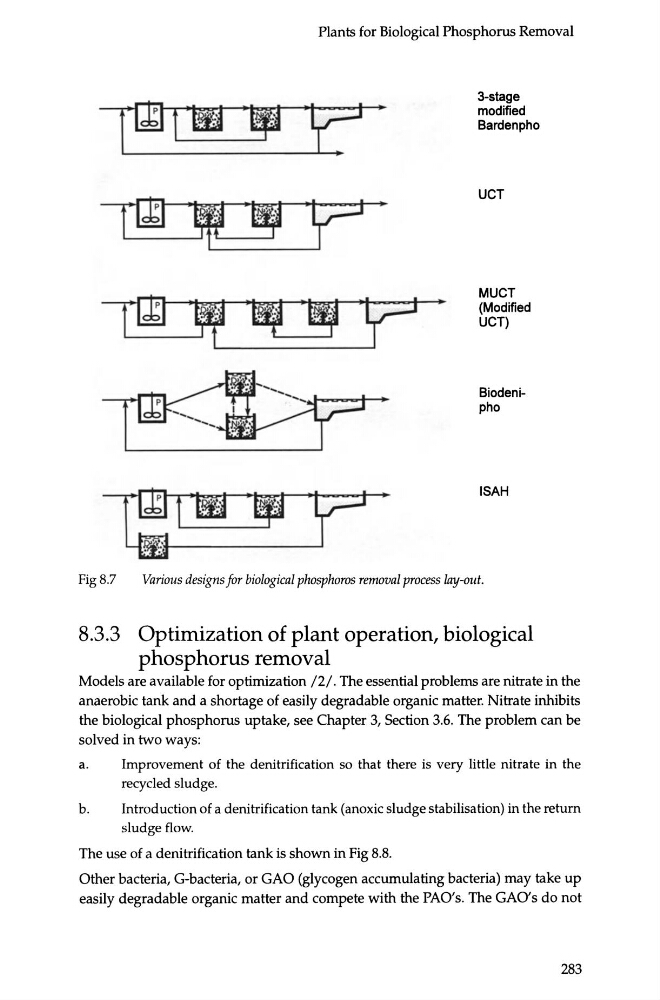
Fig 8.7
Various designs for biological phosphoros removal process lay-out.
8.3.3 Optimization of plant operation, biological
phosphorus removal
Models are available for optimization /2/. The essential problems are nitrate in the
anaerobic tank and a shortage of easily degradable organic matter. Nitrate inhibits
the biological phosphorus uptake, see Chapter 3, Section 3.6. The problem can be
solved in two ways:
a.
Improvement of the denitrification so that there is very little nitrate in the
recycled sludge.
b.
Introduction of a denitrification tank (anoxic sludge stabilisation) in the return
sludge flow.
The use of a denitrification tank is shown in Fig 8.8.
Other bacteria, G-bacteria, or GAO (glycogen accumulating bacteria) may take up
easily degradable organic matter and compete with the PAO's. The GAO's do not
283
•
3-stage
modified
Bardenpho
UCT
MUCT
(Modified
UCT)
Biodenipho
ISAH
Fig 8.7
Various designs for biological phosphoros removal process lay-out.
8.3.3 Optimization of plant operation, biological
phosphorus removal
Models are available for optimization /2/. The essential problems are nitrate in the
anaerobic tank and a shortage of easily degradable organic matter. Nitrate inhibits
the biological phosphorus uptake, see Chapter 3, Section 3.6. The problem can be
solved in two ways:
a.
Improvement of the denitrification so that there is very little nitrate in the
recycled sludge.
b.
Introduction of a denitrification tank (anoxic sludge stabilisation) in the return
sludge flow.
The use of a denitrification tank is shown in Fig 8.8.
Other bacteria, G-bacteria, or GAO (glycogen accumulating bacteria) may take up
easily degradable organic matter and compete with the PAO's. The GAO's do not
283