

Plants for Biological Phosphorus Removal
8.3.2 Design of tanks for biological phosphorus
removal
The design of the anaerobic tank for biological phosphorus removal is as yet at a
virgin stage. There are not many experiences to rely on. Two methods can be tried
out, that is, design on the basis of the hydraulic retention time or on the basis of the
kinetics for the uptake of the easily degradable organic matter.
Design based on the hydraulic retention time
The hydraulic retention time in the anaerobic tank must be min. 1 h at 10°C in order
that the process can be assumed to have been completed. Retention times up to 3 h
at 10°C will increase the phosphorus removal in that, through the hydrolysis/fermentation, a larger amount of easily degradable matter is available.
Design based on kinetics for easily degradable
organic matter
By using Expression (8.3), the effluent concentration of easily degradable organic
matter from the anaerobic tank can be calculated. Knowing SHAc,2, the removal rate
for organic matter, rv,HAc , in the anaerobic tank can be calculated. Based on
Expressions (8.4) and (8.6):
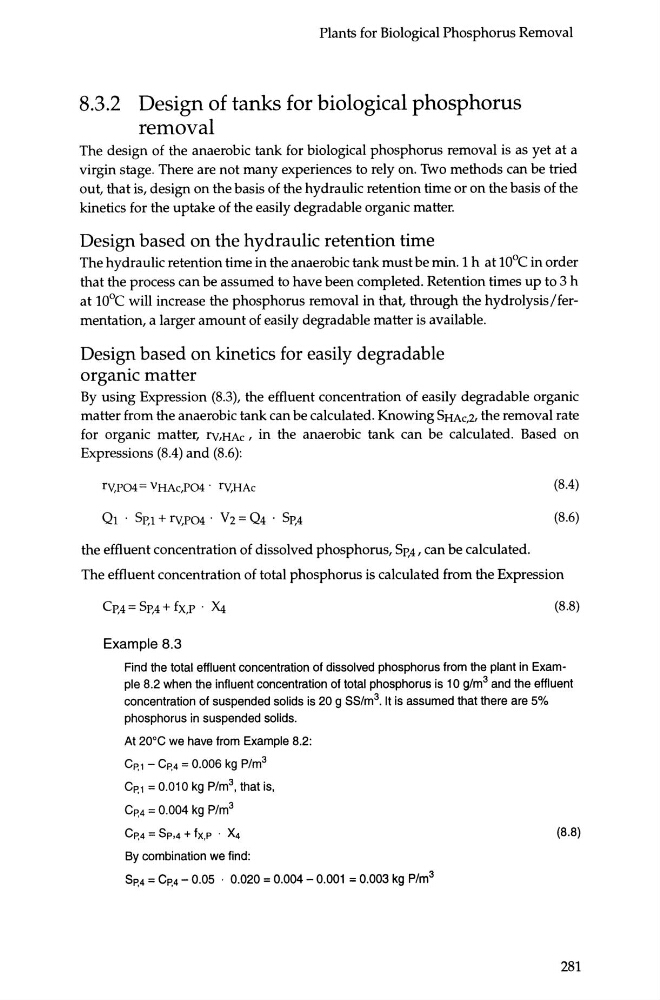
rv,P04 = VHAc,P04 · fV,HAc
01 · Sr,1 + rv,P04 · V 2 = 04 · Sp,4
the effluent concentration of dissolved phosphorus, Sr,4, can be calculated.
(8.4)
(8.6)
The effluent concentration of total phosphorus is calculated from the Expression
(8.8)
Example 8.3
Find the total effluent concentration of dissolved phosphorus from the plant in Example 8.2 when the influent concentration of total phosphorus is 10 g/m 3 and the effluent
concentration of suspended solids is 20 g SS/m 3 . It is assumed that there are 5%
phosphorus in suspended solids.
At 20°C we have from Example 8.2:
CP,1- CP.4 = 0.006 kg P/m 3
CP, 1 = 0.010 kg P/m 3 , that is,
CP. 4 = 0.004 kg P/m 3
Cp.4 = Sp,4 + fx,P · X4
By combination we find:
SP.4 = CP.4- 0.05 · 0.020 = 0.004- 0.001 = 0.003 kg P/m 3
(8.8)
281
8.3.2 Design of tanks for biological phosphorus
removal
The design of the anaerobic tank for biological phosphorus removal is as yet at a
virgin stage. There are not many experiences to rely on. Two methods can be tried
out, that is, design on the basis of the hydraulic retention time or on the basis of the
kinetics for the uptake of the easily degradable organic matter.
Design based on the hydraulic retention time
The hydraulic retention time in the anaerobic tank must be min. 1 h at 10°C in order
that the process can be assumed to have been completed. Retention times up to 3 h
at 10°C will increase the phosphorus removal in that, through the hydrolysis/fermentation, a larger amount of easily degradable matter is available.
Design based on kinetics for easily degradable
organic matter
By using Expression (8.3), the effluent concentration of easily degradable organic
matter from the anaerobic tank can be calculated. Knowing SHAc,2, the removal rate
for organic matter, rv,HAc , in the anaerobic tank can be calculated. Based on
Expressions (8.4) and (8.6):
rv,P04 = VHAc,P04 · fV,HAc
01 · Sr,1 + rv,P04 · V 2 = 04 · Sp,4
the effluent concentration of dissolved phosphorus, Sr,4, can be calculated.
(8.4)
(8.6)
The effluent concentration of total phosphorus is calculated from the Expression
(8.8)
Example 8.3
Find the total effluent concentration of dissolved phosphorus from the plant in Example 8.2 when the influent concentration of total phosphorus is 10 g/m 3 and the effluent
concentration of suspended solids is 20 g SS/m 3 . It is assumed that there are 5%
phosphorus in suspended solids.
At 20°C we have from Example 8.2:
CP,1- CP.4 = 0.006 kg P/m 3
CP, 1 = 0.010 kg P/m 3 , that is,
CP. 4 = 0.004 kg P/m 3
Cp.4 = Sp,4 + fx,P · X4
By combination we find:
SP.4 = CP.4- 0.05 · 0.020 = 0.004- 0.001 = 0.003 kg P/m 3
(8.8)
281