

Plants for Biological Phosphorus Removal
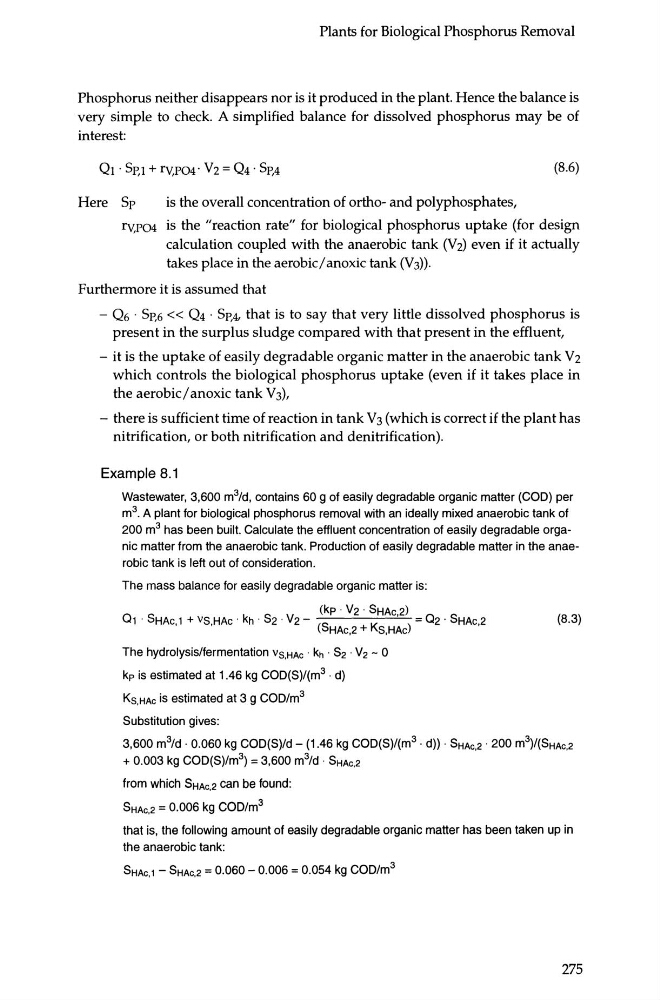
Phosphorus neither disappears nor is it produced in the plant. Hence the balance is
very simple to check. A simplified balance for dissolved phosphorus may be of
interest:
(8.6)
Here Sp
is the overall concentration of ortho- and polyphosphates,
fV,P04 is the "reaction rate" for biological phosphorus uptake (for design
calculation coupled with the anaerobic tank (Vz) even if it actually
takes place in the aerobic/anoxic tank (V3)).
Furthermore it is assumed that
- 06 · Sr,6 << 04 · Sr,4, that is to say that very little dissolved phosphorus is
present in the surplus sludge compared with that present in the effluent,
- it is the uptake of easily degradable organic matter in the anaerobic tank Vz
which controls the biological phosphorus uptake (even if it takes place in
the aerobic/anoxic tank V3),
- there is sufficient time of reaction in tank V 3 (which is correct if the plant has
nitrification, or both nitrification and denitrification).
Example 8.1
Wastewater, 3,600 m 3 /d, contains 60 g of easily degradable organic matter (COD) per
m 3 . A plant for biological phosphorus removal with an ideally mixed anaerobic tank of
200 m 3 has been built. Calculate the effluent concentration of easily degradable organic matter from the anaerobic tank. Production of easily degradable matter in the anaerobic tank is left out of consideration.
The mass balance for easily degradable organic matter is:
(kp · V2 · SHAc 2)
01 · SHAc 1 + VS HAc · kh · S2 · V2 -
' = 02 · SHAc 2
'
'
(SHAc,2 + Ks,HAc)
'
The hydrolysis/fermentation VS,HAc · kt, · S2 · V2- 0
kp is estimated at 1.46 kg COD(S)/(m 3 · d)
Ks.HAc is estimated at 3 g COD/m 3
Substitution gives:
(8.3)
3,600 m 3 /d · 0.060 kg COD(S)/d- (1.46 kg COD(S)/(m 3 · d)) · SHAc,2 · 200 m 3 )/(SHAc,2
+ 0.003 kg COD(S)/m 3 ) = 3,600 m 3 /d · SHAc,2
from which SHAc,2 can be found:
SHAc,2 = 0.006 kg COD/m 3
that is, the following amount of easily degradable organic matter has been taken up in
the anaerobic tank:
SHAc,1- SHAc,2 = 0.060-0.006 = 0.054 kg COD/m 3
275
Phosphorus neither disappears nor is it produced in the plant. Hence the balance is
very simple to check. A simplified balance for dissolved phosphorus may be of
interest:
(8.6)
Here Sp
is the overall concentration of ortho- and polyphosphates,
fV,P04 is the "reaction rate" for biological phosphorus uptake (for design
calculation coupled with the anaerobic tank (Vz) even if it actually
takes place in the aerobic/anoxic tank (V3)).
Furthermore it is assumed that
- 06 · Sr,6 << 04 · Sr,4, that is to say that very little dissolved phosphorus is
present in the surplus sludge compared with that present in the effluent,
- it is the uptake of easily degradable organic matter in the anaerobic tank Vz
which controls the biological phosphorus uptake (even if it takes place in
the aerobic/anoxic tank V3),
- there is sufficient time of reaction in tank V 3 (which is correct if the plant has
nitrification, or both nitrification and denitrification).
Example 8.1
Wastewater, 3,600 m 3 /d, contains 60 g of easily degradable organic matter (COD) per
m 3 . A plant for biological phosphorus removal with an ideally mixed anaerobic tank of
200 m 3 has been built. Calculate the effluent concentration of easily degradable organic matter from the anaerobic tank. Production of easily degradable matter in the anaerobic tank is left out of consideration.
The mass balance for easily degradable organic matter is:
(kp · V2 · SHAc 2)
01 · SHAc 1 + VS HAc · kh · S2 · V2 -
' = 02 · SHAc 2
'
'
(SHAc,2 + Ks,HAc)
'
The hydrolysis/fermentation VS,HAc · kt, · S2 · V2- 0
kp is estimated at 1.46 kg COD(S)/(m 3 · d)
Ks.HAc is estimated at 3 g COD/m 3
Substitution gives:
(8.3)
3,600 m 3 /d · 0.060 kg COD(S)/d- (1.46 kg COD(S)/(m 3 · d)) · SHAc,2 · 200 m 3 )/(SHAc,2
+ 0.003 kg COD(S)/m 3 ) = 3,600 m 3 /d · SHAc,2
from which SHAc,2 can be found:
SHAc,2 = 0.006 kg COD/m 3
that is, the following amount of easily degradable organic matter has been taken up in
the anaerobic tank:
SHAc,1- SHAc,2 = 0.060-0.006 = 0.054 kg COD/m 3
275