

Design of denitrifying plants
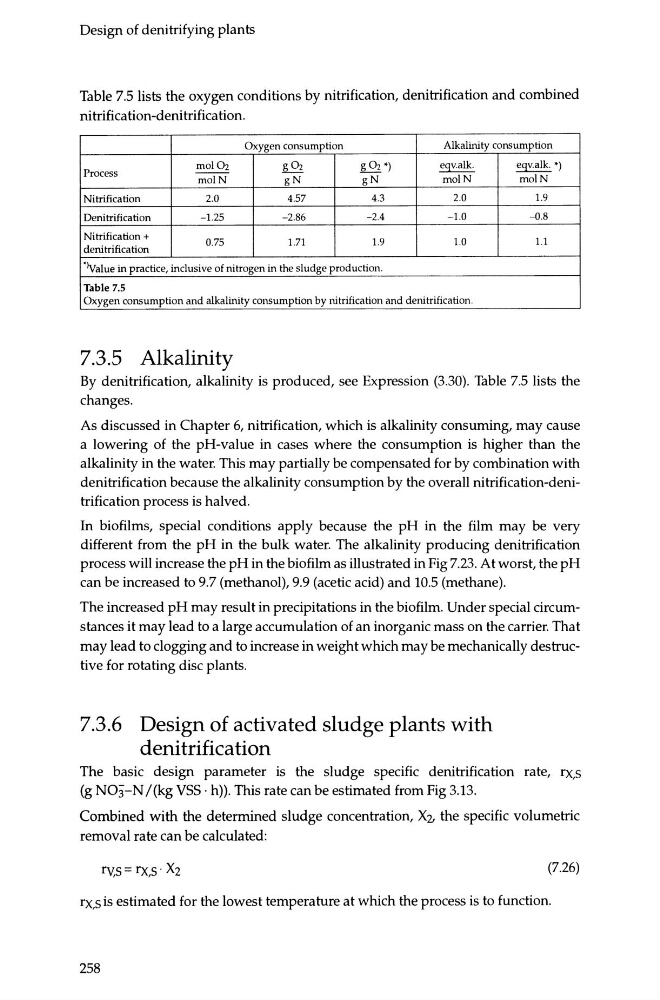
Table 7.5 lists the oxygen conditions by nitrification, denitrification and combined
nitrification-denitrification.
Oxygen consumption
Alkalinity consumption
Process
molOz
g02
g02 ')
eqv.alk.
eqv.alk. ')
- -
molN
gN
gN
molN
molN
Nitrification
2.0
4.57
4.3
2.0
1.9
Denitrification
-1.25
-2.86
-2.4
-1.0
-0.8
Nitrification+
0.75
1.71
1.9
1.0
1.1
denitrification
'lvalue in practice, inclusive of nitrogen in the sludge production.
Table 7.5
Oxygen consumption and alkalinity consumption by nitrification and denitrification.
7.3.5 Alkalinity
By denitrification, alkalinity is produced, see Expression (3.30). Table 7.5 lists the
changes.
As discussed in Chapter 6, nitrification, which is alkalinity consuming, may cause
a lowering of the pH-value in cases where the consumption is higher than the
alkalinity in the water. This may partially be compensated for by combination with
denitrification because the alkalinity consumption by the overall nitrification-denitrification process is halved.
In biofilms, special conditions apply because the pH in the film may be very
different from the pH in the bulk water. The alkalinity producing denitrification
process will increase the pH in the biofilm as illustrated in Fig 7.23. At worst, the pH
can be increased to 9.7 (methanol), 9.9 (acetic acid) and 10.5 (methane).
The increased pH may result in precipitations in the biofilm. Under special circumstances it may lead to a large accumulation of an inorganic mass on the carrier. That
may lead to clogging and to increase in weight which may be mechanically destructive for rotating disc plants.
7.3.6 Design of activated sludge plants with
denitrification
The basic design parameter is the sludge specific denitrification rate, rx,s
(g N03-N /(kg VSS ·h)). This rate can be estimated from Fig 3.13.
Combined with the determined sludge concentration, Xz, the specific volumetric
removal rate can be calculated:
rv,s = rx,s · Xz
(7.26)
rx,s is estimated for the lowest temperature at which the process is to function.
258
Table 7.5 lists the oxygen conditions by nitrification, denitrification and combined
nitrification-denitrification.
Oxygen consumption
Alkalinity consumption
Process
molOz
g02
g02 ')
eqv.alk.
eqv.alk. ')
- -
molN
gN
gN
molN
molN
Nitrification
2.0
4.57
4.3
2.0
1.9
Denitrification
-1.25
-2.86
-2.4
-1.0
-0.8
Nitrification+
0.75
1.71
1.9
1.0
1.1
denitrification
'lvalue in practice, inclusive of nitrogen in the sludge production.
Table 7.5
Oxygen consumption and alkalinity consumption by nitrification and denitrification.
7.3.5 Alkalinity
By denitrification, alkalinity is produced, see Expression (3.30). Table 7.5 lists the
changes.
As discussed in Chapter 6, nitrification, which is alkalinity consuming, may cause
a lowering of the pH-value in cases where the consumption is higher than the
alkalinity in the water. This may partially be compensated for by combination with
denitrification because the alkalinity consumption by the overall nitrification-denitrification process is halved.
In biofilms, special conditions apply because the pH in the film may be very
different from the pH in the bulk water. The alkalinity producing denitrification
process will increase the pH in the biofilm as illustrated in Fig 7.23. At worst, the pH
can be increased to 9.7 (methanol), 9.9 (acetic acid) and 10.5 (methane).
The increased pH may result in precipitations in the biofilm. Under special circumstances it may lead to a large accumulation of an inorganic mass on the carrier. That
may lead to clogging and to increase in weight which may be mechanically destructive for rotating disc plants.
7.3.6 Design of activated sludge plants with
denitrification
The basic design parameter is the sludge specific denitrification rate, rx,s
(g N03-N /(kg VSS ·h)). This rate can be estimated from Fig 3.13.
Combined with the determined sludge concentration, Xz, the specific volumetric
removal rate can be calculated:
rv,s = rx,s · Xz
(7.26)
rx,s is estimated for the lowest temperature at which the process is to function.
258