

Fig 7.6
a,
c,
s,
x,
Treatment Plants for Denitrification
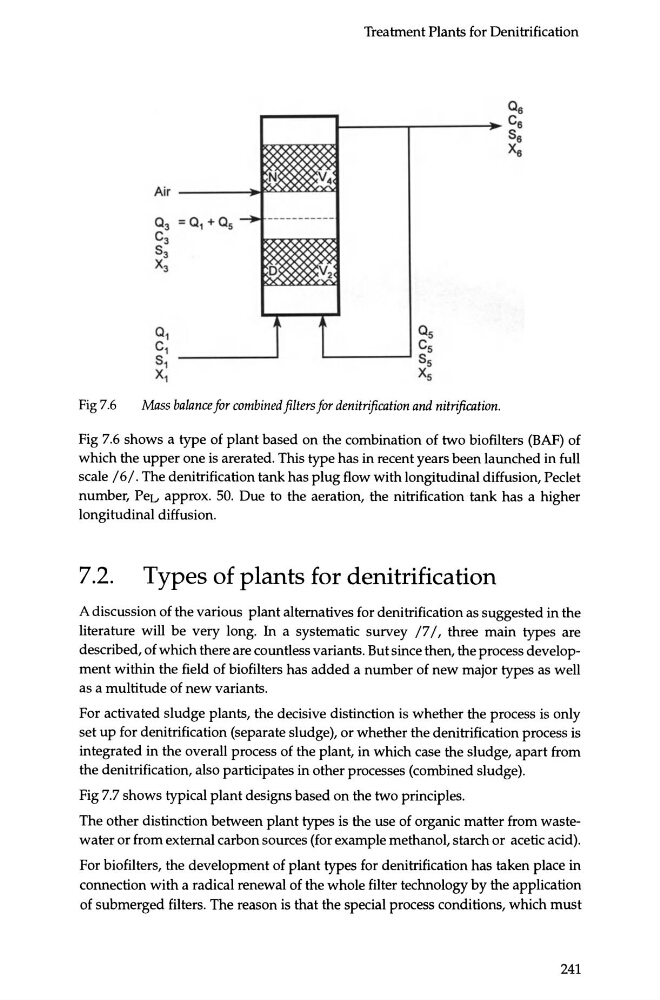
Mass balance for combined filters for denitrification and nitrification.
Fig 7.6 shows a type of plant based on the combination of two biofilters (BAF) of
which the upper one is arerated. This type has in recent years been launched in full
scale I 6 I. The denitrification tank has plug flow with longitudinal diffusion, Peclet
number, Per., approx. 50. Due to the aeration, the nitrification tank has a higher
longitudinal diffusion.
7.2. Types of plants for denitrification
A discussion of the various plant alternatives for denitrification as suggested in the
literature will be very long. In a systematic survey 17 I, three main types are
described, of which there are countless variants. But since then, the process development within the field of biofilters has added a number of new major types as well
as a multitude of new variants.
For activated sludge plants, the decisive distinction is whether the process is only
set up for denitrification (separate sludge), or whether the denitrification process is
integrated in the overall process of the plant, in which case the sludge, apart from
the denitrification, also participates in other processes (combined sludge).
Fig 7.7 shows typical plant designs based on the two principles.
The other distinction between plant types is the use of organic matter from wastewater or from external carbon sources (for example methanol, starch or acetic acid).
For biofilters, the development of plant types for denitrification has taken place in
connection with a radical renewal of the whole filter technology by the application
of submerged filters. The reason is that the special process conditions, which must
241
a,
c,
s,
x,
Treatment Plants for Denitrification
Mass balance for combined filters for denitrification and nitrification.
Fig 7.6 shows a type of plant based on the combination of two biofilters (BAF) of
which the upper one is arerated. This type has in recent years been launched in full
scale I 6 I. The denitrification tank has plug flow with longitudinal diffusion, Peclet
number, Per., approx. 50. Due to the aeration, the nitrification tank has a higher
longitudinal diffusion.
7.2. Types of plants for denitrification
A discussion of the various plant alternatives for denitrification as suggested in the
literature will be very long. In a systematic survey 17 I, three main types are
described, of which there are countless variants. But since then, the process development within the field of biofilters has added a number of new major types as well
as a multitude of new variants.
For activated sludge plants, the decisive distinction is whether the process is only
set up for denitrification (separate sludge), or whether the denitrification process is
integrated in the overall process of the plant, in which case the sludge, apart from
the denitrification, also participates in other processes (combined sludge).
Fig 7.7 shows typical plant designs based on the two principles.
The other distinction between plant types is the use of organic matter from wastewater or from external carbon sources (for example methanol, starch or acetic acid).
For biofilters, the development of plant types for denitrification has taken place in
connection with a radical renewal of the whole filter technology by the application
of submerged filters. The reason is that the special process conditions, which must
241