

Mass balances, denitrifying treatment plants
removal of nitrogen. The plant layouts which are typically used in full-scale plants
have gained their success by appropriately combining the processes.
Denitrification in connection with the treatment of wastewater is a rather new
process. Only 25 years ago, the first process designs for efficient nitrogen removal
were described in the literature /1/. Later the development has accelerated and
even if there are today (1994) 1000 or more plants, very few have been in operation
for more than 10 years. Consequently process know-how is still to a great extent
based on experiments in laboratories or on a semi-technical scale. Hence the available know-how about denitrification in biofilters is almost solely based on such pilot
plants.
7.1. Mass balances, denitrifying treatment
plants
As discussed in the introduction, the denitrification process is always related to the
oxidation of organic matter (or hydrogen or sulphur). The process can be carried out
in a separate process exclusively developed for denitrification, or in a combined
process with nitrification and denitrification. The microbiological denitrification
process is basically the same, irrespective of the design of the treatment plant. The
differences in plant designs may be the consumption of organic matter (the required
C/N-ratio) and the size of the fraction of denitrifying organisms in the biomass.
o,
l~:lo l
:II 03
c,
t
c3
s,
s3
x,
x3
04 5<4
Os
Xs
Ss
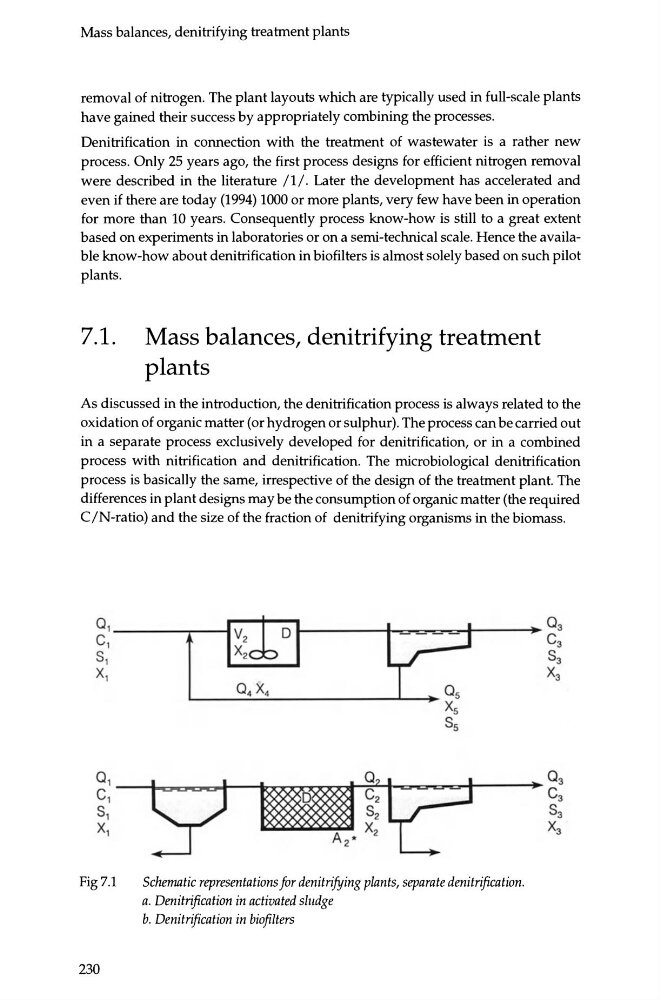
Fig 7.1
Schenwtic representations for denitrifying plants, separate denitrification .
a. Denitrification in activated sludge
b. Denitrification in biofi/ters
230
removal of nitrogen. The plant layouts which are typically used in full-scale plants
have gained their success by appropriately combining the processes.
Denitrification in connection with the treatment of wastewater is a rather new
process. Only 25 years ago, the first process designs for efficient nitrogen removal
were described in the literature /1/. Later the development has accelerated and
even if there are today (1994) 1000 or more plants, very few have been in operation
for more than 10 years. Consequently process know-how is still to a great extent
based on experiments in laboratories or on a semi-technical scale. Hence the available know-how about denitrification in biofilters is almost solely based on such pilot
plants.
7.1. Mass balances, denitrifying treatment
plants
As discussed in the introduction, the denitrification process is always related to the
oxidation of organic matter (or hydrogen or sulphur). The process can be carried out
in a separate process exclusively developed for denitrification, or in a combined
process with nitrification and denitrification. The microbiological denitrification
process is basically the same, irrespective of the design of the treatment plant. The
differences in plant designs may be the consumption of organic matter (the required
C/N-ratio) and the size of the fraction of denitrifying organisms in the biomass.
o,
l~:lo l
:II 03
c,
t
c3
s,
s3
x,
x3
04 5<4
Os
Xs
Ss
Fig 7.1
Schenwtic representations for denitrifying plants, separate denitrification .
a. Denitrification in activated sludge
b. Denitrification in biofi/ters
230