

Design of nitrifying plants
6.2.6 Combined biofilters and activated sludge
treatment plants for nitrification
The design of nitrification plants in two sludge treatment plants can of course be
realized with one stage as a biofilter and another as an activated sludge plant. Such
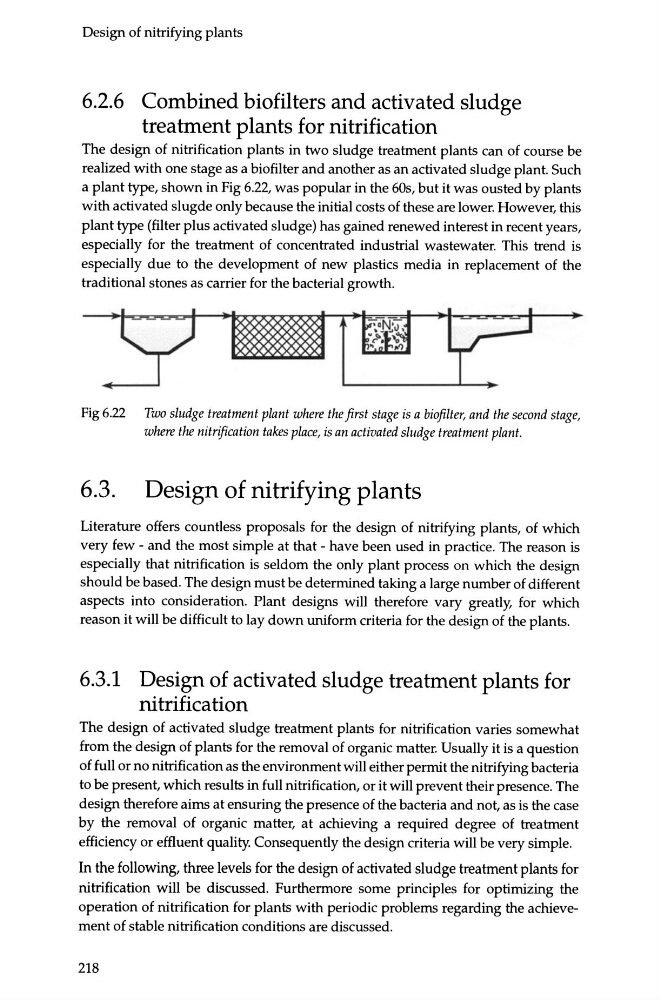
a plant type, shown in Fig 6.22, was popular in the 60s, but it was ousted by plants
with activated slugde only because the initial costs of these are lower. However, this
plant type (filter plus activated sludge) has gained renewed interest in recent years,
especially for the treatment of concentrated industrial wastewater. This trend is
especially due to the development of new plastics media in replacement of the
traditional stones as carrier for the bacterial growth.
Fig 6.22 Two sludge treatment plant where the first stage is a biofilter, and the second stage,
where the nitrification takes place, is an activated sludge treatment plant.
6.3. Design of nitrifying plants
Literature offers countless proposals for the design of nitrifying plants, of which
very few - and the most simple at that - have been used in practice. The reason is
especially that nitrification is seldom the only plant process on which the design
should be based. The design must be determined taking a large number of different
aspects into consideration. Plant designs will therefore vary greatly, for which
reason it will be difficult to lay down uniform criteria for the design of the plants.
6.3.1 Design of activated sludge treatment plants for
nitrification
The design of activated sludge treatment plants for nitrification varies somewhat
from the design of plants for the removal of organic matter. Usually it is a question
of full or no nitrification as the environment will either permit the nitrifying bacteria
to be present, which results in full nitrification, or it will prevent their presence. The
design therefore aims at ensuring the presence of the bacteria and not, as is the case
by the removal of organic matter, at achieving a required degree of treatment
efficiency or effluent quality. Consequently the design criteria will be very simple.
In the following, three levels for the design of activated sludge treatment plants for
nitrification will be discussed. Furthermore some principles for optimizing the
operation of nitrification for plants with periodic problems regarding the achievement of stable nitrification conditions are discussed.
218
6.2.6 Combined biofilters and activated sludge
treatment plants for nitrification
The design of nitrification plants in two sludge treatment plants can of course be
realized with one stage as a biofilter and another as an activated sludge plant. Such
a plant type, shown in Fig 6.22, was popular in the 60s, but it was ousted by plants
with activated slugde only because the initial costs of these are lower. However, this
plant type (filter plus activated sludge) has gained renewed interest in recent years,
especially for the treatment of concentrated industrial wastewater. This trend is
especially due to the development of new plastics media in replacement of the
traditional stones as carrier for the bacterial growth.
Fig 6.22 Two sludge treatment plant where the first stage is a biofilter, and the second stage,
where the nitrification takes place, is an activated sludge treatment plant.
6.3. Design of nitrifying plants
Literature offers countless proposals for the design of nitrifying plants, of which
very few - and the most simple at that - have been used in practice. The reason is
especially that nitrification is seldom the only plant process on which the design
should be based. The design must be determined taking a large number of different
aspects into consideration. Plant designs will therefore vary greatly, for which
reason it will be difficult to lay down uniform criteria for the design of the plants.
6.3.1 Design of activated sludge treatment plants for
nitrification
The design of activated sludge treatment plants for nitrification varies somewhat
from the design of plants for the removal of organic matter. Usually it is a question
of full or no nitrification as the environment will either permit the nitrifying bacteria
to be present, which results in full nitrification, or it will prevent their presence. The
design therefore aims at ensuring the presence of the bacteria and not, as is the case
by the removal of organic matter, at achieving a required degree of treatment
efficiency or effluent quality. Consequently the design criteria will be very simple.
In the following, three levels for the design of activated sludge treatment plants for
nitrification will be discussed. Furthermore some principles for optimizing the
operation of nitrification for plants with periodic problems regarding the achievement of stable nitrification conditions are discussed.
218