

Treatment Plants for Nitrification
pH-inhibition
Nitrification is an alkalinity-consuming process. If the alkalinity of the water is too
small, it can be exhausted, resulting in a substantial reduction of the pH, which will
inhibit the nitrification process. This happens at pH = 5.8 and limits what can be
nitrified without the addition of alkalinity, for example lime.
This is futher complicated by treatment in biofilm processes because the diffusional
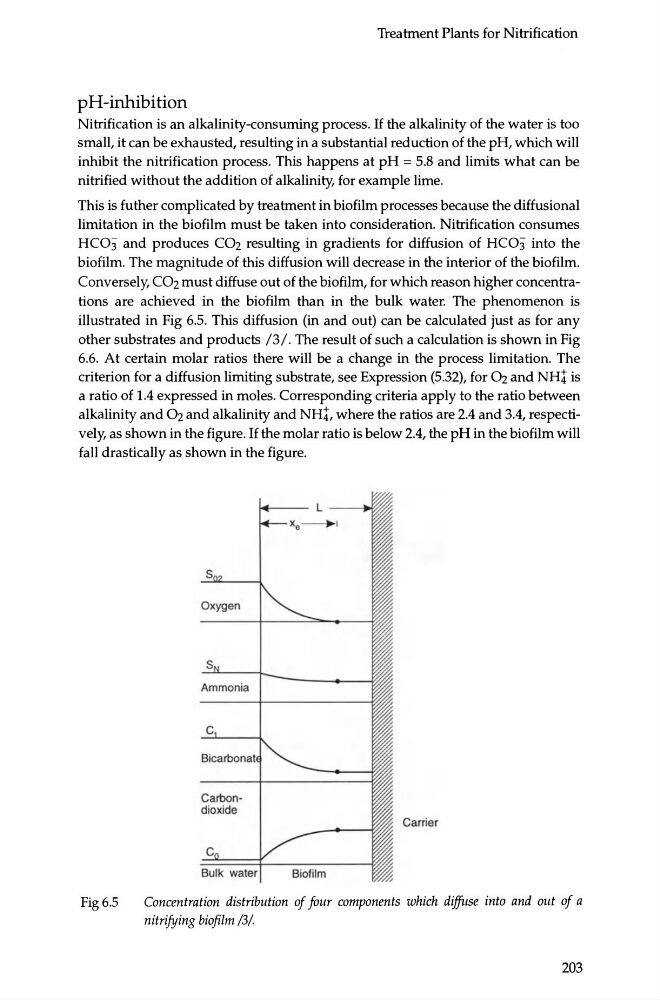
limitation in the biofilm must be taken into consideration. Nitrification consumes
HC03 and produces C02 resulting in gradients for diffusion of HC03 into the
biofilm. The magnitude of this diffusion will decrease in the interior of the biofilm.
Conversely, C02 must diffuse out of the biofilm, for which reason higher concentrations are achieved in the biofilm than in the bulk water. The phenomenon is
illustrated in Fig 6.5. This diffusion (in and out) can be calculated just as for any
other substrates and products /3/. The result of such a calculation is shown in Fig
6.6. At certain molar ratios there will be a change in the process limitation. The
criterion for a diffusion limiting substrate, see Expression (5.32), for 02 and NH4 is
a ratio of 1.4 expressed in moles. Corresponding criteria apply to the ratio between
alkalinity and 02 and alkalinity and NH4, where the ratios are 2.4 and 3.4, respectively, as shown in the figure. If the molar ratio is below 2.4, the pH in the biofilm will
fall drastically as shown in the figure.
Fig6.5
Carbondioxide
Carrier
Concentration distribution of four components which diffuse into and out of a
nitrifying biofilm /3/.
203
pH-inhibition
Nitrification is an alkalinity-consuming process. If the alkalinity of the water is too
small, it can be exhausted, resulting in a substantial reduction of the pH, which will
inhibit the nitrification process. This happens at pH = 5.8 and limits what can be
nitrified without the addition of alkalinity, for example lime.
This is futher complicated by treatment in biofilm processes because the diffusional
limitation in the biofilm must be taken into consideration. Nitrification consumes
HC03 and produces C02 resulting in gradients for diffusion of HC03 into the
biofilm. The magnitude of this diffusion will decrease in the interior of the biofilm.
Conversely, C02 must diffuse out of the biofilm, for which reason higher concentrations are achieved in the biofilm than in the bulk water. The phenomenon is
illustrated in Fig 6.5. This diffusion (in and out) can be calculated just as for any
other substrates and products /3/. The result of such a calculation is shown in Fig
6.6. At certain molar ratios there will be a change in the process limitation. The
criterion for a diffusion limiting substrate, see Expression (5.32), for 02 and NH4 is
a ratio of 1.4 expressed in moles. Corresponding criteria apply to the ratio between
alkalinity and 02 and alkalinity and NH4, where the ratios are 2.4 and 3.4, respectively, as shown in the figure. If the molar ratio is below 2.4, the pH in the biofilm will
fall drastically as shown in the figure.
Fig6.5
Carbondioxide
Carrier
Concentration distribution of four components which diffuse into and out of a
nitrifying biofilm /3/.
203