

x + dx
Layer 1
}
Layer 2
(for example biological film) surface (for example water)
ul
z
.J
I
I
It> I
Jki,z2
z + Az
Biofilters
z
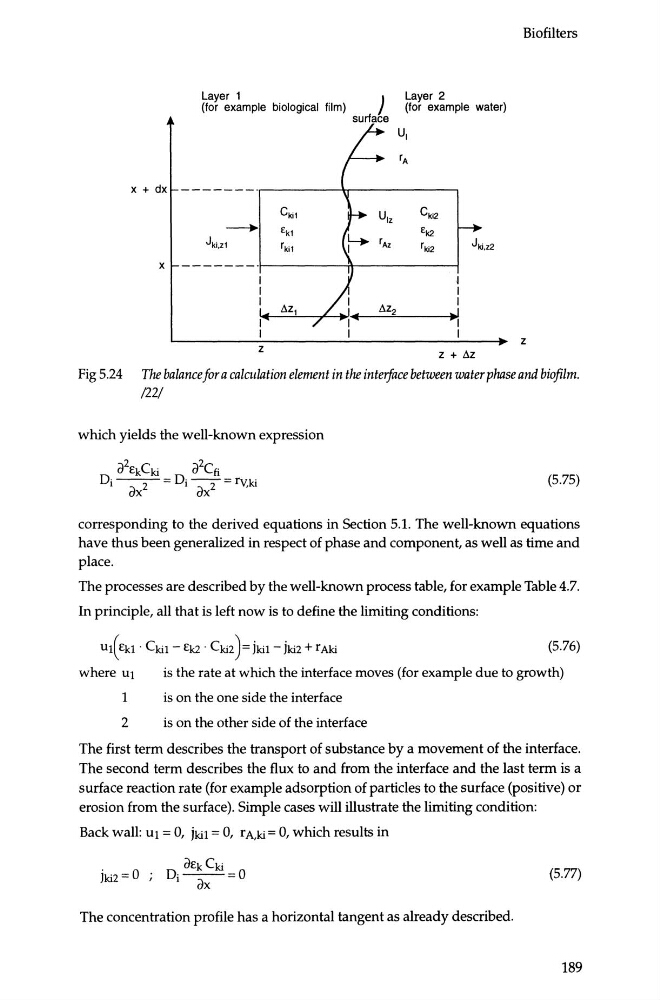
Fig 5.24 The balance for a calatlation element in the interface between water phase and biofilm.
/221
which yields the well-known expression
iiekcki
ricfi
Di -----aT = Di ax2 = IY.ki
(5.75)
corresponding to the derived equations in Section 5.1. The well-known equations
have thus been generalized in respect of phase and component, as well as time and
place.
The processes are described by the well-known process table, for example Table 4.7.
In principle, all that is left now is to define the limiting conditions:
(5.76)
where u1
1
2
is the rate at which the interface moves (for example due to growth)
is on the one side the interface
is on the other side of the interface
The first term describes the transport of substance by a movement of the interface.
The second term describes the flux to and from the interface and the last term is a
surface reaction rate (for example adsorption of particles to the surface (positive) or
erosion from the surface). Simple cases will illustrate the limiting condition:
Back wall: u1 = 0, ikil = 0, rA,ki = 0, which results in
(5.77)
The concentration profile has a horizontal tangent as already described.
189
Layer 1
}
Layer 2
(for example biological film) surface (for example water)
ul
z
.J
I
I
It> I
Jki,z2
z + Az
Biofilters
z
Fig 5.24 The balance for a calatlation element in the interface between water phase and biofilm.
/221
which yields the well-known expression
iiekcki
ricfi
Di -----aT = Di ax2 = IY.ki
(5.75)
corresponding to the derived equations in Section 5.1. The well-known equations
have thus been generalized in respect of phase and component, as well as time and
place.
The processes are described by the well-known process table, for example Table 4.7.
In principle, all that is left now is to define the limiting conditions:
(5.76)
where u1
1
2
is the rate at which the interface moves (for example due to growth)
is on the one side the interface
is on the other side of the interface
The first term describes the transport of substance by a movement of the interface.
The second term describes the flux to and from the interface and the last term is a
surface reaction rate (for example adsorption of particles to the surface (positive) or
erosion from the surface). Simple cases will illustrate the limiting condition:
Back wall: u1 = 0, ikil = 0, rA,ki = 0, which results in
(5.77)
The concentration profile has a horizontal tangent as already described.
189