

Removal of particulate organic matter
demonstrated for starch as a non-diffusible substance, and kinetic expressions are
available, see the simplified representation below:
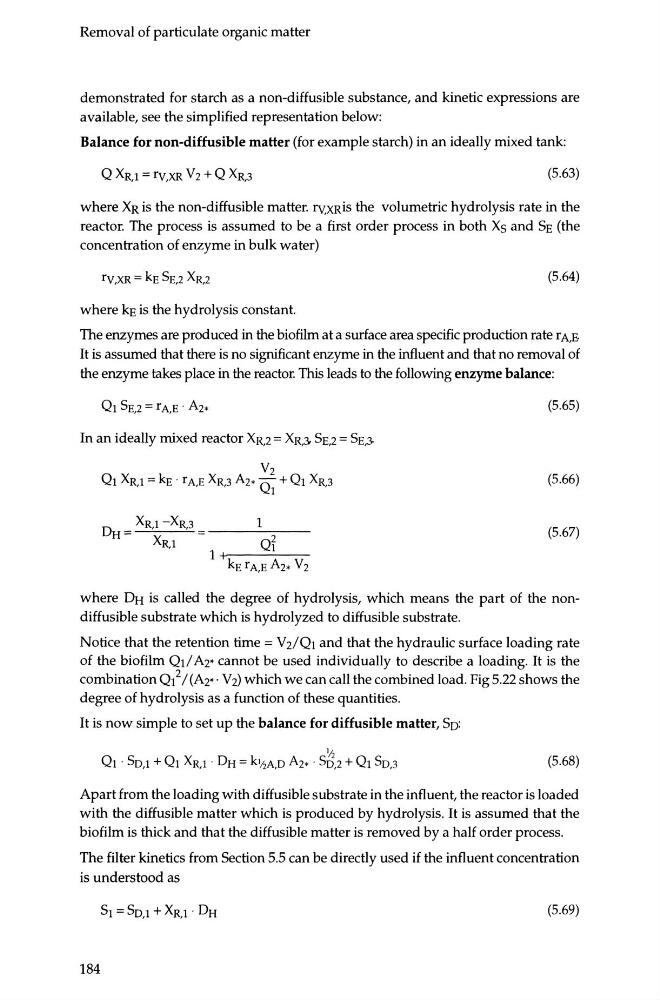
Balance for non-diffusible matter (for example starch) in an ideally mixed tank:
(5.63)
where XR is the non-diffusible matter. rv,xRiS the volumetric hydrolysis rate in the
reactor. The process is assumed to be a first order process in both Xs and SE (the
concentration of enzyme in bulk water)
(5.64)
where kE is the hydrolysis constant.
The enzymes are produced in the biofilm at a surface area specific production rate rA,E·
It is assumed that there is no significant enzyme in the influent and that no removal of
the enzyme takes place in the reactor. This leads to the following enzyme balance:
(5.65)
In an ideally mixed reactor XR,2 = XR,3. SE,2 = SE,J.
(5.66)
1
(5.67)
where DR is called the degree of hydrolysis, which means the part of the nondiffusible substrate which is hydrolyzed to diffusible substrate.
Notice that the retention time= Vz/Ql and that the hydraulic surface loading rate
of the biofilm Q1/ Az• cannot be used individually to describe a loading. It is the
combination Q1 2 I (Az• · V 2) which we can call the combined load. Fig 5.22 shows the
degree of hydrolysis as a function of these quantities.
It is now simple to set up the balance for diffusible matter, So:
(5.68)
Apart from the loading with diffusible substrate in the influent, the reactor is loaded
with the diffusible matter which is produced by hydrolysis. It is assumed that the
biofilm is thick and that the diffusible matter is removed by a half order process.
The filter kinetics from Section 5.5 can be directly used if the influent concentration
is understood as
(5.69)
184
demonstrated for starch as a non-diffusible substance, and kinetic expressions are
available, see the simplified representation below:
Balance for non-diffusible matter (for example starch) in an ideally mixed tank:
(5.63)
where XR is the non-diffusible matter. rv,xRiS the volumetric hydrolysis rate in the
reactor. The process is assumed to be a first order process in both Xs and SE (the
concentration of enzyme in bulk water)
(5.64)
where kE is the hydrolysis constant.
The enzymes are produced in the biofilm at a surface area specific production rate rA,E·
It is assumed that there is no significant enzyme in the influent and that no removal of
the enzyme takes place in the reactor. This leads to the following enzyme balance:
(5.65)
In an ideally mixed reactor XR,2 = XR,3. SE,2 = SE,J.
(5.66)
1
(5.67)
where DR is called the degree of hydrolysis, which means the part of the nondiffusible substrate which is hydrolyzed to diffusible substrate.
Notice that the retention time= Vz/Ql and that the hydraulic surface loading rate
of the biofilm Q1/ Az• cannot be used individually to describe a loading. It is the
combination Q1 2 I (Az• · V 2) which we can call the combined load. Fig 5.22 shows the
degree of hydrolysis as a function of these quantities.
It is now simple to set up the balance for diffusible matter, So:
(5.68)
Apart from the loading with diffusible substrate in the influent, the reactor is loaded
with the diffusible matter which is produced by hydrolysis. It is assumed that the
biofilm is thick and that the diffusible matter is removed by a half order process.
The filter kinetics from Section 5.5 can be directly used if the influent concentration
is understood as
(5.69)
184