

Biofilters
Process
Equipment
Substrate
ki/2A*
gl/2m-l/2d-l
Oxidation of org. matter Lab. rot. disc
Acetic acid
3.5-6.2
Oxygen
3.2-4.1
-
Methanol
1.4-1.8
-
Oxygen
4.2
-
Glucose
3.2-3.8
-
Oxygen
3.3
Nitrification
Rot. discs
Ammonium
1.5
Oxygen
3.8
Lab. filter
Oxygen
1.4
Lab. rot. disc
Ammonium
5.6
-
Ammonium
4.5
-
Nitrite
5.1
Denitrification
Methanol
2.8-5.4
-
Nitrate
0.6-3.7
-
Nitrate
3.1
*ki/2A,s~(2-Ds,2·knvr ) 112
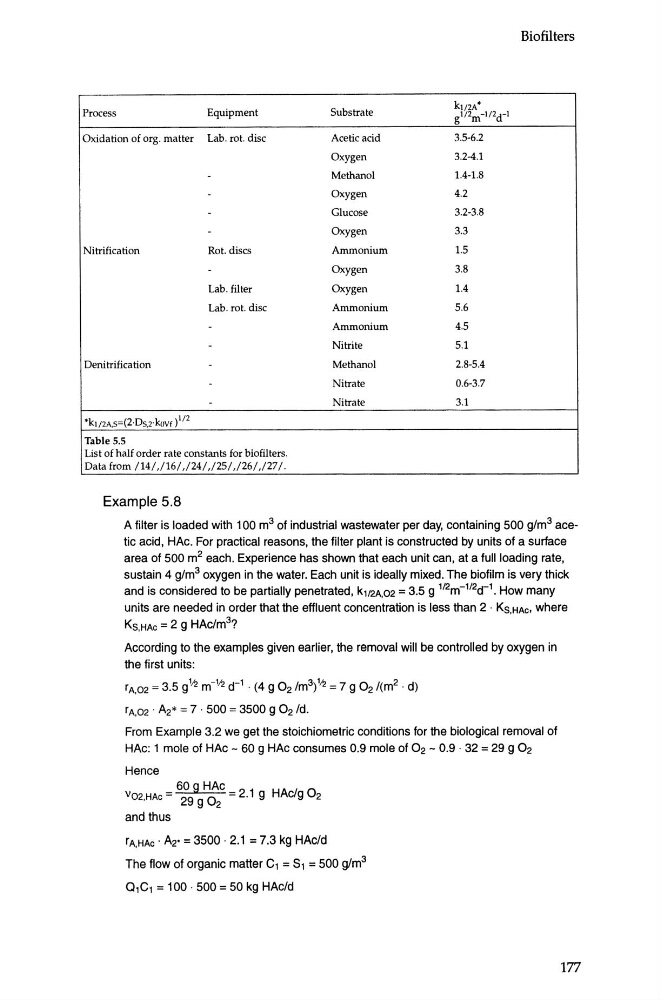
Table 5.5
List of half order rate constants for biofilters.
Data from /14/,/16/,/24/,/25/,/26/,/27/.
Example 5.8
A filter is loaded with 100 m 3 of industrial wastewater per day, containing 500 g/m 3 acetic acid, HAc. For practical reasons, the filter plant is constructed by units of a surface
area of 500 m 2 each. Experience has shown that each unit can, at a full loading rate,
sustain 4 g/m 3 oxygen in the water. Each unit is ideally mixed. The biofilm is very thick
and is considered to be partially penetrated, k112A.o2 = 3.5 g 112 m- 112 d- 1 . How many
units are needed in order that the effluent concentration is less than 2 · Ks.HAc. where
Ks,HAc = 2 g HAc/m 3 ?
According to the examples given earlier, the removal will be controlled by oxygen in
the first units:
rA,02 = 3.5 g 112 m-1;2 d- 1 · (4 g 0 2 /m 3 ) 112 = 7 g 0 2 /(m 2 ·d)
rA,02 · A2* = 7 · 500 = 3500 g 02 /d.
From Example 3.2 we get the stoichiometric conditions for the biological removal of
HAc: 1 mole of HAc - 60 g HAc consumes 0.9 mole of 0 2 - 0.9 · 32 = 29 g 0 2
Hence
_ 60g HAc
vo2,HAc- 29 g 02
2.1 g HAc/g 02
and thus
rA.HAc · A2· = 3500 · 2.1 = 7.3 kg HAc/d
The flow of organic matter C1 = S1 = 500 g/m 3
01C1 = 100 · 500 =50 kg HAc/d
177
Process
Equipment
Substrate
ki/2A*
gl/2m-l/2d-l
Oxidation of org. matter Lab. rot. disc
Acetic acid
3.5-6.2
Oxygen
3.2-4.1
-
Methanol
1.4-1.8
-
Oxygen
4.2
-
Glucose
3.2-3.8
-
Oxygen
3.3
Nitrification
Rot. discs
Ammonium
1.5
Oxygen
3.8
Lab. filter
Oxygen
1.4
Lab. rot. disc
Ammonium
5.6
-
Ammonium
4.5
-
Nitrite
5.1
Denitrification
Methanol
2.8-5.4
-
Nitrate
0.6-3.7
-
Nitrate
3.1
*ki/2A,s~(2-Ds,2·knvr ) 112
Table 5.5
List of half order rate constants for biofilters.
Data from /14/,/16/,/24/,/25/,/26/,/27/.
Example 5.8
A filter is loaded with 100 m 3 of industrial wastewater per day, containing 500 g/m 3 acetic acid, HAc. For practical reasons, the filter plant is constructed by units of a surface
area of 500 m 2 each. Experience has shown that each unit can, at a full loading rate,
sustain 4 g/m 3 oxygen in the water. Each unit is ideally mixed. The biofilm is very thick
and is considered to be partially penetrated, k112A.o2 = 3.5 g 112 m- 112 d- 1 . How many
units are needed in order that the effluent concentration is less than 2 · Ks.HAc. where
Ks,HAc = 2 g HAc/m 3 ?
According to the examples given earlier, the removal will be controlled by oxygen in
the first units:
rA,02 = 3.5 g 112 m-1;2 d- 1 · (4 g 0 2 /m 3 ) 112 = 7 g 0 2 /(m 2 ·d)
rA,02 · A2* = 7 · 500 = 3500 g 02 /d.
From Example 3.2 we get the stoichiometric conditions for the biological removal of
HAc: 1 mole of HAc - 60 g HAc consumes 0.9 mole of 0 2 - 0.9 · 32 = 29 g 0 2
Hence
_ 60g HAc
vo2,HAc- 29 g 02
2.1 g HAc/g 02
and thus
rA.HAc · A2· = 3500 · 2.1 = 7.3 kg HAc/d
The flow of organic matter C1 = S1 = 500 g/m 3
01C1 = 100 · 500 =50 kg HAc/d
177