

Biofilters
tric loading rate. For industrial wastewater with high influent concentrations, the requirement of recycle could be quite unrealistic. Therefore filter media in plastics have now
become popular as they can be built high without incurring considerable costs. Nor do
such filters need correspondingly large hydraulic loadings because of the large void volume of the media which prevents clogging. On the other hand, small effluent concentrations are seldom found. Therefore plastic filters are normally used for pretreatment
only.
5.9.2 Design of discs
Some of the rules for rotating discs are very good examples to show how different
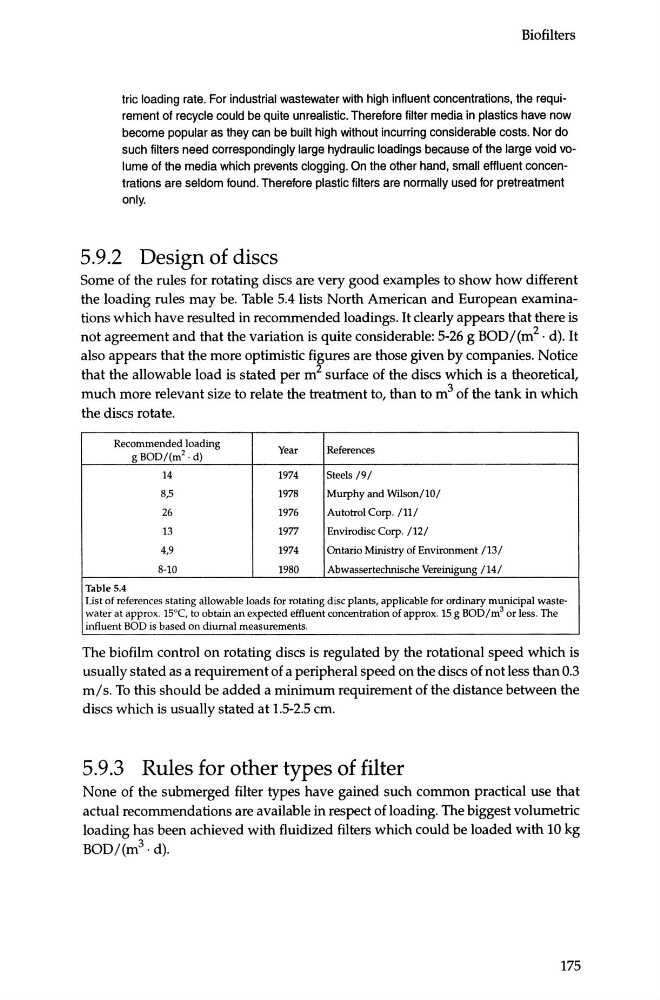
the loading rules may be. Table 5.4 lists North American and European examinations which have resulted in recommended loadings. It clearly appears that there is
not agreement and that the variation is quite considerable: 5-26 g BOD I (m 2 · d). It
also appears that the more optimistic fiFes are those given by companies. Notice
that the allowable load is stated per m surface of the discs which is a theoretical,
much more relevant size to relate the treatment to, than to m 3 of the tank in which
the discs rotate.
Recommended loading
g BOD/(m 2 ·d)
Year
References
14
1974
Steels /9/
8,5
1978
Murphy and W!lson/10/
26
1976
Autotrol Corp. /11/
13
1977
Envirodisc Corp. /12/
4,9
1974
Ontario Ministry of Environment /13/
8-10
1980
Abwassertechnische Vereinigung /14/
Table 5.4
List of references stating allowable loads for rotating disc plants, applicable for ordinary municipal wastewater at approx. 15°C, to obtain an expected effluent concentration of approx. 15 g BOD/m 3 or less. The
influent BOD is based on diurnal measurements.
The biofilm control on rotating discs is regulated by the rotational speed which is
usually stated as a requirement of a peripheral speed on the discs of not less than 0.3
m/ s. To this should be added a minimum requirement of the distance between the
discs which is usually stated at 1.5-2.5 em.
5.9.3 Rules for other types of filter
None of the submerged filter types have gained such common practical use that
actual recommendations are available in respect of loading. The biggest volumetric
loading has been achieved with fluidized filters which could be loaded with 10 kg
BOD/(m 3 ·d).
175
tric loading rate. For industrial wastewater with high influent concentrations, the requirement of recycle could be quite unrealistic. Therefore filter media in plastics have now
become popular as they can be built high without incurring considerable costs. Nor do
such filters need correspondingly large hydraulic loadings because of the large void volume of the media which prevents clogging. On the other hand, small effluent concentrations are seldom found. Therefore plastic filters are normally used for pretreatment
only.
5.9.2 Design of discs
Some of the rules for rotating discs are very good examples to show how different
the loading rules may be. Table 5.4 lists North American and European examinations which have resulted in recommended loadings. It clearly appears that there is
not agreement and that the variation is quite considerable: 5-26 g BOD I (m 2 · d). It
also appears that the more optimistic fiFes are those given by companies. Notice
that the allowable load is stated per m surface of the discs which is a theoretical,
much more relevant size to relate the treatment to, than to m 3 of the tank in which
the discs rotate.
Recommended loading
g BOD/(m 2 ·d)
Year
References
14
1974
Steels /9/
8,5
1978
Murphy and W!lson/10/
26
1976
Autotrol Corp. /11/
13
1977
Envirodisc Corp. /12/
4,9
1974
Ontario Ministry of Environment /13/
8-10
1980
Abwassertechnische Vereinigung /14/
Table 5.4
List of references stating allowable loads for rotating disc plants, applicable for ordinary municipal wastewater at approx. 15°C, to obtain an expected effluent concentration of approx. 15 g BOD/m 3 or less. The
influent BOD is based on diurnal measurements.
The biofilm control on rotating discs is regulated by the rotational speed which is
usually stated as a requirement of a peripheral speed on the discs of not less than 0.3
m/ s. To this should be added a minimum requirement of the distance between the
discs which is usually stated at 1.5-2.5 em.
5.9.3 Rules for other types of filter
None of the submerged filter types have gained such common practical use that
actual recommendations are available in respect of loading. The biggest volumetric
loading has been achieved with fluidized filters which could be loaded with 10 kg
BOD/(m 3 ·d).
175